CONCEPT OF THE SOUL
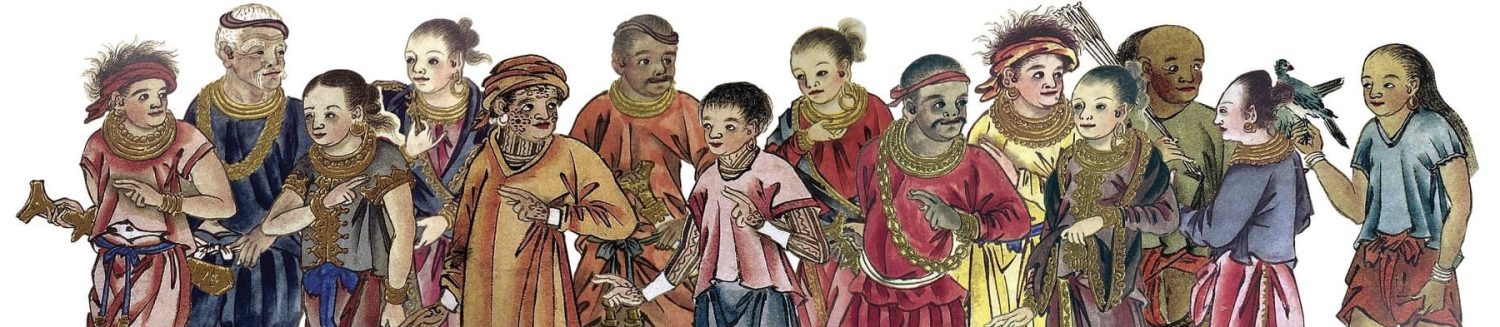
Each ethnic group has their own concept and number of the soul of a being, notably humans. In most cases, a person has two or more souls while he or she is alive. The origin of a person's soul has been told through narratives concerning the Indigenous Philippine folk religions, where each ethnic religion has its unique concept of soul origin, soul composition, retaining and caring for the soul, and other matters, such as the eventual passage of the soul after the person's life is relinquished. In some cases, the souls are provided by certain deities such as the case among the Tagbanwa, while in others, the soul comes from certain special regions such as the case among the Bisaya. Some people have two souls, such as the Ifugao, while others have five souls such as the Hanunoo Mangyan. In general, a person's physical and mental health contribute to the overall health of the person's soul. In some instances, if a soul is lost, a person will become sick, and if all living souls are gone, then the body eventually dies. However, there are also instances in which the body can still live despite the loss of all of its souls, such as the phenomenon called mekararuanan among the Ibanag. Overall, caring for oneself is essential to long life for the soul, which in turn provides a long life to the body.
Ghosts or ancestral spirits, in a general Philippine concept, are the spirits of those who have already died. In other words, they are the souls of the dead. They are different from the souls of the living, in which, in many instances, a person has two or more living souls, depending on the ethnic group. Each ethnic group in the Philippine islands has their own terms for ghosts and other types of souls. While ghosts in Western beliefs are generally known for their sometimes horrific nature, ghosts of the dead for the various ethnic groups in the Philippines are traditionally regarded in high esteem. These ghosts are usually referred to as ancestral spirits who can guide and protect their relatives and community, though ancestral spirits can also cast harm if they are disrespected. In many cases among various Filipino ethnic groups, spirits of the dead are traditionally venerated and deified in accordance to ancient belief systems originating from the Indigenous Philippine folk religions.
SOULS OF THE LIVING
Each ethnic group has their own concept and number of the soul of a being, notably humans. In most cases, a person has two or more souls while they are alive. The origin of a person's soul have been told through narratives concerning the indigenous Philippine folk religions, where each ethnic religion has its unique concept on soul origin, soul composition, retaining and caring for the soul, and other matters, such as the eventual passage of the soul after the person's life is relinquished. In some cases, the souls are provided by certain deities such as the case among the Tagbanwa, while in others, the soul comes from certain special regions such as the case among the Bisaya. Some people have two souls such as the Ifugao, while others have five souls such as the Hanunoo Mangyan. In general, a person's physical and mental health contribute to the overall health of the person's souls. In some instances, if a soul is lost, a person will become sick, and if all living souls are gone, then the body eventually dies. However, there are also instances where the body can still live despite the loss of all of its souls, such as the phenomenon called mekararuanan among the Ibanag. Overall, caring for one's self is essential to a long life for the souls, which in turn provide a long life to the body.
SOULS OF THE DEAD
Ghosts or ancestral spirits, in a general Philippine concept, are the spirits of those who have already died. In other words, they are the souls of the dead. They are different from the souls of the living, where in many instances, a person has two or more living souls, depending on the ethnic group. In some cases, when the body dies, the souls that have been lost eventually re-combine in the afterlife such as the case among the Bukidnon. In other cases, the last main soul travels to the afterlife alone such as the case of the Suludnon, while in other cases, the soul eventually goes back to its region of origin such as the case among the Bisaya. In a unique case among the Bagobo, their right soul goes to the afterlife, while the left soul becomes a creature called busaw.
Each ethnic group in the Philippine islands has their own terms for ancestral spirits or souls of the dead. Unlike in Western beliefs where ghosts are generally known for their sometimes horrific nature, ghosts of the dead for the various ethnic groups in the Philippines are traditionally regarded in high esteem. These ghosts are usually referred to as ancestral spirits who can guide and protect their relatives and community. Although ancestral spirits can also cast harm if they are disrespected. In many cases among various Filipino ethnic groups, spirits of the dead are traditionally venerated and deified in accordance to ancient belief systems originating from the indigenous Philippine folk religions.
The concept of soul(s) is integral to all ethnic groups in the Philippines. Each ethnic group has their own unique concept of what a soul is, how many are there, and how a soul follows the cycle of life and death or how it follows the linear path of life, death, and beyond.
SOULS IN ETHNIC SPECIFIC CONCEPTS
Ifugao: a person has two souls, one located in the eyes, the other in a person's breath; the withdrawal of the eyes soul causes illness, while the withdrawal of the breath soul causes death; souls of murdered victims go to the lowest level of the skyworld.
Ibaloi: a soul is believed to formally rest on the summit of Mount Pulag, which is a traditional sanctuary for departed loved ones.
Kalinga: the souls of the dead roam around earth during 10–11 in the morning and 2–3 in the afternoon; the other hours of the day and night are reserved for the living.
Tagalog: the soul, called kaluluwa, can leave the body involuntarily; the soul is called a kakambal when the person is alive; the kakambal travels once a person is sleeping; this soul-travelling is one of the causes of nightmares, when the soul encounters a terrifying event; the kakambal transforms into the kaluluwa when the person dies; it then travels or gets delivered by the sacred buwayas (crocodiles with coffin-like backs) of the god, Buwaya, to the underworld, either in Maca (for good souls, ruled by Sitan and Bathala) or Kasanaan (for sinful souls, ruled by Sitan); during specific times of the year, the kaluluwa may enter the mortal world easily during pangangaluwa rituals.
Ilokano: there are four soul systems; the first is kadkadduwa which is the “inseparable partner” and “constant companion”; the second is kararma is a person's natural vigor, mind, and reason which can be lost when one is frightened; the kararma can also be stolen and must be retrieved back as failure to regain kararma will lead to insanity; the third is aniwaas which left the sleeping body to visit familiar places; a person who wakes up before the return of aniwaas may lose it and become insane; the last is araria which is the liberated soul of the dead who visits relatives and friends in the mortal world.
Ibanag: the body is called baggi while the soul is called ikaruruwa; the Ibanags believe that the soul's purpose is to give direction and wholeness to a person, but a person can survive even without a soul; without a body, the soul can also experience material wants and needs; a phenomenon called mekararuanan is unique to the Ibanag where the soul leaves the body but without sense.
Hanunoo Mangyan: an individual, whether human or not, is believed to possess 2–5 other souls, which the Hanunoo Mangyan believe to be the explanation for miraculous recoveries, their dreams, or individual reactions to startling sounds and movements; a human soul is called a karaduwa tawu, while other animal souls differ per species, namely karaduwa manok (chicken soul), karaduwa baboy (pig soul), karaduwa kuti (cat soul), and karaduwa hipon (shrimp soul).
Bisaya: the soul, called dungan, can be taken by bad spirits; souls can also be imprisoned in a sacred spirit cave guarded by Tan Mulong, who has a spirit dog with one mammary gland and two genitals; sickness is believed to be the temporary loss of the dungan, while death is its permanent loss; old tradition says that before inhabiting the body of an unborn being, a dungan first lives in a special region, home to other dungans; the dungan is fragile from usog (unintentional transfer of disturbing vapors of a strong body to a weak one by proximity), and thus, must be nurtured and strengthened through time and rituals; once a person dies, the dungan flies to its upperworld region of origin to await another unborn body to become its avatar; in another story, the soul (probably of a sinful person), upon death, is sent to the underworld; the soul of the dead remains forever in Kasakitan, the lowerworld, unless if a living relative or friend offers sacrifices for redemption towards Pandaque (Pandaki), the god of second chances and messenger of Sidapa, goddess of death; a soul that stays in Kasakitan is kept by Sisiburanen as slaves and after years of staying in the underworld sub-realm of Kanitu-nituhan without redemption sacrifices being offered, the souls are fed to the sub-realm's giant gate guardians, Simuran and Siguinarugan.
Karay-a and Hiligaynon: the Ilonggo peoples, which includes the Karay-a and the Hiligaynon peoples, call the soul as dungan, which cannot be seen; it can voluntarily come out of the body to take in the form of insects and small animals, notably when a person is sleeping; if the body is badly treated, the dungan leaves; the soul's lifespan on earth is measured by the god of death, Sidapa, using a sacred magical tree which grows sturdy on Mount Madia-as (Madyaas); the soul may be saved through the aid of Pandaki, the god of second chances and loyal friend of Sidapa who occasionally visits Mount Madia-as.
Sulodnon: the soul is called umalagad; the soul is watched over by three divine brothers; the first brother is Mangganghaw, who keeps track over a person's affairs after marriage, including pregnancy, where he visits the house of a laboring mother to peep and see if the child was born; the second brother is Manglaegas, who, after having the reports of Mangganghaw, enters the house to see the child to make sure the child is alive; the last brother is Patag’aes, who, after getting the reports from Mangganghaw, waits until midnight to enter a house and have a sacred conversation of life and death with the infant; if someone eavesdrops, the infant dies through choking; the sacred conversation revolves around on how the infant wants to live and the infant's preferential way to die; the infant always gets to choose his or her death preference; after the conversation, Patag’aes uses a measuring stick, computes the infant's life span, and leaves the house; once a person dies, the soul travels to an anthill near the deathbed; around the anthill, the stream Muruburu appears, where the soul removes its funeral vestments and bathes in its lake to remove the scent of incense called kamangyan; after changing clothes, the souls goes into a journey into Lima’awen; in that realm, the soul faces Bangla’e, who ferries the soul across the realm until it arrives in the stream Himbarawen, which has a bridge guarded by Balagu; the soul afterwards travels to the entrance of Mount Madia-as (Madyaas) until it reaches a cockpit, where the soul's relatives welcome it; cockfight betting, feasts, and dressing is made; if the soul is underdressed, it will haunt its living relatives for negligence; after the feasts, the soul is brought to a rest house where it waits for a ritual to restore its body in the lowerworld.
Waray: the soul of the dead is said to be guided by the god Badadum, who gathers the souls of the newly dead to meet their relatives and friends at the mouth of a river located in the lowerworld; old stories say that souls eventually lead to a sacred cave in the interior of Samar Island.
Tagbanwa: the true soul is called the kiyaraluwa and is different from the five other secondary souls; the true soul is given to each infant by the god Magindusa when the nose of a child emerges from the vulva; the secondary souls are located in the hands, feet, and the head below the air whorl (puyo) of the hair; the specific soul at the puyo is not properly aligned and must be re-aligned by a shaman to prevent illnesses caused by its non-alignment; the soul at the puyo has a material form similar to a round white stone; the soul of the dead travels into a cave entrance to the underworld; it then meets its ruler Taliyakud, who tends a fire between two sacred tree trunks; a sinful soul is burned while a good soul passes onto a happier place where food is abundant; a soul may die seven times in the underworld, with each death the soul goes deeper into its realms; the soul is buried in the underworld by insects and lizards when it dies there; if the soul dies seven times, it is reincarnated into an insect such as a fly, dragonfly or dung beetle; if the insect reincarnation is killed, the soul disappears into oblivion.
Bukidnon: the soul, called makatu, exists before a child's birth but is separate from the body; a special crib for the makatu is established prior to the child birth; the deity, Miyaw-Biyaw, breathes seven makatu into a person; with the withdrawal of each makatu from a body, the weaker a person becomes; if all makatu withdraws from a body, the individual dies; upon death, all seven makatu combine into one and journeys into Mount Balatucan for final judgment; the soul first travels to the huge rock, Liyang, which is followed by a journey to Binagbasan, where the Tree of Records grows. After making a mark on the tree, the soul journeys to Pinagsayawan, where the soul must dance and sweat for atonement; the next journey is to Panamparan, where the soul gets a haircut to be presentable at Kumbirahan, where a banquet awaits the soul; the god Andalapit then leads the soul to the foot of Mount Balatucan, where the gods of the dead assemble to judge the soul; good souls are sent to Dunkituhan, the cloud capped stairway that leads into heaven at the summit of Balatucan; an evil soul is sent to a river of penance for atone until forgiven; souls at the river sweat blood, the source of the river's color and fishy scent; a forgiven soul afterwards also goes into Balatucan's summit.
Bagobo: there are two souls called gimokud; the right hand gimokud is the good soul that manifests as a shadow on the right hand side of the path while the left hand gimokud is the bad soul that manifests as a shadow on the left side of the path; if the right soul leaves the body, it notifies the person in an insect form; if the left soul leaves, it causes effects such as shivers, depending on the place where it travels; upon death, the left soul transforms into a busaw, a monster that digs up dead bodies; all larger animals have two souls as well, but smaller birds, bees, insects, and inanimate objects only have one soul; the souls of inanimate objects directly go to the underworld to serve its previous owner; the right hand soul travels to the underworld by passing a black river and arriving at a town ruled by Mebuyan, who is both goddess and priestess in the underworld; the soul bathes itself, and once contented, becomes unwilling to return to the earthworld.
Bikol:The ancient Bikols believed in an after life. The good eventually will go to the side of Gugurang to receive the reward for their heroic deeds, their achievements and exploits in war in the skyworld called kamurawayan where peace and rest await them. The bad will go to the side of the aswang in the tormenting gagamban and there suffer the punishment for their evil deeds. This belief of the early Bikols in a kamurawayan and a gagamban in the next world was higher in form to the belief of many early Filipinos who considered the transition between life and the great beyond simply as a journey beyond the seas, represented in that famous archeological soul-boat of the Manunggul burial jar, where the eternal boatman, Maguayen, ferried a dead soul on the journey to the great beyond. Although the early Bikols believed in the soul-boat symbol in much the same way as did the primitive makers of the manunggul burial jar, there was a marked difference in their beliefs because the early Bikols believed that the journey was not to the unknown but to some fixed destination of a life of reward or punishment represented by the skyworld kamurawayan and the lower world gagambam. Archeological finds in Bicol grave diggings have revealed crudely carved images of stone or clay figurines of idols and deities. These are not common grave furniture. And yet, they have been found among the articles which were interred with the early Bikol dead, indicating adherence to the belief of a journey to the world which ends in the company of some deity.
TYPES OF INDIGENOUS FILIPINO BURIALS
There are a wide variety of indigenous Filipino burial methods that have been found across the islands. Each burial custom was different and depended on the family and the region they were located. Some burial types were more prominent in certain locations than others. Among the range of preservation processes and burial customs, some of the most common were mummification, enclosed burials, and log coffins.
Mummification:
Mummification attributed to the preservation of the dead and the customs. In many regions, having the body displayed in their homes is a form of honoring them in the afterlife and is done so in places such as Kabayan, Benguet, where bodies are preserved through processes of dehydration and smoking. Mummification in the Philippines is almost always due to intentional man-made preservation. The warm, wet climate of the islands is not favorable to natural mummification processes and naturally occurring mummies are very rare as a result.
Enclosed burials and log coffin burials:
Enclosed burials most often refers to the different types of jar enclosed burials. There are three types: primary, secondary, and multiple jar burials. These same three categories also exist for log coffin burials. A primary burial is when the cadaver is completely disposed of. A secondary burial involves a corpse being removed from its initial grave location and being placed in another grave or ossuary. Multiple burials signify bones of different skeleton being placed in the same grave. Jar burials can also obtain anthropomorphic features on them to represent the person that died, and was then placed into the jar. These features can give hints about the sex and age of the corpse.
HANGING COFFINS
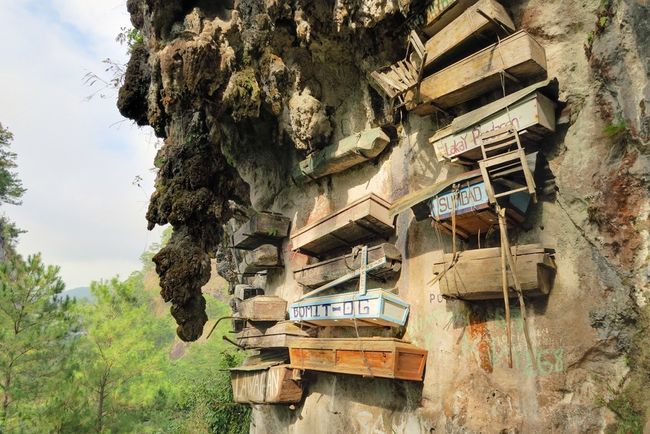
Hanging coffins are one of the funerary practices among the Kankanaey people of Sagada, Mountain Province, in the island Luzon of the Philippines. They have not been studied by archaeologists, so the exact age of the coffins is unknown, though they are believed to be centuries old. The coffins are placed underneath natural overhangs, either on natural rock shelves/crevices or on projecting beams slotted into holes dug into the cliff-side. The coffins are small because the bodies inside the coffins are in a fetal position. This is due to the belief that people should leave the world in the same position as they entered it, a tradition common throughout the various cultures of the Philippines. The coffins are usually carved by their eventual occupants during their lifetimes.
Despite their popularity, hanging coffins are not the main funerary practice of the Kankanaey. It is reserved only for distinguished or honorable leaders of the community. They must have performed acts of merit, made wise decisions, and led traditional rituals during their lifetimes. The height at which their coffins are placed reflects their social status. Most people interred in hanging coffins are the most prominent members of the amam-a, the council of male elders in the traditional dap-ay (the communal men's dormitory and civic center of the village). There is also one documented case of a woman being accorded the honor of a hanging coffin interment.
The more common burial custom of the Kankanaey is for coffins to be tucked into crevices or stacked on top of each other inside limestone caves. Like in hanging coffins, the location depends on the status of the deceased as well as the cause of death. All of these burial customs require specific pre-interment rituals known as the sangadil. The Kankanaey believe that interring the dead in caves or cliffs ensures that their spirits (anito) can roam around and continue to protect the living.
The hanging coffins in Echo Valley have become tourist attractions.
BURIAL JARS
The Manunggul Jar is a secondary burial jar excavated from a Neolithic burial site in the Manunggul cave of the Tabon Caves at Lipuun Point in Palawan, Philippines. It dates from 890–710 B.C. and the two figures at the top handle of its cover represent the journey of the soul to the afterlife.
Manunggul Jar displayed at Philippine National Museum of Anthropology The Manunggul Jar is widely acknowledged to be one of the finest Philippine artworks ever produced and is considered a masterpiece of Philippine ceramics. It is listed as a national treasure and designated as item 64-MO-74 by the National Museum of the Philippines. It is now housed at the National Museum of Anthropology and is one of the most popular exhibits there. It is made from clay with some sand soil.
The Manunggul Jar shows that the Filipinos' maritime culture is paramount that it reflected its ancestors' religious beliefs. Many epics around the Philippines would tell how souls go to the next life, aboard boats, pass through the rivers and seas. This belief is connected with the Austronesian belief of the anito. The fine lines and intricate designs of the Manunggul Jar reflect the artistry of early Filipinos. These designs are proof of the Filipinos' common heritage from the Austronesian-speaking ancestors despite the diversity of the cultures of the Filipinos. The upper part of the Manunggul jar, as well as the cover, is carved with curvilinear scroll designs (reminiscent of waves on the sea) which are painted with hematite.
Close-up of the two figures in a boat at the lid of the jar Early Filipinos believed that a man is composed of a body, a life force called ginhawa, and a kaluluwa. This explains why the design of the cover of the Manunggul Jar features three faces - the soul, the boatman, and the boat itself. On the faces of the figures and on the prow of the boat are eyes and mouth rendered in the same style as other artifacts of Southeast Asia of that period. The two human figures in a boat represent a voyage to the afterlife. The boatman is holding a steering paddle while the one on his front shows hands crossed on his chest. The steersman's oar is missing its paddle, as is the mast in the center of the boat, against which the steersman would have braced his feet. The manner in which the hands of the front figure are folded across the chest is a widespread practice in the Philippines when arranging the corpse.
The lid of the Manunggul Jar provides a clear example of a cultural link between the archeological past and the ethnographic present. It also signifies the belief of ancient Filipinos in life after death.
FUNERARY CUSTOMS (TAGALOG)
The Tagalog people have had numerous burial practices. In rural areas of Cavite, trees are used as burial places. The dying person chooses the tree beforehand, thus when he or she becomes terminally ill or is evidently going to die because old age, a hut is built close to the said tree. The deceased's corpse is then entombed vertically inside the hollowed-out tree trunk. A statue known as likha is also entombed with the dead inside the tree trunk. In Mulanay, Quezon and nearby areas, the dead are entombed inside limestone sarcophagi along with a likha statue. In Calatagan, Batangas and nearby areas, the dead are buried under the earth along with likha statues. The statues, measuring 6–12 inches, are personified depictions of anitos. Likha statues are not limited to burial practices as they are also used in homes, prayers, agriculture, medicine, travel, and other means.
FUNERARY CUSTOMS (APAYAO)
The Apayaos-also known as the Isnegs or Isnags-of the Cordillera Administrative Region, wrap the deceased person in a mat (ikamen), and is then carried on the shoulders of the immediate male family members. Items are placed inside the coffin in order to help the deceased person throughout his/her journey. For example, a jar (basi) is placed in the coffin to quench the deceased one's thirst. Another example is a spear and shield also being put inside in order to help him/her protect himself/herself from enemies during the journey. The coffin is then lowered into either the kitchen area of their families home or in a burial site owned by his/her family.
FUNERARY CUSTOMS (BENGUET)
For 9 consecutive days, the indigenous people from Benguet blindfold the dead and then place it on a chair that is located next to their house's main entrance. The arms and legs are tied together in a sitting position. A bangil rite is performed by the elders on the eve of the funeral, which is a chanted narration of the biography of the deceased. During interment, the departed is directed towards heaven by hitting bamboo sticks together.
FUNERARY CUSTOMS (IFUGAO)
The Ifugao people practice bogwa, which is the practice of exhuming the bones of the deceased person, cleaning and rewrapping them, and then returning them to the grave.
FUNERARY CUSTOMS (ILOCANO)
Ilocanos observe distinct funeral and burial customs known as pompón or "burial rites" that last a year. These traditions are deeply rooted in respect for the deceased and their journey to the afterlife.
Wake:
The preparation of the body, called bagongon, is typically done by the deceased’s spouse, particularly the wife. She carefully dresses the body, believing that the spirit of the deceased can convey messages through her. The body is then placed in a lungón (coffin), positioned so the head faces east, symbolizing the rising sun and hope, rather than west, which is considered inauspicious.
A wooden log, known as atong or panag-atong, is lit in front of the house and kept burning throughout the wake. This symbolizes the light guiding the deceased’s soul. Chanting and crying, known as dung-áw, which involves singing dirges and laments are performed to honor the deceased and ensure their safe passage to the afterlife. Food offering called atang also performed with prayers and different kind of kankanen or rice cakes.
During the wake, several taboos are observed:
1. Immediate family members are prohibited from working, cooking, or carrying heavy objects, as these actions are believed to signify haste in burying the deceased.
2. Sweeping the floor is avoided to prevent "sweeping away" another family member's life.
3. Bathing is not allowed during the wake to prevent another death in the family and is believed to show disrespect by implying the deceased is offensive.
4. A candle must remain lit beside the coffin as a light for the deceased’s soul. If the candle goes out, it is believed the deceased may lose their way in the afterlife.
5. Eating beans or fruits with seeds is prohibited, as they are thought to cause skin diseases. Eating marunggáy (moringa) is also avoided because stripping its leaves is believed to symbolize family members dying one after another.
Family members wear black clothing, with women covering their heads and shoulders with a black veil called a manto. Immediate family members, such as the spouse, parents, or siblings, wear white headbands called baridbed. Traditionally, these headbands were worn to alleviate headaches caused by excessive crying, but they also serve as identifiers of mourning. Relatives wear black bar pins to signify grief, which are kept on until the 40th day after the death.
Funeral:
Before the burial, a hen and a rooster are beheaded. These chickens are believed to precede the deceased, symbolically announcing their arrival in the afterlife. The house’s windows are closed as the coffin is taken out to prevent the spirit from lingering. The coffin must not touch any part of the house, as this is believed to bring misfortune or another death in the family.
As the coffin is carried out, a family member scatters rice grains, symbolizing pammalubos or letting go of the deceased’s soul. If there are children in the family, they are passed over the coffin in a ritual called sukal, meant to protect the family from further loss. Items known as pabalon—such as personal belongings—are placed in the coffin, symbolizing the deceased’s “luggage” for their journey to the afterlife. The remaining possessions of the deceased are burned or thrown into a river to signify release and closure.
After the burial, family members undergo a ritual called diram-os, washing their hands and feet with water boiled with leaves of guava, guayabano, or dangla to ward off evil spirits that might have followed them from the cemetery.
Cleansing and Commemoration:
The day after the funeral, a cleansing ritual called gulgol is performed to remove grief, bad luck, and the lingering spirit of the deceased. Family members wash their hair with shampoo made from water, basí (sugarcane wine), or suká (vinegar). They burn arútang (rice stalks) and offer gawéd (betel pepper leaves) and pinádis (rolled tobacco) under the guidance of a prayer leader. The family offers rice cakes, boiled unripe bananas (saba), and basí to attendees after prayer sessions.
On the ninth night, a feast follows the novena prayers. This is repeated on the first death anniversary in a ceremony called panagwaksi or babangluksa, marking the end of the mourning period and celebrating the deceased's life.
FUNERARY CUSTOMS (ILONGOT)
The Ilongot is buried in a sitting position, and if a woman, has her hands tied to her feet, to prevent her "ghost" from roaming. The wife of the deceased person prepares the body with specially chosen clothes by herself, and is placed in a coffin in the center of the house when done. A wood log is then lit in the front of the house and is burned during the entire wake, and is completed by all the family members washing their hair with a special shampoo.
ITNEG FUNERARY CUSTOMS (ITNEG)
FUNERARY CUSTOMS (PALAWANO)
Sketch of an anthropomorphic jar from Maitum in the Saranggani Province of Mindanao One of the ancient customs for burying the dead in the Philippines is through the use of burial jars known as Manunggul jars. These ancient potteries were found in the Manunggul Cave on the island of Palawan. A characteristic of the jars for the dead is the presence of anthropomorphic human figures on the pot covers. These figures embody souls riding a boat for the dead while seafaring towards their sanctuary in the afterlife. These containers have been dated from 710 BC to 890 BC. There are also figures of boating people steering paddles, wearing headbands, jaw-bands, and persons with hands folded across the chest area. The latter is a method of arranging the remains of the dead.
Other similar anthropomorphic jars were also found at Pinol (also spelled as Piñol), Maitum, in the Saranggani Province of the island of Mindanao. These funeral jars dates back from the Metal Age.
In addition to these jars, a cave known as Leta-leta Cave was a burial site that dates to the Late Neolithic Period.
FUNERARY CUSTOMS (KANKANAEY)
The more common burial custom of the Kankanaey people in Sagada, Mountain Province is for coffins to be tucked into crevices or stacked on top of each other inside limestone caves. The location depends on the status of the deceased as well as the cause of death. The coffins are small because the body inside the coffins are in a fetal position. This is due to the belief that people should leave the world in the same position as they entered it, a tradition common throughout the various cultures of the Philippines. The coffins are usually carved by their eventual occupants while they were still alive.
The Kankanaey also practice interring their dead in hanging coffins, a custom unique to the Sagada Kankanaey within the Philippines. In this practice, the coffins are placed underneath natural overhangs, either on natural rock shelves/crevices or on projecting beams slotted into holes dug into the cliff-side.
Hanging coffins are reserved for distinguished or honorable leaders of the community. They must have performed acts of merit, made wise decisions, and led traditional rituals during their lifetimes. The height at which their coffins are placed reflected their social status. Most people interred in hanging coffins are the most prominent members of the amam-a, the council of male elders in the traditional dap-ay. There is also one documented case of a woman being accorded the honor of a hanging coffin interment.
All of these burial customs require specific pre-interment rituals known as the sangadil. The Kankanaey believe that interring the dead in caves or cliffs ensures that their spirits (anito) can roam around and continue to protect the living.
FUNERARY CUSTOMS (TINGUIAN)
For many weeks, the Tinguian people dress the dead body with the best garments, sit it on a chair, and sometimes put a lit tobacco source between the dead person's lips.
BELIEF IN THE AFTERWORLD (BIKOL)
The ancient Bikols believed in an after life. The good eventually will go to the side of Gugurang to receive the reward for their heroic deeds, their achievements and exploits in war in the skyworld called kamurawayan where peace and rest await them. The bad will go to the side of the aswang in the tormenting gagamban and there suffer the punishment for their evil deeds. This belief of the early Bikols in a kamurawayan and a gagamban in the next world was higher in form to the belief of many early Filipinos who considered the transition between life and the great beyond simply as a journey beyond the seas, represented in that famous archeological soul-boat of the Manunggul burial jar, where the eternal boatman, Maguayen, ferried a dead soul on the journey to the great beyond. Although the early Bikols believed in the soul-boat symbol in much the same way as did the primitive makers of the manunggul burial jar, there was a marked difference in their beliefs because the early Bikols believed that the journey was not to the unknown but to some fixed destination of a life of reward or punishment represented by the skyworld kamurawayan and the lower world gagambam. Archeological finds in Bicol grave diggings have revealed crudely carved images of stone or clay figurines of idols and deities. These are not common grave furniture. And yet, they have been found among the articles which were interred with the early Bikol dead, indicating adherence to the belief of a journey to the world which ends in the company of some deity.
A magaanito rite took place when a maguinoo died. The natives performed a ceremony for the dead called pasaka, which consisted in preserving and keeping unburied for a long time the remains of the dead, until a big feast called abataya was celebrated to extol the qualities of the deceased during his lifetime. In order that the remains will not deteriorate, they embalmed the dead in their own way – by removing the entrails. This done, the body was placed between two halves of an agul tree the inside of which had been hollowed out. The tree-coffin was then sealed with the sap of the dangkalan tree. Strangely but true, no foul odor emitted from the tree-coffin which was left unburied for sometime.
The basbas was a rite for the dead which literally meant the washing of the dead. It was the common belief that those who have died are impure, especially those who have died because of sickness and that unless purified, they would suffer great torments inflicted by the aswang. The purification rites was performed by the balianas, who fashioned at the end of a short pole the aromatic leaves of the lukban. The pole was soaked in perfumed water and struck at the various parts of the body of the deceased accompanied by the ritual song called katumba. Once the purification rites were made it was believed that the anito of the deceased journeyed freely in the valleys and the luxuriant forests of their settlements. Should a misfortune befall the village, they called upon the most celebrated of their anitos, and implore him with reverential respect by way of sighs and shouts to cast away the malaise. In order to hasten the grant of their petitions they performed the dool which was to abstain from eating foods which they usually like to eat.
They have also the child ritual called the yocod which was to offer the young child or infant to the anitos of their deceased ancestors by tossing and passing the child from one hand to another rapidly around their dwelling place. It was believed that once the aswang heard the ritual it will allow the child to come under the protection of the anitos.
SUPERNATURAL BELIEFS AND OMENS (KANKANA-EY)
These play a major role in the religious life of the Northern Kankana-eys. For example, whenever a person travels to another place, he must first kill a chicken and inspect its liver (pidis). He continues on the journey if the pidis is favorable; otherwise, he delays the trip or butchers another chicken before he proceeds. And when he is on the way and a bird of any kind flies across the trail ahead of him, he must not continue for he might not be able to accomplish his mission or he might get into trouble. But if the trip is of outmost importance to him that he needs to go without delay, he stops right at the place where the bird crossed and stays there for about half an hour or he must retrace his’ steps and make a new start. A rat ·or a snake crossing his path is also considered a bad sign. If a man has started building a house, he is altogether prohibited to go on a journey until the house is completed (Robertson 1914:484, 486, 509). Also, the appearance of a rainbow or the occurrence of an earthquake during the performance of rituals is a bad omen. The ritual has to be performed all over again on a scheduled day when any of these two bad signs is observed.
The people are always careful to heed these omens otherwise misfortune shall befall them. Sometimes, they resort to the performance of special rituals to counteract bad signs.
DAP-AY OR ABONG (KANKANA-EY)
The dap-ay is a political, religious and social institution as in the Bontoc ethnolinguistic group. It serves as the center of all religious rites, a gathering place to meet and settle disputes, hold meetings, and a place for men and boys to sleep at night. It is also a place where young boys are given lessons on discipline and where customs, traditions and taboos are also taught. In the days of active raiding and headhunting, the dap-ay also served as a unit for guarding and protection.
COSMOS (KALINGA)
The Kalinga cosmos consists of five regions:
Pita: the earth.
Ngato: the skyworld.
Dalum di pita: the underworld.
Daiya or Suyung: the upstream region; and
Lagod: the downstream region.
Ambagdukan means both ”a line at right angles across the river (at Lubwagan roughly EastWest)” and ”on both sides of the river” figuratively, everywhere.” Lagod and Daiya likewise mean in Lubwagan roughly North and South, respectively.
The region of souls is called Langit (in some regions Kakalading) and is located in Ngato, the Skyworld. There, the souls live much as on earth; they own property and live in kinship groups. The soul is ashamed to present itself without property to his kindred: for that reason, the surviving kindred on earth must sacrifice carabaos and pigs for the soul to take with it. Formerly, these were sacrificed on the second day after death at present on the first day.
After the soul has delivered them, it is said that a part of it returns to its house and remains until after the rites just described (called yabyab) are performed. Then it leaves the house, but remains in the neighborhood until it is dispatched to Kakalading. Apparently, there is here an attempt to unify conceptions of multiple souls, or else clashing concepts of the soul carried by separate streams of immigrants into the habitat.
FUNERARY CUSTOMS (VISAYAS)
The Visayas has six major islands, namely: Panay, Negros, Cebu, Bohol, Samar, and Leyte. The islands are home to different ethnic groups, and have similarities and differences in their traditions.
Ancient practices in the Visayas:
The paguli was a ritual performed when all efforts to heal the moribund had failed, in an effort to call back the departed soul. A coconut shell of water was set upon the dying person's stomach and was rotated to the chant: "Come back, soul, come back". In the case of a datu, some slaves could be sacrificed to appease ancestor spirits.
A cadaver was anointed and groomed, and shrouded in gold and jewelry. The deceased was dressed in gold to assure ready reception in the afterlife, and gold was placed within the mouth and between the layers of the many blankets that covered the body.
Visayan coffins called longon were made out of hardwood made out of a single tree trunk, which was fitted and pegged with a lid cut out of the same tree and sealed with resin. Persons of prominence and datus could be buried in a coffin with decorative carvings, and the carvings often executed by the future occupant himself. Poor Visayans were buried wrapped in banana leaves or simple caskets made out of thin boards or bamboo.
A corpse was placed within the coffin with all body cavities filled with betel sap, along with finery and heirlooms. Plates and saucers could be placed under the head like a pillow, or over the face and chest, in some areas some corpses could be adorned with masks or mouthpieces made of gold. Deceased infants, newborns, or aborted babies were buried in crocks or jars, even porcelain.
Grave sites varied considerably in the Visayas. Some graveyards were outside village borders, dug into banks of rivers or at the seacoast. Caves, or small islands would be used when available. Spiritual leaders and members of the datu class were not buried in public graveyards, and were buried under their houses or in the case of the babaylan, were exposed to the elements hanging from the branches of the balete tree.
Wakes lasted for as long as the bereaved family could offer food and drink for guests. Professional mourners who were generally old women, sang dirges to emphasize the grief of the survivors, and eulogized the qualities of the dead. The eulogies were considered a form of ancestor worship as they were addressed directly to the dead and included prayers of petition.
Widows and widowers observed three days of fasting and silence, wherein they did not bathe or comb their hair, and may even shave their hair and eyebrows as a special sign of grief. They abstained from eating cooked food until the mourning period ended. In the case of the death of a datu, his wives, or children: the community was placed under a strict mourning requirement called the pumaraw where no one was to wear colored clothes, climb coconut trees, or fish in certain streams; and spears were to be carried point down and side arms blade up. A mournful silence was to be conserved, and families could be enslaved as punishment for breaking the mourning interdict.
FUNERARY CUSTOMS (CEBUANO)
Cebuanos have superstitious beliefs related to funerals that include: placing funeral alms or limos into a container, refraining from sweeping the floor of the deceased's home (wastes are collected by hand instead of being swept by brooms; other Filipinos also have this superstition), no bathing and no combing of hair on the part of relatives (other Filipinos too believe in this), placing worn mourning pins into the coffin during interment, preventing tears from dropping onto the glass plate of the casket (in order for the departed soul to travel in peace), placing a chick on top of the coffin of an individual who died due to a transgression (to hasten justice for the dead victim), wearing black or white clothes during the interment (except for a child who is dressed with a red-colored garment, as a deterrent from seeing the ghost of the dead relative), urging relatives to pass through under the casket before it is loaded onto the funeral hearse (to assist the surviving relatives in moving on with their life), marching the dead towards the church and the cemetery (known as the hatod, or "carrying the departed to his destination" on foot), consuming food only at the cemetery after the interment, and passing through smoke while still within the cemetery or by the gates of the cemetery (to untangle the spirits of the dead from the bodies of the living).
FUNERARY CUSTOMS (ILONGGO)
Merriment, singing, and poem recitations are components of funerals in Iloilo. Gambling is also permitted because gaming contributions help defray expenses incurred in burying the dead.
FUNERARY CUSTOMS (WARAY)
For those in Leyte, Samar and Biliran, practices are similar to the Cebuano and Ilonggo. A similar palina is practiced called tobas or kalipayan which is composed of water and some leaves of different plants, components of whose are known only to those who know how to create one.
DEATH AND BURIAL (VISAYAS)
When all healing paganito failed to revive the moribund, one last desperate rite was performed to call back the departed soul-the Paguli. A coconut shell of water was placed on the stomach of the inert invalid and rotated to chants of "Uli, uli, kalag [Come back, soul, come back]". In the case of a datu, some of his slaves were sacrificed in the hope they would be accepted in his stead by the ancestor spirit who was calling him away. Or an itatanun expedition would be sent to take captives in some other community. These captives were sacrificed in a variety of brutal ways, though after first being intoxicated. In Cebu they were speared on the edge of the house porch to drop into graves already dug for them. In Carigara, a boat was rolled over their prostrate bodies. In Butuan, they were bound to a cross, tortured all day with bamboo spikes, and finally run through with a spear and cast into the river at dawn-"cross and all,". This violence indicates the conviction that a datu was the ordinary target for vengeful spirits of men he had vanquished, and that fitting retribution was therefore required to satisfy his own ancestors.
The cadaver was usually anointed and groomed as in life, though in Cebu subjected to a ritual haircut: there was a funeral in which the widow lay on the body, mouth to mouth, while this mournful ritual was performed. So as to be assured of a ready reception in the next life, the deceased were bedecked with the jewelry they were accustomed to wearing on festive occasions, and as much gold as possible, some even being placed in their mouth and between the layers of as many as ten blankets with which they were shrouded. Aromatics like camphor were applied for embalming effect, and the house was meanwhile fumigated with burning incense in porcelain jars. During a wake which lasted as long as the bereaved family could supply food and drink for guests, the widow or widower, together with first-degree kin, were secluded behind tattered white hangings-actually, mapuraw, undyed, not maputi, white. Professional mourners, generally old women, sang dirges which emphasized the grief of the survivors (who responded with keening wails), and eulogized the qualities of the deceased-the bravery and generosity of men, the beauty and industry of women, and the sexual fulfillment of either. These eulogies were addressed directly to the deceased and included prayers of petition: they were therefore a form of ancestor worship.
Poor Visayans were buried wrapped in a banana leaf in simple caskets of thin boards or even bamboo, but the standard Visayan coffin was made of a hardwood like ipil, incorruptible enough to outlast its contents. It was hewn from a single tree trunk with a lid cut from the same piece, fitted, pegged, and caulked airtight with resin. (This hermetic seal was an essen- tial feature since coffins were often kept unburied in the house.) These were called longon, a term Visayans did not apply to the sort of casket introduced by the missionary fathers. All datus or prominent persons wanted to be buried in a traditional longon, decorated with fanciful carvings often executed by the future occupant himself during his lifetime. The corpse was placed in the coffin with all body cavities filled with buyo sap, together with its finery and such heirloom valuables as porcelain jars or plates and saucers placed under the head like a pillow or over the face and breasts. Some wore actual masks and mouthpieces of beaten gold, or were provided with bejeweled side arms. Aside from these, an ax handle was placed in the coffin of a bingil, a woman who had known no man other than her husband-just as the hole in the ax handle fit only the axhear made for it. Naturally, all this gold and porcelain attracted grave robbers in the sixteenth century just as it does in the twentieth. (Langab meant to bury a coffin in a secret location in hopes of protecting its contents.) Infants and newborn or aborted babies were buried in crocks or jars, sometimes porcelains with matching lids. There has been told said that Visayans buried not only in longon, "but in large jars, glazed and strong, in which they placed the bodies seated, and all the wealth they had when alive." Some of the burial jars must have been secondary burials since the "dragon jars" mentioned-what Visayans called ihalasan from ihas, snake-would have been too small to accommodate an adult body, even with the knees drawn up under the chin.
There was considerable local variation in Visayan grave sites. There were graveyards outside village limits, frequently dug into the banks of upstream rivers or the seacoast, where they were often exposed by natural erosion; more than a kilometer of them were revealed along the Mandawi water- front in Cebu. Caves were also used where available, or small islands reserved for this purpose: the reason Homonhon was uninhabited when Magellan landed there was that Visayans considered it haunted. But sha mans and members of the datu class were never buried in these public graveyards: their caskets were kept in or under their houses or, in the case of babaylan, exposed to the elements in the branches of the balete trees where they had established spirit contact.
Renowned sea raiders sometimes left instructions for their burial. One in Leyte directed that his longon be placed in a shrine on the seacoast between Abuyog and Dulag, where his kalag could serve as patron for followers in his tradition. Many were interred in actual boats: the most celebrated case was that of Bohol chieftain who was buried. A slave called dayo might be stationed at a datu's tomb for the rest of his life to guard it against robbers or aswang, with the right to feed himself off anybody's field, a security considered enviable in a subsistence economy: men with permanent positions said, "Baga dayo na kita dinhi [We are like dayo here]".
Slaves were also sacrificed at a datu's death, even being killed in the same manner in which he had died-for example, by drowning. These slaves were usually foreign captives, but occasionally a lifelong personal attendant-atubang-who expected to fol- low his master to the grave. Most prestigious, and regarded as especially respectful and affectionate, was secondary burial-that is, the reburial of bones exhumed from a primary burial after the body has decomposed. For one year, the coffin was kept in the house suspended from the rafters, or in a small chamber extended to one side, or in a shed underneath, or in a field. If it was hung in the house, putrefied matter was drained off as necessary by caulking a bamboo tube into a small hole in the bottom which was resealed after- wards. If it was removed from the house, it was not taken out the door- lest the spirits of the living follow it--but through a temporary opening in the wall. A year or so later, the bones were removed, given a ritual cleansing by a babaylan, and placed in a small chest: here they were permanently preserved, venerated, and carried along if the family moved.
The most dramatic expression of grief for a departed parent was to dismantle or burn the house in which he died, or cut down trees he had planted. All these things, like a slave sacrificed to accompany him, were called onong, something which shares the same fate. When placing heir- loom wealth-bahandi like gold or porcelain-in the grave, his children would say, "Iyonong ta inin bahandi kan ama [May this bahandi accompany our father]"; and when men swore by the sun, they said, "May I share the sun's fate [nahaonong ako sa arlaw] if I am not telling the truth"--that is, disappear at sunset.
MOURNING (VISAYAS)
Both widows and widowers observed three days of fasting and silence during which they neither bathed nor combed, and might even shave their hair and eyebrows as a special sign of grief; and until the full mourning period was ended, they did not eat cooked food. Family members draped undyed cloth over their heads when they went out, men let their G-strings drag in the dust, and widowers did not don their red pudong or G-strings again until they had contracted another marriage. The house was fenced off, all seeds were taken out and planted lest they be contaminated with death, and all fires were extinguished and rekindled for each new use.
In the case of the death of a datu, or of one of his wives or children, the whole community was placed under strict mourning interdict, pumaraw Nobody could wear colored clothes, climb palm trees, or fish in certain streams; and spears were carried point down and side arms blade up. A mournful silence was to be maintained, and families are said to have been enslaved as a punishment for breaking the tabu when their dogs barked or cocks crowed. The mourning period only ended with the taking of human life.This same requirement pertained to any death by violence, drowning, or suspected sorcery, though when the cause was not certain, a wild boar or deer could be speared instead. Men charged with responsibility for family honor would tie rings of irritating vines around their arms or neck, and swear not to remove them or partake of certain food or drink until they had completed this duty. Once the requirement was satisfied, the end of the mourning period was announced by the ranking lady of the household presenting gifts of wine to allied communities, being rowed there by three respected warriors singing victory chants and boasting of their exploits. The oaths were called balata or lalaw, while awut was the promised fasting or abstinence. The fact that these same terms were applied to a pact two men would make when one of them was leaving on a trip, swearing to observe awut until they met again, suggests the insecurity of travel outside one's own community in the sixteenth-century Visayas.
THE AFTERLIFE (VISAYAS)
The departing Visayan soul was delivered to the land of the dead, Saad or Sulad, by boat. On the other shore, the kalag would be met by relatives who had predeceased him, but they accepted him only if he was well ornamented with gold jewelry. If rejected, he remained permanently in Sulad unless reprieved by, the god Pandaki in response to rich paganito offered by his survivors. In Panay, Magwayen was the boatman; the lords of the underworld were Mural and Ginarugan; and Sumpos, the one who rescued the souls on Pandaki's behalf and gave them to Siburanen who, in turn, brought them to where they would live out their afterlife-Mount Madyaas for the Kiniray-a, or Borneo for the Cebuanos and Boholanos.
In the afterlife, married couples were reunited to continue accustomed activities like farming, fishing, raiding, spinning, and weaving, but did not bear children. (Babies, who had never engaged in adult activities, did not have an afterlife.) In this way, they spent their days for nine lifetimes, being reborn each time smaller than the last, until in their final reincarnation, they were buried in a coffin the size of a grain of rice. The souls of those who drowned, however, remained in the sea; indeed, drowning was such a common cause of death that Samareños figuratively used the terms mean- ing drowning for any death. Those who died in war, who were murdered, or killed by crocodiles, traveled up the rainbow to the sky; in the Panay epic or! Labaw Donggon, the rainbow itself is formed by their blood falling to earth. In the sky world they became gods who, deprived of the company of their kin, were presumably ready to lend their aid to survivors who undertook to avenge their deaths.
Sulad was therefore not a hell where evildoers were punished, though, as they call the Inferno, Solar [that is, Sulad], and those who dwell in the Inferno, solanun." These solanun, of course, were simply those who went to the grave without sufficient gold and whose relatives could not afford the paganito to rescue them. There was also a common belief that there was a deep cave called Lalangban which was an entrance to the underworld, and that from it a loud noise like the slamming of a door could be heard prior to a ranking datu's death.
Nor was the sky a heaven where the good were rewarded. It was the abode of Makaptan, that deity who killed the first man with a thunderbolt and visited disease and death on his descendants. They believe that their souls go down below and say that this is better because they are cooler there than up above where it is very hot."
MAGGANGHAW, MANLAEGAS AND PATAG'AES (SULUDNON)
There are three brothers in Sulod mythology who “determine death and manner of dying.” They are: Mangganghaw, Manlaegas, and Patag’aes.
These three brothers keep watch over man’s affairs immediately after marriage and keep track of pregnancy. When a child is born they are the first to come into the house. These three brothers live in the bungalug (natural underground passage or tunnel).
Mangganghaw is usually the first of the three brothers to come to the house of any laboring mother. He does not enter the house, however; he merely peeps in (ganghaw). As soon as he is sure that a child is born, he hurries back to the bungalug and reports to Manlaegas, who enters the house and looks for the child. His main job is to verify whether the child is born alive or not. This done, he returns to the bungalug and reports to his brother Patag’aes.
Patag’aes waits for midnight before he goes into the house. Once inside he steals to the child, and after ascertaining that no one is awake, he converses with the infant. No one is supposed to hear this conversation between Patag’aes and the child for should Patag’aes discover that someone is eavesdropping, he chokes the child to death. The conversation between the two centers on how long the child wants to live and by what mode it wants to die. The choice is the child’s.
As soon as the child had made its choice, Patag’aes takes out his measuring stick and, by some unknown method, computes the infant’s life span. This done, he departs.
Sociologically, the above myth provides the Sulod with a theoretical frame of reference which enables him to grasp the often subtle relationship between his basic beliefs and the modes of his everyday expression. It gives meaning to events which take place around him and serves as an instrument by which conviction is renewed and strengthened. It expresses for him the nature of life and death and the universe in which he lives. Thus, the phenomenon of death ceases to be a mystery to the average Sulod because he knows what looms ahead after death, where the ‘umalagad (soul) goes immediately after it leaves the body, and what happens to it. This awareness is best documented by the following conceptualization of death, the land of the dead, and the route which the soul takes to reach it.
Dying is like passing through a narrow door. One pulls hard to get in; the experience is horrible. The departed cannot return once he steps over the threshold, leaving no footprints or any trace of himself; he simply vanishes. This is what makes thinking of death dreadful to all people.
Some distance away from the door, which is also the deathbed, is an anthill. One goes around this anthill and finds oneself near the bank of the stream called Muruburu. Along the bank of this river live the mahikawon (evil spirits) which eat the new arrival, unless they are propitiated by the living before the time it starts its journey to the land of the dead.
In Muruburu, the soul divests itself of its funeral vestments and takes a bath in order to wash off whatever “mountain” smell or aspect remains, and to remove the odor of the kamangyan (native incense), ginger and other leaves used for the washing ceremony prior to the dressing of the dead in its funeral attire. This is one reason why the best clothes and things need to be buried with the dead. The soul of the dead man ought to prepare itself for welcome upon arrival in the region of the dead.
Muruburu is the place where the soul cleanses itself. It is also the place where it prepares for the eternal life. After having changed its clothes, the ’umalagad continues on its way to Lim’awaen. Lim’awaen is a deep lake where the water is black and sticky and whirls and bubbles towards its panibwangan (navel) in the center.
On the bank of this lake lives Banglae’, a huge man with a hairy body. Banglae’s shoulders measure seven dangaw (length of thumb and index finger). He guards the lake and waits for the souls to come. Then he ferries them to the other side.
Before Banglae’ carries any soul across the lake he interrogates it. Among the questions he asks is how many wives or husbands the soul had when it was still inside mortal flesh. Should the male ’umalagad answer he had but one wife, Banglae’ ridicules him; if it were a female ’umalagad, he castigates her for having more than one husband. However, should the male ’umalagad answer he had more than one wife during his mortal existence, Banglae’ congratulates him and carries him on his shoulders across the lake; but if the ’umalagad had only one wife, or worse, if he had none at all, Banglae’ lets him hold one of his (Banglae’s) pubic hairs and lets him (the ’umalagad) swim in the sticky water while Banglae’ walks over the water. The reverse is true for the female ’umalagad. During the interrogation the ’umalagad cannot tell a lie because Banglae’ summons the tuma (body louse) to testify for its host.
Soon after it has crossed the Lim’awaen, the ’umalagad follows a trail which leads to another stream, the Himbarawaen, over which is a timber bridge guarded by Balugu. The soul passes here only after the guard has cross-examined it. The body louse is again called to testify for its host. As in Lim’awaen the examination deals with how many wives or husbands the ’umalagad had when it was still in the human body. Should the ’umalagad pass the examination, which it generally does, it is welcomed by its dead relatives. It is now in Madyaas but not yet in the final resting place.
Right at the entrance to Madyaas there is a cockpit. The welcoming relatives take the newcomer to the cockpit to bet on one of the spurred roosters. This explains why the Sulod are fond of cockfighting. Then feasting follows. Because of the social gatherings which the soul attends as soon as it reaches the region of the dead, it must be dressed properly. Should it be embarrassed because it is not well-dressed, it usually haunts the living for their negligence.
From the cockpit, the soul is taken to the resthouse called haramyangan where it stays until the rituals intended to strengthen its spiritual body and to redeem it from the guard of the haramyangan have been performed by its living relatives. If no such rituals are performed by the surviving kinsmen, the soul is transferred to another place where Hulubaw, the guardian of the region, changes it into a marispis (a nocturnal cricket) or into any other animal and sends it back to earth.
If the necessary ceremonies have been performed, the soul is brought to a place in the center of Madyaas where it enjoys a normal happy life. Some years later, it joins the pantheon of the environmental spirits and actively participates in the affairs of the living.
It now receives the appropriate ties from its surviving kinsmen.
Three main points which are important in understanding the Sulod concept of death and the various sociocultural activities associated with it emerge from this account. First, it is not death but the pain of dying which is most dreaded by the Sulod; second, it is the breaking of the bond of kinship, the cessation of intimate relationships with someone dear, reinforced by the realization that this loved one will never return, which charges the phenomenon of death with emotions and brings about fear and repulsion; and third, it is the supernatural beings which can harm the ’umalagad (soul) which are the center of attention and horror. These spirits must be propitiated so that they will not harm the ’umalagad, for the hurt ’umalagad usually returns to haunt the living and bring bad luck to the community. It is therefore necessary to prepare the ’umalagad for its journey to the land of the dead and to “bribe” the spirits of the trail so that they might give the travelling soul protection along the way. In this setting it becomes understandable why death is surrounded by many diverse beliefs and practices, ranging from specific prescription concerning the corpse to elaborate rituals for the supernatural beings.
DEATH AND THE BABAYLAN RITUAL (BISAYA)
Sular was essentially perceived as hell, and was not entirely a good place for souls to rest. A Babaylan would need to intervene and hold a sacrificial ritual for the gods in order to place the soul of all the dead in a certain area in the island. There, they cannot be seen by any person and the rest of their lives would be spent in a luxurious feast. They called the ritual Maganito, which was done by Baylanes or Baysanas. Using a spear, they would slaughter a pig. Only the Baylanes would have the right to touch the head of the pig as it was possibly thought to be a sacred as the god they were making the offering to.
After the ritual, the Baylan would eat the head of the pig and the rest of the meat would be divided among the people. They would continue to celebrate and feast with rice wine until they were full and drunk. Many rituals stated often depict early Filipinos including feasts and merriment in their ceremonies, which could be the reason why Filipinos love to celebrate today – for it was once a sacred ritual where everyone would take part.
DEATH BELIEFS AND PRACTICES (SULOD)
There are three brothers in Sulod mythology who “determine death and manner of dying.” They are: Mangganghaw, Manlaegas, and Patag’aes.
These three brothers keep watch over man’s affairs immediately after marriage and keep track of pregnancy. When a child is born they are the first to come into the house. These three brothers live in the bungalug (natural underground passage or tunnel).
Mangganghaw is usually the first of the three brothers to come to the house of any laboring mother. He does not enter the house, however; he merely peeps in (ganghaw). As soon as he is sure that a child is born, he hurries back to the bungalug and reports to Manlaegas, who enters the house and looks for the child. His main job is to verify whether the child is born alive or not. This done, he returns to the bungalug and reports to his brother Patag’aes.
Patag’aes waits for midnight before he goes into the house. Once inside he steals to the child, and after ascertaining that no one is awake, he converses with the infant. No one is supposed to hear this conversation between Patag’aes and the child for should Patag’aes discover that someone is eavesdropping, he chokes the child to death. The conversation between the two centers on how long the child wants to live and by what mode it wants to die. The choice is the child’s.
As soon as the child had made its choice, Patag’aes takes out his measuring stick and, by some unknown method, computes the infant’s life span. This done, he departs.
Sociologically, the above myth provides the Sulod with a theoretical frame of reference which enables him to grasp the often subtle relationship between his basic beliefs and the modes of his everyday expression. It gives meaning to events which take place around him and serves as an instrument by which conviction is renewed and strengthened. It expresses for him the nature of life and death and the universe in which he lives. Thus, the phenomenon of death ceases to be a mystery to the average Sulod because he knows what looms ahead after death, where the ‘umalagad (soul) goes immediately after it leaves the body, and what happens to it. This awareness is best documented by the following conceptualization of death, the land of the dead, and the route which the soul takes to reach it.
Dying is like passing through a narrow door. One pulls hard to get in; the experience is horrible. The departed cannot return once he steps over the threshold, leaving no footprints or any trace of himself; he simply vanishes. This is what makes thinking of death dreadful to all people.
Some distance away from the door, which is also the deathbed, is an anthill. One goes around this anthill and finds oneself near the bank of the stream called Muruburu. Along the bank of this river live the mahikawon (evil spirits) which eat the new arrival, unless they are propitiated by the living before the time it starts its journey to the land of the dead.
In Muruburu, the soul divests itself of its funeral vestments and takes a bath in order to wash off whatever “mountain” smell or aspect remains, and to remove the odor of the kamangyan (native incense), ginger and other leaves used for the washing ceremony prior to the dressing of the dead in its funeral attire. This is one reason why the best clothes and things need to be buried with the dead. The soul of the dead man ought to prepare itself for welcome upon arrival in the region of the dead.
Muruburu is the place where the soul cleanses itself. It is also the place where it prepares for the eternal life. After having changed its clothes, the ’umalagad continues on its way to Lim’awaen. Lim’awaen is a deep lake where the water is black and sticky and whirls and bubbles towards its panibwangan (navel) in the center.
On the bank of this lake lives Banglae’, a huge man with a hairy body. Banglae’s shoulders measure seven dangaw (length of thumb and index finger). He guards the lake and waits for the souls to come. Then he ferries them to the other side.
Before Banglae’ carries any soul across the lake he interrogates it. Among the questions he asks is how many wives or husbands the soul had when it was still inside mortal flesh. Should the male ’umalagad answer he had but one wife, Banglae’ ridicules him; if it were a female ’umalagad, he castigates her for having more than one husband. However, should the male ’umalagad answer he had more than one wife during his mortal existence, Banglae’ congratulates him and carries him on his shoulders across the lake; but if the ’umalagad had only one wife, or worse, if he had none at all, Banglae’ lets him hold one of his (Banglae’s) pubic hairs and lets him (the ’umalagad) swim in the sticky water while Banglae’ walks over the water. The reverse is true for the female ’umalagad. During the interrogation the ’umalagad cannot tell a lie because Banglae’ summons the tuma (body louse) to testify for its host.
Soon after it has crossed the Lim’awaen, the ’umalagad follows a trail which leads to another stream, the Himbarawaen, over which is a timber bridge guarded by Balugu. The soul passes here only after the guard has cross-examined it. The body louse is again called to testify for its host. As in Lim’awaen the examination deals with how many wives or husbands the ’umalagad had when it was still in the human body. Should the ’umalagad pass the examination, which it generally does, it is welcomed by its dead relatives. It is now in Madyaas but not yet in the final resting place.
Right at the entrance to Madyaas there is a cockpit. The welcoming relatives take the newcomer to the cockpit to bet on one of the spurred roosters. This explains why the Sulod are fond of cockfighting. Then feasting follows. Because of the social gatherings which the soul attends as soon as it reaches the region of the dead, it must be dressed properly. Should it be embarrassed because it is not well-dressed, it usually haunts the living for their negligence.
From the cockpit, the soul is taken to the resthouse called haramyangan where it stays until the rituals intended to strengthen its spiritual body and to redeem it from the guard of the haramyangan have been performed by its living relatives. If no such rituals are performed by the surviving kinsmen, the soul is transferred to another place where Hulubaw, the guardian of the region, changes it into a marispis (a nocturnal cricket) or into any other animal and sends it back to earth.
If the necessary ceremonies have been performed, the soul is brought to a place in the center of Madyaas where it enjoys a normal happy life. Some years later, it joins the pantheon of the environmental spirits and actively participates in the affairs of the living.
It now receives the appropriate ties from its surviving kinsmen.
Three main points which are important in understanding the Sulod concept of death and the various sociocultural activities associated with it emerge from this account. First, it is not death but the pain of dying which is most dreaded by the Sulod; second, it is the breaking of the bond of kinship, the cessation of intimate relationships with someone dear, reinforced by the realization that this loved one will never return, which charges the phenomenon of death with emotions and brings about fear and repulsion; and third, it is the supernatural beings which can harm the ’umalagad (soul) which are the center of attention and horror. These spirits must be propitiated so that they will not harm the ’umalagad, for the hurt ’umalagad usually returns to haunt the living and bring bad luck to the community. It is therefore necessary to prepare the ’umalagad for its journey to the land of the dead and to “bribe” the spirits of the trail so that they might give the travelling soul protection along the way. In this setting it becomes understandable why death is surrounded by many diverse beliefs and practices, ranging from specific prescription concerning the corpse to elaborate rituals for the supernatural beings.
As indicated previously, the manner of dying, though set for an individual at birth, depends on the whims of supernatural beings. As Hugdawan said “no one knows the idiosyncrasy of the spirits.” An infringement of a supernatural prohibition, for example, is sufficient to alter the whole scheme of man’s fate. Or circumstances may turn in favor of the person and change his destiny.
FUNERARY CUSTOMS (T'BOLI)
T'boli tribe thrive near Lake Sebu and has an interesting philosophy of death and life. They believed that death occurs if his/her spirit leave the body permanently by the evil spirit, Busao. So their burial custom starts with laying the corpse on the boat-shaped coffin, which will be celebrated from a week to five months (and even a year for respected people like datu). The tribe often throws feast for commemoration in a positive vibe. This body, together with the wooden boat will be burnt at the end of the long wake, where the liquid extract from burnt woods will be collected for eatery. The tribe believes that the good qualities of the dead will be passed over through that liquid extract.
FUNERARY CUSTOMS (MAMANUAS)
This tribe occupying Surigao del Norte has customs that fear the spirit of dead. The tribe community move their settlements when a death occurs, because they believed that the spirit of dead will come back for revenge. Therefore, the corpse is buried as close to his/her death as possible. This is accomplished using leaves, a mat and a coffin to cover the body either in the sitting or standing position. Just like usual burial, this coffin is buried under the soil or it is sometimes displayed on the platform for people in high positions within their community. The community mourns and prays for the dead for approximately 9 days.
FUNERARY CUSTOMS (TAUSUG)
The Tausug people, primarily occupying Sulu, are mostly Muslims, thus, they have defined set of burial customs in the strong influence of their religion. The process of burial contains four steps: sutchihun (cleaning the body), saputan (wrapping the body), sambayanganun (obligatory prayer), and hikubul (burial). The grave is created hollow under 6 to 9 feet depth in north–south direction, which will be prayed upon by a religious man for a peaceful rest of the dead. Afterwards, the grave will be closed using ding ding hali (means "wall of the rest") made of huge flat slab.
FUNERARY CUSTOMS (MANOBO)
Manobos occupied hinterland areas which today are within Davao. Originally, they either wrapped the corpse in mat and bamboo slats to hang up on the tree or laid the dead on an elevated station (such as platform) beside the trees. Placing the body on an elevated place was believed to help the dead's soul reach the heaven. The custom changed to burying the corpse under the house. Due to the plantation, it became impossible to simply move out from their places like how they did before. For Ata-Manobos occupying the forest areas of Davao, have the unique superstition in teaching Antuk (riddles) other than for wake ceremony will bring misfortune. So in Ata-manobos' joyful wake custom, close people of the deceased gather and sit around the corpse (in laid down position) and chat, tell stories, sing, dance, play instruments and more to elevate the atmosphere of grief.
FUNERARY CUSTOMS (BADJAO)
Similar to Manobo, Badjao tribe also carries out religious process to burying the dead. First, the body of dead will be positioned in the center of Umboh (floating hut) where it is laid parallel to the side wall. The preparation until the burial itself happens during the wake; first, food as homage will be brought, and the Song of the Dead will be sung. Second, the corpse-wrapping bandages are cut and washed in water while Imam (religious man) cleanses the body. Third, the dead will be dressed and decorated, which will later position itself lying on the floor. Next, Imam finally prays for the dead before the bandage completely covers the corpse. Then batik (a decoration) will be spread all over the cocoon. After finishing this ceremony within a day, Imam finally prays at the four corners of the buried site, then place Sundok (oblong stone that is believed to contain the spirit) near the head of the dead).
FUNERARY CUSTOMS (SUBANEN)
The Subanu people had different burial procedure depending on the causes of death. For ordinary cause (dying due to age), the body was placed in the cemetery for common families. However, if for special cause (like contagion and illnesses), Balian or shaman is called to apply herbs and prayers on the dead for driving away evil spirits. After then, would they prepare for the wake by sculpting tree trunk to create coffin. Sometimes, bodies are merely placed in the empty cave or under the house, so that they could prevent stray dogs digging out the graveyard. It is a unique custom of Subanu to place jars containing offerings or food with the dead body, so that the afterlife journey of the dead will be successful. For the highly respected members of the community, two people (one being Balian) chant Geloy (funeral song) during Gukas (ritual ceremony to special people). Just like mass, this ritual ceremony is accompanied by food and wine called Pangasi offered to the dead.
FUNERARY CUSTOMS (B'LAAN)
B'laan tribe is probably the most popular Mindanao occupants of Mountain provinces for Hanging Coffins of Sagada.The elders feared being buried on the ground, since they wanted to reach heaven in their afterlife. Out of love and concern, the family would hang the coffins on the wall of the cave (such as Lumiang cave). However, this kind of burial procedure was similar to other fishing communities like Banton of Romblon. Another unique characteristic of burial custom contains the tradition of inserting jars in the coffin. This was similar to the Manunggul jar discovered in Tabon cave, Palawan. For B'laan people, trees served as a zone of final rest, which is a unique pattern for most of the Mindanao tribes' burial custom as well.
FUNERARY CUSTOMS (DAVAO)
The Davao people are mostly known for placing objects in the coffin of the person, such as cutting rosaries and placing them in the hands of the deceased person and placing a chick in the coffin during the wake. The Davao people also have other superstitions such as preventing teardrops from touching the coffin, breaking plates before taking the coffin out of any edifice, making children walk under the coffin before its put into a hearse, and smoking feet when the coffin is leaving the burial ground from burning dried leaves.
FUNERARY CUSTOMS (ILOKO)
Whether it is due to old age, illness, accident, or harm inflicted upon by another person (e.g. murder), death is accepted as gasat(fate) or as nakem ti Apo (God’s will). However, murder, illness, and death believed to have been caused by a manggagamud (sorcerer), evoke a feeling of hatred towards the suspect and his/her family. Such often lead to disputes, and though in rare instances, to binnales (a cycle of revenge).
In earlier times, interment was held either on the same day that the person died or on the following day, thus holding a wake of two days and one night at most. The wakes became longer – from four days to more than a week – when embalming was introduced. All throughout the wake, a temtém (small bonfire) is kept at the entrance of the house where the wake is held. Coffee, snacks, and meals are served during the wake, depending on how much can be afforded by the family or on what has been donated by sympathizers.
When the dead is a victim of murder, a chick is placed on top of the coffin the whole time of the wake supposedly to keep the dead seeking for justice as well as to continuously haunt the culprit.
The kin and the entire community are expected to makiminatày or makidilangit (“share in the grief”) and to pay their respects to the dead at least once throughout the wake. They also extend their arayat, be it in cash or kind. The closest relatives and neighbors usually stay around the nagminatay (bereaved family) during the wake, taking turns to do the housework for the latter.
By custom, the immediate members of the family of the dead (parents, siblings, spouse, children) are not allowed to work while the wake is held. They are not to cook because seeing fire is believed to cause poorer eyesight later. They are not to carry heavy objects, especially over the head, because this will supposedly weaken their (neck) bones and lead to involuntary shaking of the head in later age. And they are not also allowed to take a bath until the burial (understandably, such was possible because the wake only took two days at most; this custom is no longer strictly followed today). Moreover, sweeping by anyone inside the house and yard is prohibited, and the bereaved are not to usher visitors out of the house.
Family members and other relatives of the dead perform the dung-àw throughout the wake, especially when the wake has just started, at night, and before the dead is buried. Kin who just arrived go directly near the coffin to do the dung-àw after condoling with those present at the wake. The dung-aw involves chanting while crying. It is where the history, good deeds, and even weaknesses of the dead person are recounted. It also contains the experiences shared between the dead person and the one doing the dung-àw and gives the opportunity for the relative or friend to beg for forgiveness of the dead for any wrong done on the latter. The longest and most touching dung-àw could be heard from the parents, especially the mother who may narrate events from the time of conception to the last moments of her child. At present, though, the dung-àw is rarely heard in the urban areas and is slowly vanishing even in the rural areas.
When the coffin is carried out of the house for the burial, a rooster is killed, by piercing its neck and letting it run around in the yard. This is done supposedly because the rooster’s spirit will accompany the spirit of the dead in the next life. Almost always, the dead is brought to the church for the last rites, wherein a mass for and blessing of the dead is undertaken by a priest or minister. The bereaved family members kiss the hands of the dead and everyone is enjoined to offer flowers either before the dead is brought out of the house or immediately after the church rites. The family and community join together in a procession following the dead – from the home to the church, then from the church to the cemetery. The spouse of the dead is immediately brought home after the church rites, prohibiting him or her to attend the actual interment as he or she may follow in death soon.
Before the interment, it is ascertained that the dead person is not wearing shoes or slippers because this may cause the bereaved members to hear his footsteps when his spirit visits the family. The metal cross (and sometimes, all metals) in the body of the dead is also removed. It is however ensured that extra clothes, footwear, some coins, and some of the favorite things of the person when he was still alive are buried with him, in order for him to have something to use in the afterlife. The dead is then covered with a white blanket from head to foot so that he “may not feel cold:’ The participants in the funeral then place objects on the coffin, mostly a handful of earth or some flowers, after it is laid down in the ground or interred inside the tomb.
After the interment, all the participants of the funeral go to the home of the bereaved family to partake of the food served. Anyone who does not do so may be mabaros (haunted or afflicted with disease by the spirit of the dead).
The panaggulgól (hair-washing rite) for the immediate members of the bereaved family is held a day after the burial. Here, the said family members take a bath (near the home’s well, or any water source, or at the beach), their hair is washed by other relatives, but more preferably, by community members who are not related to the family. For Catholics, a nine-day novena for the dead and partaking of food commences immediately on the first day of the wake. The last day of this novena is made special by serving more food after the prayers are done. The kin and close neighbors also join the bereaved family in going to the river or beach to take a bath on the ninth day or during the panaggulgól.
The kararwà (soul or spirit) of the dead is believed to linger on earth with his or her family for forty days from the time of death. On the fortieth day, the soul is believed to leave the earth for its destination in another plane. Another novena is held on this occasion, followed by another sharing of food. Although they are expected to visit their loved ones from time to time, only the kararwà who cannot find peace are believed to continue staying on earth. Victims of crimes and accidents, other untimely deaths or the dead who left behind serious problems are said to stay on and haunt the living until they have been appeased. When manifesting its presence to the living, the kararwà is referred to as al-alyà or aninga-as.
Coming together in grief, strained relationships in a family are often mended when a death occurs.
SPIRIT WORLD (BUKIDNON)
Any attempt to understand or to describe the spirit world results in great confusion. The investigator learns of a spirit—its name, attributes, place of residence and other details—then suddenly it may appear to be several spirits. The account which follows is, I believe, an accurate picture of what the average Bukidnon believes and understands. The special knowledge of the baylans is noted in each instance where it exceeds or contradicts the usual pattern of belief.
The Bukidnon recognizes three classes of spirits. First to be noted are the gimokod—the spirits of all men living or dead. Second are the Alabydnon—a division which includes most of the powerful spirits. Finally come the Kaliga-ṑn, sixteen powerful beings which are represented at certain ceremonies by well-known symbols. They keep watch over the affairs of men and warn offenders by sending illness. The harvest ceremony is held in their honor, although other spirits appear at that time. In addition to these three classes, the baylans sometimes mention a fourth, made up of unfriendly spirits called busau or bal-bal. Actually it seems that they should be included under the Inkanto, the second group of Alabydnon.
THE SEVEN SPIRITS (BUKIDNON)
Spirits of the Bukidnon: Gimokod (seven spirits of the individual). In our discussion of spirits we deal first with the individual Bukidnon. Each person has seven spirits called gimokod: one jumps on the cliff; one swims in the water; one puts its hands into snake holes; one sits under a tree; one is always walking around; one is awake in the day; one is awake in the night. If all are in his (or her) body at the same time, he is well and strong, but if one or more are wandering or get into trouble, the owner becomes ill. Should all the gimokod leave the body at one time death results.
This idea of multiple spirits leads to several unusual practices, among which “soul catching” is of special importance. When a person becomes thin or ailing with no apparent reason, it is evident that at least one of his gimokod is wandering. It then becomes necessary to hold the Pagalono (Pag-gimokod) ceremony, to cause its speedy return—otherwise it may meet with disaster, and its owner will fall sick or die, or at least become disabled.
A small chicken is killed and prepared for food, but its legs and feet are removed, for those might encourage the gimokod to wander. It is then placed on a dish of cooked rice. A mat is spread near the patient and on it are placed the food, prepared betel nut and a betel nut box. The baylan addresses the spirits: “Now I call you, gimokod of this man which is walking about; and you gimokod which sits under a large tree; and you gimokod which jumps on the cliff; and you gimokod which swims in the water; come here and eat, you are hungry. Return now to the body of this man. Now enter the betel box.” Suddenly he snaps the lid of the box, as he cries, “This is the sign that I will not let you go, for I fear you may be frightened by falling trees or rolling stones.” The people eat the food and chew the betel nut, but the spirit is left imprisoned until next morning. At that time the baylan places the betel box on the patient’s head and says, ”Gimokod of this man, I want you to return so that he may become well again. Do not walk any more. Let him become fat.”
When a man dies his seven gimokod merge into one which, after the Mag-kataposen ceremony, goes to live on Mount Balatocan. “We know that this is what happens, for our ancestors have taught us to call only one gimokod of the dead, so that must be all there are.” In this new home the gimokod are under the care of the spirit Gomogonal. There they have houses, plant crops, and live much as they did on earth. The home of the gimokod is said to be a happy place where there is no trouble, and people have clear minds. Despite this promise of a happy hereafter, every effort is made to delay entrance to the land of the dead. The dead do not die again, neither do they return to earth in any other form. However, they do visit the living although they may not be seen. They have power to injure the living so it is always a good idea to offer them food and to pray to them at the time of ceremonies. In some instances they cause illness. When this occurs the victim can see the gimokod.
Such offerings raise the question of ancestor worship. Regard is paid to the gimokod of the dead, as just noted. The ancestors are also called upon at the time of a wedding, but such attentions are on a minor scale. In only one area—close to the Manobo—is a major ceremony held in their honor.
Related to the person, but not one of his gimokod, is the Molin-olin, the spirit of the afterbirth. It is said by some that if a person has been very bad while on earth the spirit Gomogonal may put him in a burning hill, called Dildilosan, where he is consumed. It may be suspected that this idea has come about through contact with the Bisayan.