

HISTORICAL DOCUMENTATION OF THE NATIVES OF THE PHILIPPINES
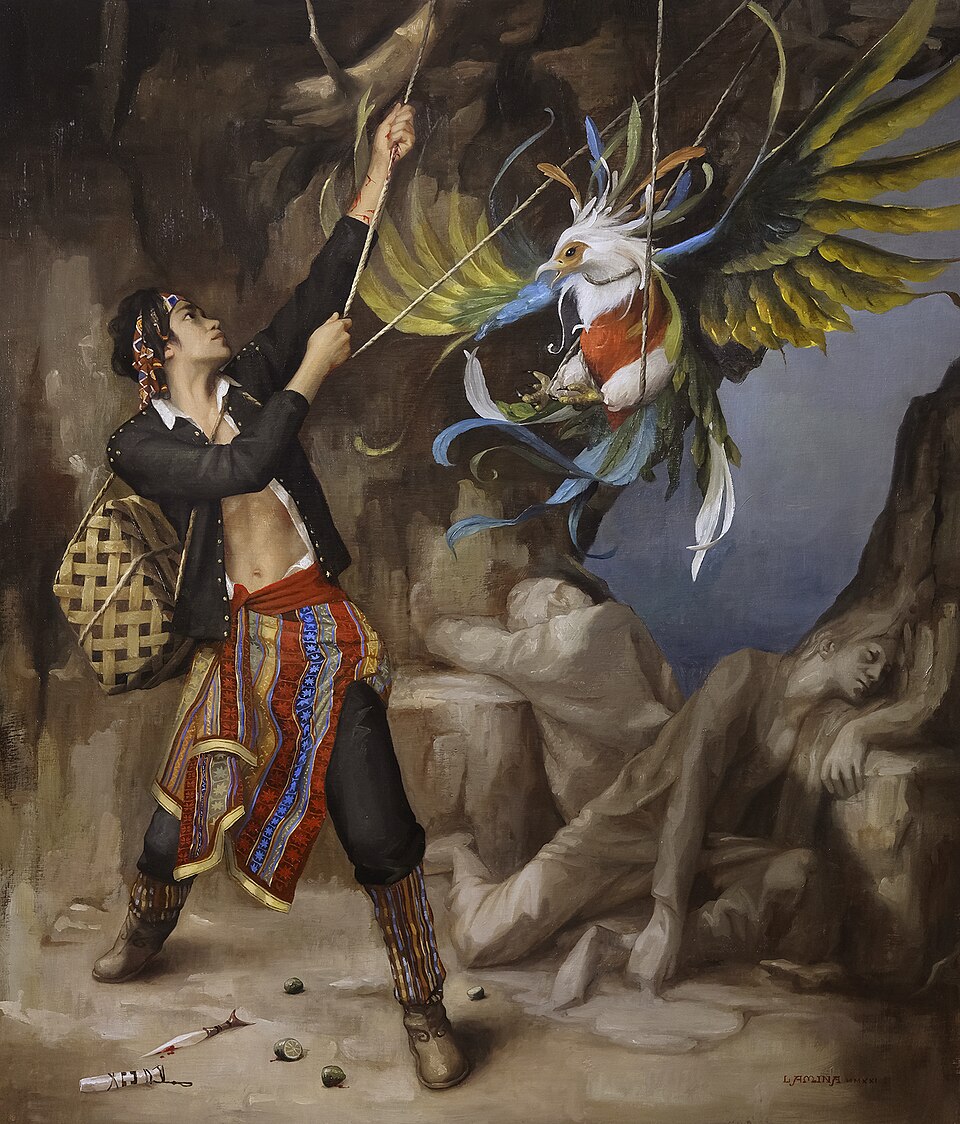
This documentation is respectively regarding history dating back to the years between 1493 and 1898. The Tagálogs wore the hair hanging to the shoulders; the Cagayans longer and hanging over the shoulders; the Ilocans shorter, and the Visayans still shorter. The nation called Zambals wear it shaved from the front half of the head, while on the skull they have a great shock of loose hair. The men adorned the head with only cendal or long and narrow thin cloth, with which they bound the forehead and temples, and which they call potong. It was put on in different modes, and now twisted and wrapped about the head. Those who were esteemed as valiant let the elaborately worked ends of the cloth fall down upon their shoulders, and these were so long that they reached the legs. By the color of the cloth they displayed their rank, and it was the badge of their deeds and exploits; and it was not allowed to anyone to use the red potong until he had at least killed one person. In order to wear it embroidered with certain borders, which were like a crown, they must have killed seven.
Some of these nations wore tattoos, which could not be removed after it was once put on. These are the tattooings of the body so greatly practiced among the Visayans, whom are called Pintados for that reason. For it was a custom among them, and was a mark of nobility and bravery, to tattoo the whole body from top to toe when they were of an age and strength sufficient to endure the tortures of the tattooing, which was done (after being carefully designed by the artists, and in accordance with the proportion of the parts of the body and the gender) with instruments like brushes or small twigs, with very fine points of bamboo. The body was pricked and marked with them until blood was drawn. Upon that a black powder or soot made from pitch, which never faded, was put on. The whole body was not tattooed at one time, but it was done gradually. In olden times no tattooing was begun until some brave deed had been performed; and after that, for each one of the parts of the body which was tattooed some new deed had to be performed. The men tattooed even their chins and about the eyes so that they appeared to be masked. Children were not tattooed, and the women only on one hand and part of the other. The Ilocans in this island of Manila also tattooed themselves but not to the same extent as the Visayans.
There were another kind of people. They generally lived about the sources of the rivers, and on that account were called in some districts, Ilayas. They were the Tingues, and were called Manguianes, Zambals, or other names, for each island had a different name for them. They generally traded with the Tagálogs, Visayans, and other civilized nations who were commonly settled near the sea and river mouths. There were also Pampangos, Pangasinans, and Bisayas.
There were many chiefs who dominated others less powerful. As there were many without much power, there was no security from the continual wars that were waged between them. Manila had two chiefs, uncle and nephew, who had equal power and authority. They were at war with another chief, who was chief alone; and he was so near that they were separated from one another by nothing more than a not very wide river. The same conditions ruled in all the rest of the island, and of even the whole archipelago. They were divided into barangays, and the cities into parishes or collations. They are called barangays, which is the name of a boat, preserving the name from the boat in which they came to settle these islands. Since they came subject to one leader in their barangay, who acted as their captain or pilot—who was accompanied by his children, relatives, friends, and comrades—after landing, they kept in company under that leader, who was the dato. Seizing the lands, they began to cultivate them and to make use of them. They seized as much of the sea and near-by rivers as they could preserve and defend from any other barangay, or from many barangays, according as they had settled near or far from others. Although on all occasions some barangays aided and protected others, yet the slave or even the timaua or freemen could not pass from one barangay to another, especially a married man or a married woman, without paying a certain quantity of gold, and giving a public feast to his whole barangay; where this was not done, it was an occasion for war between the two barangays.
Their laws and policy, consisted wholly of traditions and customs, observed with so great exactness that it was not considered possible to break them in any circumstance. One was the respect of parents and elders, carried to so great a degree that not even the name of one’s father could pass the lips. The individuals, even the children, must have followed the general [custom]. There were other laws also. For the determination of their suits, both civil and criminal, there was no other judge than the said chief, with the assistance of some old men of the same barangay. With them the suit was determined in the following form. They had the opponents summoned, and endeavored to have them come to an agreement. But if they would not agree, then an oath was administered to each one, to the effect that he would abide by what was determined and done. Then they called for witnesses, and examined summarily. If the proof was equal [on both sides], the difference was split; but, if it were unequal, the sentence was given in favor of the one who conquered.
There were three kinds and classes of people: the chiefs, whom the Visayans called dato and the Tagálogs maginoo; the timauas, who were the ordinary common people, called maharlicà among the Tagálogs; and the slaves, called oripuen by the Visayans and alipin by the Tagálogs. The last are divided into several kinds. The chiefs attained that position generally through their blood; or, if not that, because of their energy and strength. For even though one may be of low extraction, if he was seen to be careful, and if he gained some wealth by his industry and schemes—whether by farming and stock-raising, or by trading; or by any of the trades among them, such as smith, jeweler, or carpenter; or by robbery and tyranny, which was the most usual method—in that way he gained authority and reputation, and increased it the more he practices tyranny and violence. With these beginnings, he took the name of dato; and others, whether his relatives or not, came to him, and added credit and esteem to him, and made him a leader. Thus there is no superior who gave him authority or title, beyond his own efforts and power.
Their manner of life and ordinary conduct from the days of old is trade, in all sorts of things by wholesale, and more by retail in the products of the earth, in accordance with what is produced in each district. The maritime peoples were great fishers with net, line, and corral. The people who lived inland were excellent farmers and hunters. They were always cultivating rice, besides other vegetables and garden products. The women also were shrewd in trading, especially of their weaving, needlework, and embroideries, which they made very neatly; and there was scarcely one who cannot read and write. Sometimes the husband and wife went together on their trading, and, whether for this or for any other thing, she must always go ahead; for it is not their custom to go together. Even if it be a band wholly made up of men or of women, or of men and women mixed, and even if the road be very wide, they went in single file one after the other.
The maritime peoples were accustomed to make many raids. Their weapons consisted of bow and arrow; a spear with a short handle, and a head shaped in innumerable ways, most often with harpoon points; other spears without any head, with the point made on the shaft itself (which is of bamboo and of wood), a vara long, hardened in fire. They had swords; large, sharp daggers, made very beautifully; and slender, long blowpipes [ceruatanas], through which they shot most dangerous poisoned arrows. Such were their offensive weapons. Their defensive weapons are wooden shields and rattan or corded breastplates, and other armor helmets of the same material.
Four nations have renown the Southern islands of the Philippines in the past, the Caragas, Mindanaos, Lutaos, and Subanos. Caraga, which, was the smallest numerically. That particular nation maintained themselves by their own valor, without protection of the kings; and on land they were the first nation of the island.
The second nation in estimation was the Mindanao, which included the kingdoms of Buhayen; for in olden times they were all one nation, and later, although various rulers governed them, they were one in customs and language. They were a nation of some valor, and with their policy of being subject to kings they had acquired esteem among the other nations, whom they had united under one political government. The Mindanaos used a weapon, it is a campilan or cutlass of one edge. It is a very bloody weapon, but, being so heavy, it is a danger for him who handles it, if he is not adroit with it. It has only two forms of use, namely, to wield it by one edge, and to raise it by the other, in order to deal another stroke, its weight allowing time for the spears of the opponents to enter. They do not gird it on, as that would be too much trouble, but carry it on the shoulders. Besides that weapon the Mindanao uses lance, kris, and shield, as do the other nations. Both these and those have begun to use firearms too much, having acquired those. They managed all sorts of artillery excellently, and in their fleets all their craft carry their own pieces, with ladle, culverins, esmerils, and other small weapons.
The large island of Mindanao took its name from a large lake (which was called Danào in the general language of these islands) which is found in that island, and into which many rivers flow. The same thing has happened in that island as I have said of the others, namely, that its first owners and settlers must have been the ones who are now found on the uplands and in the fastnesses of the mountains and the crags. Since they were inclined to the mountains, they allowed the foreign traders to settle their seacoasts and rivers. From this fact came the variety of tribes that had been found in that island of Mindanào: such as the Caragas, the Butuans, the Cagayans, the Dapitans, the Mindanaos, the Malanaos, besides the Tagabaloòyes, Manòbos, and Lutàos, and a great number of dark skinned persons.
The third nation was the Lutaya. It was a nation common to these islands of Mindanao, Jolo, and Basilan. In all these islands it preserved the name of Lutao, for since that was their vocation it well explained their nature. For Lutao meant, in those languages, “he who swims and goes floating over the water.” Such was the nature of these people that they knew no other house than the ship. In the villages which they had formed they well showed the inclination with which they were born; for they were so fond of living on the sea that their houses were built in it, in places which the low tide leaves exposed. In that way they could set upright the trunks of the trees with which they formed their houses, driving them down according to the load which they had to sustain. When it was high tide the houses were very far from the shore, and the water in between was so deep that brigs and craft of heavier tonnage could sail there. These people disliked the land so thoroughly that they did not trouble themselves at all about its cultivation, nor got any benefit from it. All their labor was fishing, and they got from that the means of barter for whatever they needed, even for the wood that they burned and the logs from which they build their houses and craft. Since they were so slightly attached to the land, they easily moved to other parts, and knew no fixed abode except the sea; for although they recognized villages, in which they assembled, they seldom lived in these, for they were scattered through the bays and beaches suitable for their fishing. They lived under the kings of Mindanao and Jolo, and the chiefs of the same, and those of the island of Basilan; today with some, tomorrow with others, according to the district in which they were. Those of this island were scattered along all the coast which extended from Samboangan to the river of Mindanao, and had no fixed dwelling in any other part—except some of them who had settled in the city of Cebú and a few others in the village of Dapitan. They were equally esteemed in all parts as being the sinews for the wars of these regions (their campaign field being the sea), and also for their skill in constructing vessels fit for the wars of these regions, and their skill in managing them.
The fourth nation was the Subano. They were the settlers along the rivers. To them is due the name suba, which was the equivalent of “river” in the general language of these nation, for they lived in the plains.
They looked out for one another, and build their houses so high up that a pike could not reach and wound them. Their usual practice was to seek a very high tree, where they could build their nests safely; and, their houses were being so unostentatious in size and furnishing, a tree holded them easily. The ladder by which they ascended is a log, some grooves that they had cut in it serving as steps. On the coming of night they draw this ladder up and thus slept secure. This nation was almost wholly in vassalage to the Lutaos, and every village recognized some chief of the latter nation to whom they payed tribute; and that chief beared himself as a king among them, and made and unmade at his will. In the beginning, this authority entered under color of protection and support against the king of Mindanao, and remained in enthroned tyranny.
The kings, although so tyrannical in government, and in power so beyond the affliction and trouble which authority and ostentation incurred, yet according to the condition of their poverty maintained the form and authority of a court. Peace affairs were in charge of a chief justice or counselor, called zarabandal. That was the greatest court title and he decided the causes and suits, and advised concerning the sentence. In the outside villages where the king did not reside, the chiefs meddle wherever they wished, without other law than their power and will; and the one injured had no recourse, for, in quarrels between the plebeians and chiefs, the king always took the part of the latter—who were more powerful, and were those who could make trouble for him, and even deprived him of his kingdom. For his principate was founded more on the recognition that they made of his nobility than on any absolute power which secured to him their vassalage.
They had established orders of nobility, with a distinction of titles which aggrandized it. Some were called tuam. Others were given the title of orancaya, which signified “rich man;” it was the greatest title, and equivalent to grandee of their kingdom. The rest were called chiefs.
There were persons living on the plateaus of the mountains, and at the mouths of rivers, and maintained themselves by hunting and fishing, and some agriculture. Most of them traded, and bartered wax with the villages. These people were called Zimarrònes, Zambals, Ylàgas, Tìngues, Tagabaloòyes, Manòbos, Mangyànes, and various other names, according to the difference of the sites where they lived.
There were dark skinned persons in this island, living in the mountains and thick forests which abound in these islands and lived on the fruits and roots of the forests. They resembled those of the island of Negros (in this large islands there were an abundance of those people, that it was for that reason called the island of Negros), and of the uplands about Manila, called Aetas. They recognized no village, nor in a land of so many inclemencies did they have any other shelter than that of the trees. They went naked, covering only the privies with some articles called bahaques, made from the bark of trees. They had no other adornments than those which they inherited from nature. They wore no other ornaments than armlets and anklets and bracelets, curiously wrought after their manner from small rattans of various colors, and garlands of branches and flowers on their heads and the fleshy parts of the arm; and at the most some rooster or sparrow-hawk feather for a plume. They had no laws or letters, or other government or community than that of kinsfolk, all those of one line of family obeyed their leader. They used the bow and arrow, as these were the weapons least difficult to obtain, and more natural [to them]. They poisoned arrows, and the wound was consequently always dangerous. The wooden points of the arrows were so hard that those people had no occasion to regret the lack of iron. Nothing more was known of their origin than what is evident from this land. There were still a number of those people in the interior in the mountains.
Some of the various ethnic groups and names of geographical locations that have been mentioned in this historical documentation are present in the Philippines nowadays as well.
LUZON ★
TAAL (TAGALOG)
In the old days, when plants yet grew on this earth, because of its surface was rocky Isagani loved a Goddess who was Taal, fairest of Bathala's daughter's, who weekly visited the earth and gave food to its people. Eery since Isagani saw her as she mounted the skies on her milk white wings, he loved her. Taal loved him too for she had seen in the young mortal the bravest of men, with eyes that turned so expressive as he looked at her. But she knew that it was prohibited in a Goddess to marry a mortal as she kept their love a secret from the father and had their weekly meetings.
But Isagani, to whom life was pure when Taal was away, imprudently asked Taal to come to him so often as possible. Taal constented. In one of their meetings Atasip suprised them afterwards related to Bathala all that he saw and heared. Bathala was furious and set out to look for Isagani. But Bathala saw them far away and sailing on his studs he dashed in persuit. When Taal saw that they were persued by her father she redoubled her efforts. But Bathala hurled at them thunderbolts until they fell. Where they fell, a volcano arose, from which the thunderbolts of Bathala now and then escape to tell the world of his anger.
NAHAPONAN (BIKOL)
Magnindan was a beloved God of the Bicols, for did he not give them abundance of fish? He was the protector of the fishermen and it was to him that they prayed when there was little catch with either the nets or the lines. This was how their relation became closer and closer.
For years there was no cause of quarrel between Magnindan and the fishermen; and fish was plentiful. The people were prosperous.
But one day into the peaceful fishing village or barrio of Bacacay came two men who were attracted by the reputed wealth of the inhabitants gained through fishing. The villagers, who could easily notice strangers among them as they were not used to them, became suspicious and asked them for their names.
The tall wily figure who apparently was the leader of the two answered: “I am Pasacat, a fisherman of Tabaco, attracted by your lucky shores. This is my helper, Maluya.” Maluya was a weak-willed youth according to his appearance but strong as well as agile in muscles.
The headman of the village conferred whether or not they would admit the two fishermen from a neighboring place.
A bright-headed old man said, “If we permit them to fish, and if Magnindan does not like them, he would in time let them know.” It was agreed that it was really a bright idea. So Pasacat and Maluya were permitted to fish in Bacacay waters.
But before leaving for the sea they were admonished not to displease the God of the fishes or else something bad might happen to them. The two did not answer. When they were ploughing the sea Pasacat asked: “What was that God they were talking about not displeasing?”
“Well, I do not know myself,” answered the younger one. “But I know that in the forest where I came from there is also a God called Ocot, the God of chase. Perhaps this God of fishes has also the power to increase or decrease the number of fishes, depending upon his will. It is very much better if we don’t offend him,” added Maluya.
“I don’t believe in it,” said the older man as if boasting. “Oh!” the other was horrified terribly. “Don’t think of that! I know several people in the forest whom I know turned to stone for disobeying the rules of the God.”
“I lead a charmed life, why should I be afraid?” said Pasacat.
“But I am afraid,” Maluya said.
“Why should you be? There is nothing alarming,” with that the discussion came to an end as they felt a nibble from one of their lines. In time they were assimilated into the barrio. The simple folks marveled at their unusual skill in their catch. Overnight they became rich. This was then during the guimata (period of time around the new moon phase). But when otong came (during the quarter phase), there was little fish to be had. Pasacat and Maluya wondered at this. They asked the villagers, and they learned that they must entreat Magnindan to give them more fish.
The villagers themselves put out to sea to make the necessary ceremony to call for more fish. They brought with them stones and shredded small fish that they had caught in the rivers. On reaching the designated spot for the ceremony, they pounded the sides of the casco on which they were riding and kept pounding throughout the whole sacrifice. The sound was made to call the attention of Magnindan. Then the other members of the party threw the shredded fish, and still the others threw the stones into the sea. After that they were happy, for fish came abundantly again.
This ceremony, however, had one limitation, that is, it could be performed at any time of the day except during twilight (naniron siron). For the people said that Magnindan was sleeping then and hated to be awakened by their prayers. This the people obeyed without any complaint and they learned to conform to that.
The two strangers used this sacrifice to advantage. They now commanded the local market and they had already raised the price of fish. This the people resented. And soon the presence of the two strangers became very obnoxious.
Time passed on. The guimata was coming again, and then the otong. And there was little fish. And the village did not cry for fish, for they were afraid that only the two strangers would catch all the fish. Pasacat and Maluya, however, set about to make an offering to the fish God. They started in the morning and continued it till noon and afternoon. They were mad with delight, for they had not more fish than desired, which they could sell to the villagers at profitable prices.
So with madness, they continued the sacrifice till twilight and kept imploring the God to give them more fish. Magnindan, on being awakened by the noise above him, was terribly angry, and summoned an attendant to see who it was that was making the noise. The helper went out, returned, and reported who it was.
“Is this my reward? I have given them more fish than the villagers. Ungrateful!” Magnindan swore to punish them. He ordered all the fishes of the sea to retire to their caverns. Pasacat swore seeing the fish was not forthcoming. This made the fish God all the more angry. Then he caused a storm.
Maluya cried, “Sir, the God is angry!”
“Weak heart! What God?” scorned Pasacat.
The storm grew and the waves swelled. The two fishermen decided to sail homeward. But when they tried to lift their anchor it would not move an inch from the bottom. All night and morning the next day they could not break away from there. The people on the shore were glad the two extortionists were being punished by a just God. Pasacat and Maluya became sick of it all.
Toward twilight they were still chained there. Then just as the sun set that day there was a huge flash of lightning (linti) followed by thunder (dalogdog). After this the air became calm and the moon rose. The villagers looked out to find out what had become of the two men. They saw them bending on their casco and looking down. They did not mind them then. But as days passed and the two did not leave the place they became curious. And they put out to sea to find out. To their great horror they discovered that the two men had been turned to black stones. And they were standing on coral beds where before there was none. The living men looked at each other knowingly.
To this day these figures, now unrecognizable as human forms, can still be seen near Bacacay Beach. The place is called nahaponan because it was there that the afternoon (hapon) ended them (twilight).
THE ORIGIN OF PINATUBO VOLCANO (AETA)
Long, long ago, ten-thousands upon ten-thousands of years before the appearence of the first man on this earth, all of the land bordering the sea was ruled by the mighty Giants, the king of the "spirit hunters." These spirits were powerful and numerous. Their chief occupation was to transform themselves into all forms of living men and to roam their hunting grounds, while aiding one another to drive away their enemies. Among them was the terrible spirit of the sea Bacobaco, who, upon command ruled the rivers and the shores. Bacobaco was also extremely fond of sleep; and whenever he wished he would transform himself into an enormous turtle; and suddenly appearing on the shore of the sea, he would wanter forth into the haunting grounds of the "spirit hunters" and spread himself with fear to the race. He would greatly threaten the tribe, but he was powerless compared to their master. It was said that Bacobaco who carried his thick shield on his back, and who threw fire from his mouth.
However, one day, he consulted Wasi, the spirit of the wind, and Wasi whispered into his ear "why don't you ask your brother to help you? he is the only one of killing Bacobaco, for if he hith even the big of the sea will be frightened."
Aglao followed his advice. He went to meet Blit and ask for help. Blit agreed because he himself is an enemy of Bacobaco. The following day the huge turtle appeared again, but Blit was quiet ready for him this time. But as he carefully placed an arrow to his bow, Bacobaco saw him and immediately hid his whole body beneath his shield. The arrow struck exactly at the place where his head had been thrust forward only a few moments before.
Before he could recharge his weapon Bacobaco escaped. Bacobaco tried to hide in a lake at the foot of Mount Pinatubo, but finding the water clear, he climbed to the peak where he started digging a hole. “Bit pieces of rock, mud, dust and other things began to fall in showers all around the mountain. During all the while (Bacobaco) howled and howled so loudly that the earth shook under the foot of Blit, Aglao and his hosts. The fire that escaped from his mouth became so thick and so hot that the pursuing party had to run away.” “For three days,” the story goes, “the turtle continues to burrow itself, throwing rocks, muds, ashes and thundering away all the time in deafening wars. At the end of three days he stopped, and all was quiet again in...
THE LEGEND OF PALAESGEN (TAGBUANA)
A long time ago, Biarongbarongan, who was a supernatural chief lived at the other side of Iraan river, [where the old agricultural high school was located]. He had two sons, namely, Baybayaren and Palaesgen. Both were married to Iloilo and Tabod, respectively. They were also enchanted. They owned wells with magical flowing water. From the wells, they could demand instantly anything that they asked for.
At one time, Biarongbiarongan went for a tournament in a foreign land. After his defeat, he was beheaded and his head was pierced in the plaza. His fierce son, Palaesgen rode his enormous ship with hundreds of his followers to avenge his father’s death. When he was exhausted in his battle, he alighted in a tree and only his sword and shield continued to fight until he was victorious and went home to Aborlan.
One afternoon, an ordinary man and woman happened to meet for a romance under Palaesgen’s house. He was angry at the sinful persons, thus he and his family together with his kins left Aborlan for another virgin land.
WALI AND THE BANGAT (TAGBUANA)
Wali, a hunter from Tigman, was once lost in the forest for seven days and nights. He found the place at the head of the Maasin River where there were countless pigs. As he wandered there, he saw some huge houses with hundreds of rooms. These houses had roofs but no floors. When he saw the huge houses he was afraid. But he said to himself, I will go there even it is the place of the damdam [an evil spirit] for I am too tired to continue. As he approached one of the houses he met a very old man. It was a panya’an, the leader of the pigs, named li’iyan kat baga. The old man said to him: “Why have you come to my house?” Wali replied: “I am lost.” The old man then told him to enter one of the houses. After he had entered they chewed betel and Wali was given food. But the rice was soft-cooked with the chaff. When the meal was over the old man told Wali not to leave as his children were coming. Late that afternoon Wali saw thousands of small pigs approaching. They all dove into a small stream nearby and, after swimming about for a short time, they became men and women! The old man fed them and they all scattered through the many rooms of the houses of sleep.
The old man told Wali: “You have learned many things while staying with me. Do you have any medicine? Many of my people are sick,” Wali went to see the people who were sick and saw that they have been injured by the shafts of the ba’ad [the “belatic” trap]. He immediately pulled the shafts out of their legs and bodies. The next morning the people were all well. The old man said: “My sons and daughters are well because you have helped them. Just tell me what you need.” Wali answered: “It’s up to you. If you give me something I will take it.” The old man handed him some pig’s hair as large as the vine nitu’ and said: “If you apply this to your dogs and traps you will get many pigs.” This gift was bangat [a type of “charm”] Wali was then told to return to his village and that he would now know the way. The panya’an had caused him to become lost. The old man also told him not to cross the river on the way until it became clear. So Wali followed the bank of the river on the way until he couldn’t find any clear water. After some time, he decided to ignore the words of the old man and he stepped into the muddy river. But when he took a second step he saw that his feet had become hoofs. He quickly returned to the place where he had been and again followed along the bank of the river. At last he saw some clear water and crossed again. As he waded his feet returned to their former shape. He hastened on to his village and told everyone what had happened.
SALAKEP (TAGBUANA)
A long time ago the salakap lived with the Tagbanuwa and the two people were friendly. One day they all decided to go fishing at the seashore. It was agreed that they would go in two groups – the Tagbanuwa in one group and the salakap in the other. Now the trail to the seashore forked and it was planned that whichever group arrived at the fork in the trail first would leave some komuy (a rice preparation) wrapped in alimutyukan (Mallotus ricinoides Muell.-Arg.) leaves in the trail, in order to indicate the direction that the first group had taken.
The Tagbanuwa reached the fork in the trail first and they decided to play a trick on salakap. Instead of placing komuy in the leaves, they proceeded to the beach.
When the salakap arrived at the fork they saw the sign (patudu) had been left on the trail as agreed. They picked it up and said, “This smells good.” Then they opened the package and said that it was filled with human excrement instead of komuy. They were very hungry, however, and decided to eat it anyway. When the salakap finished, they said: “That was very good. If the waste matter of the Tagbanuwa is so tasty, their flesh must be even better. Let’s eat them all.”
Now the salakap proceeded to the beach and caught and ate all but two of the Tagbanuwa who were fishing, a man and a woman. Then they returned to the dwellings of the Tagbanuwa and devoured all of those who had remained behind. The salakap told the surviving man and woman that they were going to kiyabusan. The said that the two must promise to hold a runsay ceremony once a year – the second night of the full moon in December. If they did not do so, they would return and devour them.
The salakap sailed away in their outrigger and the people have held the runsay as promised, every year.
APONIBOLINAYEN (TINGGUIAN)
The most beautiful girl in all the world was Aponibolinayen of Nalpangan. Many young men had come to her brother, Aponibalagen, to ask for her hand in marriage, but he had refused them all, for he awaited one who possessed great power. Then it happened that the fame of her beauty spread over all the world till it reached even to Adasen; and in that place there lived a man of great power named Gawigawen.
Now Gawigawen, who was a handsome man, had sought among all the pretty girls but never, until he heard of the great beauty of Aponibolinayen, had he found one whom he wished to wed. Then he determined that she should be his wife; and he begged his mother to help him win her. So Dinawagen, the mother of Gawigawen, took her hat which looked like a sunbeam and set out at once for Nalpangan; and when she arrived there she was greeted by Ebang, the mother of the lovely maiden, who presently began to prepare food for them.
She put the pot over the fire, and when the water boiled she broke up a stick and threw the pieces into the pot, and immediately they became fish. Then she brought basi in a large jar, and Dinawagen, counting the notches in the rim, perceived that the jar had been handed down through nine generations. They ate and drank together, and after they had finished the meal, Dinawagen told Aponibalagen of her son's wishes, and asked if he was willing that his sister should marry Gawigawen. Aponibalagen, who had heard of the power of the suitor, at once gave his consent. And Dinawagen departed for home, leaving a gold cup as an engagement present.
Gawigawen was watching at the door of his house for his mother's return, and when she told him of her success, he was so happy that he asked all the people in the town to go with him the next day to Nalpangan to arrange the amount he must pay for his bride.
Now the people of Nalpangan wanted a great price for this girl who was so beautiful, and the men of the two towns debated for a long time before they could come to an agreement. Finally, however, it was decided that Gawigawen should fill the spirit house eighteen times with valuable things; and when he had done this, they were all satisfied and went to the yard where they danced and beat on the copper gongs. All the pretty girls danced their best, and one who wore big jars about her neck made more noise than the others as she danced, and the jars sang "Kitol, kitol, kanitol; inka, inka, inkatol."
But when Aponibolinayen, the bride of Gawigawen, came down out of the house to dance, the sunshine vanished, so beautiful was she; and as she moved about, the river came up into the town, and striped fish bit at her heels.
For three months the people remained here feasting and dancing, and then early one morning they took Aponibolinayen to her new home in Adasen. The trail that led from one town to the other had become very beautiful in the meantime: the grass and trees glistened with bright lights, and the waters of the tiny streams dazzled the eyes with their brightness as Aponibolinayen waded across. When they reached the spring of Gawigawen, they found that it, too, was more beautiful than ever before. Each grain of sand had become a bead, and the place where the women set their jars when they came to dip water had become a big dish.
Then said Aponibalagen to his people, "Go tell Gawigawen to bring an old man, for I want to make a spring for Aponibolinayen."
So an old man was brought and Aponibalagen cut off his head and put it in the ground, and sparkling water bubbled up. The body he made into a tree to shade his sister when she came to dip water, and the drops of blood as they touched the ground were changed into valuable beads. Even the path from the spring to the house was covered with big plates, and everything was made beautiful for Aponibolinayen.
Now during all this time Aponibolinayen had kept her face covered so that she had never seen her husband, for although he was a handsome man, one of the pretty girls who was jealous of the bride had told her that he had three noses, and she was afraid to look at him.
After her people had all returned to their homes, she grew very unhappy, and when her mother-in-law commanded her to cook she had to feel her way around, for she would not uncover her face. Finally she became so sad that she determined to run away. One night when all were asleep, she used magical power and changed herself into oil. Then she slid through the bamboo floor and made her escape without anyone seeing her.
On and on she went until she came to the middle of the jungle, and then she met a wild rooster who asked her where she was going.
"I am running away from my husband," replied Aponibolinayen, "for he has three noses and I do not want to live with him."
"Oh," said the rooster, "some crazy person must have told you that. Do not believe it. Gawigawen is a handsome man, for I have often seen him when he comes here to snare chickens."
But Aponibolinayen paid no heed to the rooster, and she went on until she reached a big tree where perched a monkey, and he also asked where she was going.
"I am running away from my husband," answered the girl, "for he has three noses and I do not want to live with him."
"Oh, do not believe that," said the monkey. "Someone who told you that must have wanted to marry him herself, for he is a handsome man."
Still Aponibolinayen went on until she came to the ocean, and then, as she could go no farther, she sat down to rest. As she sat there pondering what she should do, a carabao came along, and thinking that she would ride a while she climbed up on its back. No sooner had she done so than the animal plunged into the water and swam with her until they reached the other side of the great ocean.
There they came to a large orange tree, and the carabao told her to eat some of the luscious fruit while he fed on the grass nearby. As soon as he had left her, however, he ran straight to his master, Kadayadawan, and told him of the beautiful girl.
Kadayadawan was very much interested and quickly combed his hair and oiled it, put on his striped coat and belt, and went with the carabao to the orange tree. Aponibolinayen, looking down from her place in the tree, was surprised to see a man coming with her friend, the carabao, but as they drew near, she began talking with him, and soon they became acquainted. Before long, Kadayadawan had persuaded the girl to become his wife, and he took her to his home. From that time every night his house looked as if it was on fire, because of the beauty of his bride.
After they had been married for some time, Kadayadawan and Aponibolinayen decided to make a ceremony for the spirits, so they called the magic betel-nuts and oiled them and said to them,
"Go to all the towns and invite our relatives to come to the ceremony which we shall make. If they do not want to come, then grow on their knees until they are willing to attend."
So the betel-nuts started in different directions and one went to Aponibalagen in Nalpangan and said,
"Kadayadawan is making a ceremony for the spirits, and I have come to summon you to attend."
"We cannot go," said Aponibalagen, "for we are searching for my sister who is lost"
"You must come," replied the betel-nut, "or I shall grow on your knee,"
"Grow on my pig," answered Aponibalagen; so the betel-nut went on to the pig's back and grew into a tall tree, and it became so heavy that the pig could not carry it, but squealed all the time.
Then Aponibalagen, seeing that he must obey, said to the betel-nut,
"Get off my pig, and we will go."
The betel-nut got off the pig's back, and the people started for the ceremony. When they reached the river, Gawigawen was there waiting to cross, for the magic nuts had forced him to go also. Then Kadayadawan, seeing them, sent more betel-nuts to the river, and the people were carried across by the nuts.
As soon as they reached the town the dancing began, and while Gawigawen was dancing with Aponibolinayen he seized her and put her in his belt. Kadayadawan, who saw this, was so angry that he threw his spear and killed Gawigawen. Then Aponibolinayen escaped and ran into the house, and her husband brought his victim back to life, and asked him why he had seized the wife of his host. Gawigawen explained that she was his wife who had been lost, and the people were very much surprised, for they had not recognized her at first.
Then all the people discussed what should be done to bring peace between the two men, and it was finally decided that Kadayadawan must pay both Aponibalagen and Gawigawen the price that was first demanded for the beautiful girl.
After this was done all were happy; and the guardian spirit of Kadayadawan gave them a golden house in which to live.
APONIBOLINAYEN AND THE SUN (TINGGUIAN)
One day Aponibolinayen and her sister-in-law went out to gather greens. They walked to the woods to the place where the siksiklat grew, for the tender leaves of this vine are very good to eat. Suddenly while searching about in the underbrush, Aponibolinayen cried out with joy, for she had found the vine, and she started to pick the leaves. Pull as hard as she would, however, the leaves did not come loose, and all at once the vine wound itself around her body and began carrying her upward.
Far up through the air she went until she reached the sky, and there the vine set her down under a tree. Aponibolinayen was so surprised to find herself in the sky that for some time she just sat and looked around, and then, hearing a rooster crow, she arose to see if she could find it. Not far from where she had sat was a beautiful spring surrounded by tall betel-nut trees whose tops were pure gold. Rare beads were the sands of the spring, and the place where the women set their jars when they came to dip water was a large golden plate. As Aponibolinayen stood admiring the beauties of this spring, she beheld a small house nearby, and she was filled with fear lest the owner should find her there. She looked about for some means of escape and finally climbed to the top of a betel-nut tree and hid.
Now the owner of this house was Ini-init, the sun, but he was never at home in the daylight, for it was his duty to shine in the sky and give light to all the world. At the close of the day when the big star took his place in the sky to shine through the night, Ini-init returned to his house, but early the next morning he was always off again.
From her place in the top of the betel-nut tree, Aponibolinayen saw the sun when he came home at evening time, and again the next morning she saw him leave. When she was sure that he was out of sight she climbed down and entered his dwelling, for she was very hungry. She cooked rice, and into a pot of boiling water she dropped a stick which immediately became fish, so that she had all she wished to eat. When she was no longer hungry, she lay down on the bed to sleep. Now late in the afternoon Ini-init returned from his work and went to fish in the river near his house, and he caught a big fish. While he sat on the bank cleaning his catch, he happened to look up toward his house and was startled to see that it appeared to be on fire. He hurried home, but when he reached the house he saw that it was not burning at all, and he entered. On his bed he beheld what looked like a flame of fire, but upon going closer he found that it was a beautiful woman fast asleep.
Ini-init stood for some time wondering what he should do, and then he decided to cook some food and invite this lovely creature to eat with him. He put rice over the fire to boil and cut into pieces the fish he had caught. The noise of this awakened Aponibolinayen, and she slipped out of the house and back to the top of the betel-nut tree. The sun did not see her leave, and when the food was prepared he called her, but the bed was empty and he had to eat alone. That night Ini-init could not sleep well, for all the time he wondered who the beautiful woman could be. The next morning, however, he rose as usual and set forth to shine in the sky, for that was his work.
That day Aponibolinayen stole again to the house of the sun and cooked food, and when she returned to the betel-nut tree she left rice and fish ready for the sun when he came home. Late in the afternoon Ini-init went into his home, and when he found pots of hot rice and fish over the fire he was greatly troubled. After he had eaten he walked a long time in the fresh air. "Perhaps it is done by the lovely woman who looks like a flame of fire," he said. "If she comes again I will try to catch her."
The next day the sun shone in the sky as before, and when the afternoon grew late he called to the big star to hurry to take his place, for he was impatient to reach home. As he drew near the house he saw that it again looked as if it was on fire. He crept quietly up the ladder, and when he had reached the top he sprang in and shut the door behind him.
Aponibolinayen, who was cooking rice over the fire, was surprised and angry that she had been caught; but the sun gave her betel-nut which was covered with gold, and they chewed together and told each other their names. Then Aponibolinayen took up the rice and fish, and as they ate they talked together and became acquainted.
After some time Aponibolinayen and the sun were married, and every morning the sun went to shine in the sky, and upon his return at night he found his supper ready for him. He began to be troubled, however, to know where the food came from, for though he brought home a fine fish every night, Aponibolinayen always refused to cook it.
One night he watched her prepare their meal, and he saw that, instead of using the nice fish he had brought, she only dropped a stick into the pot of boiling water.
"Why do you try to cook a stick?" asked Ini-init in surprise.
"So that we can have fish to eat," answered his wife.
"If you cook that stick for a month, it will not be soft," said Ini-init. "Take this fish that I caught in the net, for it will be good."
But Aponibolinayen only laughed at him, and when they were ready to eat she took the cover off the pot and there was plenty of nice soft fish. The next night and the next, Aponibolinayen cooked the stick, and Ini-init became greatly troubled for he saw that though the stick always supplied them with fish, it never grew smaller.
Finally he asked Aponibolinayen again why it was that she cooked the stick instead of the fish he brought, and she said:
"Do you not know of the woman on earth who has magical power and can change things?"
"Yes," answered the sun, "and now I know that you have great power."
"Well, then," said his wife, "do not ask again why I cook the stick."
And they ate their supper of rice and the fish which the stick made.
One night not long after this Aponibolinayen told her husband that she wanted to go with him the next day when he made light in the sky.
"Oh, no, you cannot," said the sun, "for it is very hot up there, and you cannot stand the heat."
"We will take many blankets and pillows," said the woman, "and when the heat becomes very great, I will hide under them."
Again and again Ini-init begged her not to go, but as often she insisted on accompanying him, and early in the morning they set out, carrying with them many blankets and pillows.
First, they went to the East, and as soon as they arrived the sun began to shine, and Aponibolinayen was with him. They traveled toward the West, but when morning had passed into noontime and they had reached the middle of the sky Aponibolinayen was so hot that she melted and became oil. Then Ini-init put her into a bottle and wrapped her in the blankets and pillows and dropped her down to earth.
Now one of the women of Aponibolinayen's town was at the spring dipping water when she heard something fall near her. Turning to look, she beheld a bundle of beautiful blankets and pillows which she began to unroll, and inside she found the most beautiful woman she had ever seen. Frightened at her discovery, the woman ran as fast as she could to the town, where she called the people together and told them to come at once to the spring. They all hastened to the spot and there they found Aponibolinayen for whom they had been searching everywhere.
"Where have you been?" asked her father; "we have searched all over the world and we could not find you.'
"I have come from Pindayan," answered Aponibolinayen. "Enemies of our people kept me there till I made my escape while they were asleep at night"
All were filled with joy that the lost one had returned, and they decided that at the next moon they would perform a ceremony for the spirits and invite all the relatives who were mourning for Aponibolinayen.
So they began to prepare for the ceremony, and while they were pounding rice, Aponibolinayen asked her mother to prick her little finger where it itched, and as she did so a beautiful baby boy popped out. The people were very much surprised at this, and they noticed that every time he was bathed the baby grew very fast so that, in a short time, he was able to walk. Then they were anxious to know who was the husband of Aponibolinayen, but she would not tell them, and they decided to invite everyone in the world to the ceremony that they might not overlook him.
They sent for the betel-nuts that were covered with gold, and when they had oiled them they commanded them to go to all the towns and compel the people to come to the ceremony.
"If anyone refuses to come, grow on his knee," said the people, and the betel-nuts departed to do as they were bidden.
As the guests began to arrive, the people watched carefully for one who might be the husband of Aponibolinayen, but none appeared and they were greatly troubled. Finally they went to the old woman, Alokotan, who was able to talk with the spirits, and begged her to find what town had not been visited by the betel-nuts which had been sent to invite the people. After she had consulted the spirits the old woman said:
"You have invited all the people except Ini-init who lives up above. Now you must send a betel-nut to summon him. It may be that he is the husband of Aponibolinayen, for the siksiklat vine carried her up when she went to gather greens."
So a betel-nut was called and bidden to summon Ini-init.
The betel-nut went up to the sun, who was in his house, and said:
"Good morning, sun. I have come to summon you to a ceremony which the father and mother of Aponibolinayen are making for the spirits. If you do not want to go, I will grow on your head."
"Grow on my head," said the sun. "I do not wish to go."
So the betel-nut jumped upon his head and grew until it became so tall that the sun was not able to carry it, and he was in great pain.
"Oh, grow on my pig," begged the sun. So the betel-nut jumped upon the pig's head and grew, but it was so heavy that the pig could not carry it and squealed all the time. At last the sun saw that he would have to obey the summons, and he said to the betel-nut:
"Get off my pig and I will go."
So Ini-init came to the ceremony, and as soon as Aponibolinayen and the baby saw him, they were very happy and ran to meet him. Then the people knew that this was the husband of Aponibolinayen, and they waited eagerly for him to come up to them. As he drew near, however, they saw that he did not walk, for he was round; and then they perceived that he was not a man but a large stone. All her relatives were very angry to find that Aponibolinayen had married a stone; and they compelled her to take off her beads and her good clothes, for, they said, she must now dress in old clothes and go again to live with the stone.
So Aponibolinayen put on the rags that they brought her and at once set out with the stone for his home. No sooner had they arrived there, however, than he became a handsome man, and they were very happy.
"In one moon," said the sun, "we will make a ceremony for the spirits, and I will pay your father and mother the marriage price for you."
This pleased Aponibolinayen very much, and they used magic so that they had many neighbors who came to pound rice for them and to build a large spirit house.
Then they sent oiled betel-nuts to summon their relatives to the ceremony. The father of Aponibolinayen did not want to go, but the betel-nut threatened to grow on his knee if he did not. So he commanded all the people in the town to wash their hair and their clothes, and when all was ready they set out.
When they reached the town they were greatly surprised to find that the stone had become a man, and they chewed the magic betel-nuts to see who he might be. It was discovered that he was the son of a couple in Aponibolinayen's own town, and the people all rejoiced that this couple had found the son whom they had thought lost. They named him Aponitolau, and his parents paid the marriage price for his wife—the spirit house nine times full of valuable jars.
After that all danced and made merry for one moon, and when the people departed for their homes Ini-init and his wife went with them to live on the earth.
THE STORY OF GAYGAYOMA WHO LIVES UP ABOVE (TINGGUIAN)
One day, while Aponitolau sat weaving a basket under his house, he began to feel very hungry and longed for something sweet to chew. Then he remembered that his field was still unplanted. He called to his wife who was in the room above, and said: "Come, Aponibolinayen, let us go to the field and plant some sugar-cane."
So Aponibolinayen came down out of the house with a bamboo tube, and while she went to the spring to fill it with water, Aponitolau made some cuttings, and they went together to the field, which was some distance from the house.
Aponitolau loosened the earth with his long stick and set out the cuttings he had brought, while his wife sprinkled them with water from the bamboo tube. And when they had filled the field, they returned home, happy to think of the splendid cane they should have.
After seven days Aponitolau went back to the field to see if the plants had lived, and he found that the leaves were already long and pointed. This delighted him, and while he stood looking at it he grew impatient and determined to use his magical power so that the cane would grow very fast. In five days he again visited the field and found that the stalks were tall and ready to chew. He hurried home to tell Aponibolinayen how fast their plants had grown, and she was proud of her powerful husband.
Now about this time Gaygayoma, who was the daughter of Bagbagak, a big star, and Sinag, the moon, looked down from her home in the sky, and when she saw the tall sugar-cane growing below, she was seized with a desire to chew it. She called to her father, Bagbagak, and said:
"Oh, Father, please send the stars down to the earth to get some of the sugar-cane that I see, for I must have it to chew."
So Bagbagak sent the stars down, and when they reached the bamboo fence that was around the field they sprang over it, and each broke a stalk of the cane and pulled some beans which Aponibolinayen had planted, and the stems of these beans were of gold. Gaygayoma was delighted with the things that the stars brought her. She cooked the beans with the golden stems and spent long hours chewing the sweet cane. When all that the stars brought was gone, however, she grew restless and called to her father, the big star:
"Come, Father, and go with me to the place where the sugar-cane grows, for I want to see it now."
Bagbagak called many stars to accompany him, and they all followed Gaygayoma down to the place where the sugar-cane grew. Some sat on the bamboo fence, while others went to the middle of the field, and all ate as much as they wished.
The day following this, Aponitolau said to his wife:
"Aponibolinayen, I am going to the field to see if the bamboo fence is strong, for the carabao will try to get in to eat our sugar-cane."
So he set out, and when he reached the field and began looking along the fence to see if it was strong, he kept finding the stalks that the stars had chewed, and he knew that someone had been there. He went into the middle of the field, and there on the ground was a piece of gold, and he said to himself:
"How strange this is! I believe some beautiful girl must have chewed my cane. I will watch tonight, and maybe she will return for more."
As darkness came on he had no thought of returning home, but he made his meal of the sugar-cane, and then hid in the tall grass near the field to wait. By and by dazzling lights blinded his eyes, and when he could see again he was startled to find many stars falling from the sky, and soon he heard someone breaking the cane. Suddenly a star so large that it looked like a flame of fire fell into the field, and then a beautiful object near the fence took off her dress which looked like a star, and she appeared like the half of the rainbow.
Never had Aponitolau seen such sights; and for a while he lay shaking with fear.
"What shall I do?" he said to himself. "If I do not frighten these companions of the beautiful girl, they may eat me."
With a great effort he jumped up and frightened the stars till they all flew up, and when the pretty girl came looking for her dress she found Aponitolau sitting on it. "You must forgive us," she said, "For your sugar-cane is very sweet, and we wanted some to chew."
"You are welcome to the sugar-cane," answered Aponitolau. "But now we must tell our names according to our custom, for it is bad for us to talk until we know each other's names."
Then he gave her some betel-nut and they chewed together, and he said:
"Now it is our custom to tell our names."
"Yes," said she; "but you tell first"
"My name is Aponitolau and I am the husband of Aponibolinayen."
"I am Gaygayoma, the daughter of Bagbagak and Sinag up in the air," said the girl. "And now, Aponitolau, even though you have a wife, I am going to take you up to the sky, for I wish to marry you. If you are not willing to go, I shall call my companion stars to eat you."
Aponitolau shook with fear, for he knew now that the woman was a spirit; and as he dared not refuse, he promised to go with her. Soon after that the stars dropped a basket that Gaygayoma had ordered them to make, and Aponitolau stepped in with the lovely star and was drawn quickly through the air up to the sky. They were met on their arrival by a giant star whom Gaygayoma introduced as her father, and he told Aponitolau that he had acted wisely in coming, for had he objected, the other stars would have eaten him.
After Aponitolau had lived with the stars for some time, Gaygayoma asked him to prick between her last two fingers, and as he did so a beautiful baby boy popped out. They named him Takyayen, and he grew very fast and was strong.
All this time Aponitolau had never forgotten Aponibolinayen who, he knew, was searching for him on the earth, but he had been afraid to mention her to the stars. When the boy was three months old, however, he ventured to tell Gaygayoma of his wish to return to the earth.
At first she would not listen to him, but he pleaded so hard that at last she consented to let him go for one moon. If he did not return at the end of that time, she said, she would send the stars to eat him. Then she called for the basket again, and they were lowered to the earth. There Aponitolau got out, but Gaygayoma and the baby returned to the sky.
Aponibolinayen was filled with joy at the sight of her husband once more, for she had believed him dead, and she was very thin from not eating while he was away. Never did she tire of listening to his stories of his life among the stars, and so happy was she to have him again that when the time came for him to leave she refused to let him go.
That night many stars came to the house. Some stood in the windows, while others stayed outside by the walls; and they were so bright that the house appeared to be on fire.
Aponitolau was greatly frightened, and he cried out to his wife:
"You have done wrong to keep me when I should have gone. I feared that the stars would eat me if I did not obey their command, and now they have come. Hide me, or they will get me."
But before Aponibolinayen could answer, Bagbagak himself called out:
"Do not hide from us, Aponitolau, for we know that you are in the corner of the house. Come out or we shall eat you."
Trembling with fear, Aponitolau appeared, and when the stars asked him if he was willing to go with them he dared not refuse.
Now Gaygayoma had grown very fond of Aponitolau, and she had commanded the stars not to harm him if he was willing to return to her. So when he gave his consent, they put him in the basket and flew away with him, leaving Aponibolinayen very sad and lonely. After that Aponitolau made many trips to the earth, but at Gaygayoma's command he always returned to the sky to spend part of the time with her.
One day when Takyayen was a little boy, Aponitolau took him down to the earth to see his half-brother, Kanag. The world was full of wonders to the boy from the sky, and he wanted to stay there always. But after some time while he and Kanag were playing out in the yard, big drops of water began to fall on them. Kanag ran to his mother and cried:
"Oh, Mother, it is raining, and the sun is shining brightly!"
But Aponitolau, looking out, said, "No, they are the tears of Gaygayoma, for she sees her son down below, and she weeps for him."
Then he took Takyayen back to his mother in the sky, and she was happy again.
After that Takyayen was always glad when he was allowed to visit the earth, but each time when his mother's tears began to fall, he returned to her. When he was old enough, Aponitolau selected a wife for him, and after that Takyayen always lived on the earth, but Gaygayoma stayed in the sky.
Aponitolau and Aponibolinayen had a son whose name was Dumalawi. When the son had become a young man, his father one day was very angry with him, and tried to think of some way in which to destroy him. The next morning he said to Dumalawi:
"Son, sharpen your knife, and we will go to the forest to cut some bamboo."
So Dumalawi sharpened his knife and went with his father to the place where the bamboo grew, and they cut many sticks and sharpened them like spears at the end.
Dumalawi wondered why they made them thus, but when they had finished, Aponitolau said:
"Now, Son, you throw them at me, so that we can see which is the braver."
"No, Father," answered Dumalawi. "You throw first, if you want to kill me."
So Aponitolau threw the bamboo sticks one by one at his son, but he could not hit him. Then it was the son's turn to throw, but he said:
"No, I cannot. You are my father, and I do not want to kill you."
So they went home. But Dumalawi was very sorrowful, for he knew now that his father wanted to destroy him. When his mother called him to dinner he could not eat.
Although he had been unsuccessful in his first attempt, Aponitolau did not give up the idea of getting rid of his son, and the next day he said:
"Come, Dumalawi, we will go to our little house in the field and repair it, so that it will be a protection when the rainy season sets in."
The father and son went together to the field, and when they reached the little house, Aponitolau, pointing to a certain spot in the ground, said:
"Dig there, and you will find a jar of basi which I buried when I was a boy. It will be very good to drink now."
Dumalawi dug up the jar and they tasted the wine, and it was so pleasing to them that they drank three cocoanut shells full, and Dumalawi became drunk. While his son lay asleep on the ground, Aponitolau decided that this was a good time to destroy him, so he used his magical power and there arose a great storm which picked up Dumalawi in his sleep and carried him far away. And the father went home alone.
Now when Dumalawi awoke, he was in the middle of a field so wide that whichever way he looked, he could not see the end. There were neither trees nor houses in the field and no living thing except himself. And he felt a great loneliness.
By and by he used his magical power, and many betel-nuts grew in the field, and when they bore fruit it was covered with gold,
"This is good," said Dumalawi, "for I will scatter these betel-nuts and they shall become people, who will be my neighbors."
So in the middle of the night he cut the gold-covered betel-nuts into many small pieces which he scattered in all directions. And in the early morning, when he awoke, he heard many people talking around the house, and many roosters crowed. Then Dumalawi knew that he had companions, and upon going out he walked about where the people were warming themselves by fires in their yards, and he visited them all.
In one yard was a beautiful maiden, Dapilisan, and after Dumalawi had talked with her and her parents, he went on to the other yards, but she was ever in his thoughts. As soon as he had visited all the people, he returned to the house of Dapilisan and asked her parents if he might marry her. They were unwilling at first, for they feared that the parents of Dumalawi might not like it; but after he had explained that his father and mother did not want him, they gave their consent, and Dapilisan became his bride.
Soon after the marriage they decided to perform a ceremony for the spirits. So Dapilisan sent for the betel-nuts which were covered with gold, and when they were brought to her, she said:
"You betel-nuts that are covered with gold, come here and oil yourselves and go and invite all the people in the world to come to our ceremony."
So the betel-nuts oiled themselves and went to invite the people in the different towns.
Soon after this Aponibolinayen, the mother of Dumalawi, sat alone in her house, still mourning the loss of her son, when suddenly she was seized with a desire to chew betel-nut.
"What ails me?" she said to herself; "why do I want to chew? I had not intended to eat anything while Dumalawi was away."
So saying, she took down her basket that hung on the wall, and saw in it a betel-nut covered with gold, and when she was about to cut it, it said:
"Do not cut me, for I have come to invite you to the ceremony which Dumalawi and his wife are to make."
Aponibolinayen was very happy, for she knew now that her son still lived, and she told all the people to wash their hair and prepare to go to the rite. So they washed their clothes and their hair and started for the home of Dumalawi; and Aponitolau, the father of the boy, followed, but he looked like a crazy man. When the people reached the river near the town, Dumalawi sent alligators to take them across, but when Aponitolau got on the alligator's back it dived, and he was thrown back upon the bank of the river. All the others were carried safely over, and Aponitolau, who was left on the bank alone, shouted as if crazy until Dumalawi sent another alligator to carry him across.
Then Dumalawi had food brought and Dapilisan passed basi in a little jar that looked like a fist, and though each guest drank a cupful of the sweet wine the little jar was still a third full. After they had eaten and drunk, Aponibolinayen spoke, and, telling all the people that she was glad to have Dapilisan for a daughter-in-law, added:
"Now we are going to pay the marriage price according to our custom. We shall fill the spirit house nine times with different kinds of jars."
Then she called, "You spirits who live in different springs, get the jars which Dumalawi must pay as a marriage price for Dapilisan,"
The spirits did as they were commanded, and when they brought the jars and had filled the spirit house nine times, Aponibolinayen said to the parents of Dapilisan:
"I think that now we have paid the price for your daughter."
But Dalonagan, the mother of Dapilisan, was not satisfied, and said:
"No, there is still more to pay."
"Very well," replied Aponibolinayen. "Tell us what it is and we will pay it."
Then Dalonagan called a pet spider and said:
"You big spider, go all around the town, and as you go spin a thread on which Aponibolinayen must string golden beads." So the spider spun the thread and Aponibolinayen again called to the spirits of the springs, and they brought golden beads which they strung on the thread. Then Dalonagan hung on the thread, and when it did not break she declared that the debt was all paid.
After this the people feasted and made merry, and when at last they departed for home Dumalawi refused to go with his parents, but remained with his wife in the town he had created.
When the rice had grown tall and it was near the time for it to ripen, Aponitolau and Aponibolinayen grew fearful lest the wild pigs should break in and destroy all their crop, so they sent their son, Kanag, to the field to guard the grain. Kanag willingly went to the place, but when he found that the fences were all strong so that the pigs could not get in, and he was left with nothing to do, life in the little watch-house grew lonely, and the boy became very unhappy.
Each day Aponitolau carried cooked rice and meat to his son in the field, but Kanag could not eat and always bade his father hang it in the watch-house until he should want it Each time Aponitolau found the food of the day before still untouched, and he began to suspect that the boy was unhappy at having to guard the grain. But he said nothing of his fears to Aponibolinayen.
One day after his father had returned home, Kanag was so lonely that he used his magical power and became a little bird and flew up into the top of a tree. The next day when Aponitolau came to the field he looked everywhere for his son, and when he could not find him he called, and from the top of a bamboo tree a little bird answered him. Realizing what had happened, the father was very sad and begged his son to come back and be a boy again, but Kanag only answered:
"I would rather be a bird and carry the messages of the spirits to the people."
At last the father went home alone, and he and the boy's mother were filled with grief that they had lost their son.
Some time after this, Aponitolau prepared to go out to fight. He took his spear and shield and head-ax and started early one morning, but when he reached the gate of the town, Kanag flew over him, giving him a bad sign, so he turned back. The next morning he started again, and this time the little bird gave him a good sign, and knowing that nothing would injure him, he went on.
After a long journey he reached a hostile town where the people said they were glad to see him, and added that because he was the first of his people who had dared to enter their town they intended to keep him there.
"Oh," said Aponitolau, "if you say that I cannot return home, call all your people together and we will fight."
"You are very brave," answered his enemies, "if you wish to fight us all."
And when the people had gathered together they laughed at him and said, "Why, one of our fingers would fight you."
Nevertheless, Aponitolau prepared to fight, and when the bravest of the enemy threw his spear and head-ax at him he jumped and escaped. They noticed that he jumped very high, so they all ran at him, throwing their spears and trying to kill him.
But Aponitolau caught all their weapons, and then while they were unarmed he threw his own spear, and it flew about among them until it had killed them all. Then he sent his head-ax, and it cut off all the heads of the enemy; and he used magical power so that these heads went to his home in Kadalayapan.
After that Aponitolau sat down by the gate of the town to rest, and the little bird, flying over his head, called down:
"The sign that I gave you was good, Father, and you have killed all your enemies."
"Yes," said the man, and as he started on the home-ward journey the little bird always flew near him. When he reached home, he stuck the heads around the town, and commanded the people to go out all over the world and invite everyone and especially the pretty girls to come to a party in celebration of his victory.
The people came from all parts of the world, and while they played on the gongs and danced, Aponitolau called to Kanag and said:
"Come down, my son; do not stay always in the tops of the trees. Come and see the pretty girls and see which one you want to marry. Get the golden cup and give them basi to drink."
But Kanag answered, "I would rather stay in the tops of the trees and give the signs when anyone goes to fight."
Then the father and mother pleaded with him to become a boy once more, begging his forgiveness and promising never again to send him to guard the rice. But he would not listen to them, and only flew away.
Finding that they could not win him that way, Aponitolau and Aponibolinayen called the spirit servants, and commanded them to follow Kanag wherever he went, and to find a girl whom he would want to marry. So the spirit servants went after him, and wherever he went they followed.
By and by they stopped near a well, and there the spirit servants used magic so that all the pretty girls nearby felt very hot; and in the early morning, they came to the well to bathe. One among them was so beautiful that she looked like a flame of fire among the betel-nut blossoms, and when the servants saw her washing her hair they ran to Kanag and begged him to come and see her. At first he would not listen to them, but after a while he flew into the top of a betel-nut tree near by, and when he caught sight of her, he flew into the tree above her head.
"But," said he to the servants, "what can I do if I become a man now, for I have no clothes and no head-band?"
"Do not worry about that," said the spirit servants, "for we have everything here for you."
So Kanag became a man and put on the clothes and head-band, and he went to speak to the girl. He gave her betel-nut, and they chewed together, and he said:
"My name is Kanag and I am the son of Aponitolau and Aponibolinayen."
Then the girl said: "My name is Dapilisan and I am the daughter of Bangan and Dalonagan."
When Dapilisan went home Kanag followed her, and he told her parents his name and how he had changed into a little bird. And when he had finished he asked if he might marry their daughter. Bangan and his wife were greatly pleased that Kanag wanted Dapilisan for his wife, but they were afraid that his parents might object, so they sent a messenger to invite Aponitolau and Aponibolinayen to come to visit them.
As soon as Kanag's parents heard that their son had become a man they were very happy and started at once to go to him, carrying many fine presents. Before arrangements for the wedding could be made, it was necessary to decide on the price to be paid for the girl. A long discussion took place. Bangan and Dalonagan finally said that the spirit house must be filled nine times with different kinds of jars.
When this was done Dalonagan raised her eyebrows, and half of the jars disappeared. Aponibolinayen used her magical power and the spirit house was filled again, and then Dalonagan said to her:
"Now the web of the spider shall be put around the town and you must put gold beads on it. If it does not break, Kanag may marry Dapilisan."
When Aponibolinayen had put the gold beads on the thread, Dalonagan hung on it to see if it would hold. As it did not break, she declared that the sign was good; and Kanag and Dapilisan were married.
Then the people played on the copper gongs, danced, and made merry for a long time, and when they returned to their homes Kanag and his bride went with Aponitolau and Aponibolinayen.
THE STORY OF THE TIKGI (TINGGUAN)
"Tikgi, tikgi, tikgi, we will come to work for you. Let us cut your rice."
Ligi had gone to the field to look at his growing rice, but when he heard this sound he looked up and was surprised to see some birds circling above and calling to him.
"Why, you cannot cut rice," said Ligi. "You are birds and know only how to fly."
But the birds insisted that they knew how to cut rice; so finally he told them to come again when the grain was ripe, and they flew away.
No sooner had the birds gone than Ligi was filled with a great desire to see them again. As he went home he wished over and over that his rice were ready to cut. As soon as Ligi left the field the tikgi birds began using magic so that the rice grew rapidly, and five days later when he returned he found the birds there ready to cut the ripened grain. Ligi showed them where to begin cutting, and then he left them.
When he was out of sight, the tikgi said to the rice cutters:
"Rice cutters, you cut the rice alone." And to the bands which were lying nearby they said: "Bands, you tie into bundles the rice which the cutters cut"
And the rice cutters and the bands worked alone, doing as they were told.
When Ligi went again to the field in the afternoon, the tikgi said:
"Come, Ligi, and see what we have done, for we want to go home now."
Ligi was amazed, for he saw five hundred bundles of rice cut. And he said:
"Oh, Tikgi, take all the rice you wish in payment, for I am very grateful to you."
Then the tikgi each took one head of rice, saying it was all they could carry, and they flew away.
The next morning when Ligi reached the field, he found the birds already there and he said:
"Now, Tikgi, cut the rice as fast as you can, for when it is finished I will make a ceremony for the spirits, and you must come."
"Yes," replied the tikgi, "and now we shall begin the work, but you do not need to stay here."
So Ligi went home and built a rice granary to hold his grain, and when he returned to the field the rice was all cut. Then the tikgi said: "We have cut all your rice, Ligi, so give us our pay, and when you go home the rice will all be in your granary."
Ligi wondered at this, and when he reached home and saw that his granary was full of rice, he doubted if the tikgi could be real birds.
Not long after this Ligi invited all his relatives from the different towns to help him make the ceremony for the spirits. As soon as the people arrived, the tikgi came also; and they flew over the people's heads and made them drink basi until they were drunk. Then they said to Ligi:
"We are going home now; it is not good for us to stay here, for we cannot sit among the people."
When they started home Ligi followed them until they came to the bana-asi tree, and here he saw them take off their feathers and put them in the rice granary. Then suddenly they became one beautiful maiden.
"Are you not the tikgi who came to cut my rice?" asked Ligi. "You look to me like a beautiful maiden."
"Yes," she replied; "I became tikgi and cut rice for you, for otherwise you would not have found me." Ligi took her back to his house where the people were making the ceremony, and as soon as they saw her they began chewing the magic betel-nuts to find who she might be.
The quid of Ebang and her husband and that of the tikgi went together, so they knew that she was their daughter who had disappeared from their house one day long ago while they were in the fields. In answer to their many questions, she told them that she had been in the bana-asi tree, where Kaboniyan had carried her, until the day that she changed herself into the tikgi birds and went to the field of Ligi.
Ligi was very fond of the beautiful girl and he asked her parents if he might marry her. They were very willing and decided on a price he should pay. After the wedding all the people remained at his house, feasting and dancing for three months.
THE STORY OF SAYEN (TINGGUAN)
In the depths of a dark forest where people seldom went, lived a wizened old Alan. The skin on her wrinkled face was as tough as a carabao hide, and her long arms with fingers pointing back from the wrist were horrible to look at. Now this frightful creature had a son whose name was Sayen, and he was as handsome as his mother was ugly. He was a brave man, also, and often went far away alone to fight.
On these journeys Sayen sometimes met beautiful girls, and though he wanted to marry, he could not decide upon one. Hearing that one Danepan was more beautiful than any other, he determined to go and ask her to be his wife.
Now Danepan was very shy, and when she heard that Sayen was coming to her house she hid behind the door and sent her servant, Laey, out to meet him. And so it happened that Sayen, not seeing Danepan, married Laey, thinking that she was her beautiful mistress. He took her away to a house he had built at the edge of the forest, for though he wished to be near his old home, he dared not allow his bride to set eyes on his ugly mother.
For some time they lived happily together here, and then one day when Sayen was making a plow under his house, he heard Laey singing softly to their baby in the room above, and this is what she sang:
"Sayen thinks I am Danepan, but Laey I am. Sayen thinks I am Danepan, but Laey I am."
When Sayen heard this he knew that he had been deceived, and he pondered long what he should do.
The next morning he went to the field to plow, for it was near the rice-planting time. Before he left the house he called to his wife:
"When the sun is straight above, you and the baby bring food to me, for I shall be busy in the field."
Before he began to plow, however, he cut the bamboo supports of the bridge which led to the field, so that when Laey and the baby came with his food, they had no sooner stepped on the bridge than it went down with them and they were drowned. Sayen was again free. He took his spear and his shield and head-ax and went at once to the town of Danepan, and there he began killing the people on all sides.
Terror spread through the town. No one could stop his terrible work of destruction until Danepan came down out of her house, and begged him to spare part of the people that she might have some from whom to borrow fire. Her great beauty amazed him and he ceased killing, and asked her to prepare some betel-nut for him to chew, as he was very tired. She did so, and when he had chewed the nut he spat on the people he had killed and they came to life again. Then he married Danepan and took her to his home.
Now it happened about this time that the people of Magosang were in great trouble. At the end of a successful hunt, while they were dividing the meat among themselves, the Komow, a murderous spirit that looks like a man, would come to them and ask how many they had caught. If they answered, "Two," then he would say that he had caught two also; and when they went home, they would find two people in the town dead. As often as they went to hunt the Komow did this, and many of the people of Magosang were dead and those living were in great fear. Finally they heard of the brave man, Sayen, and they begged him to help them. Sayen listened to all they told, and then said:
"I will go with you to hunt, and while you are dividing the meat, I will hide behind the trees. When the Komow comes to ask how many deer you have, he will smell me, but you must say that you do not know where I am,"
So the people went to hunt, and when they had killed two deer, they singed them over a fire and began to divide them. Just then the Komow arrived and said:
"How many have you?"
"We have two," replied the people.
"I have two also," said the Komow, "but I smell Sayen."
"We do not know where Sayen is," answered the people; and just then he sprang out and killed the Komow, and the people were greatly relieved.
Now when Kaboniyan, a great spirit, heard what Sayen had done, he went to him and said:
"Sayen you are a brave man because you have killed the Komow, Tomorrow I will fight with you. You must remain on the low ground by the river, and I will go to the hill above."
So the following day Sayen went to the low ground by the river. He had not waited long before he heard a great sound like a storm, and he knew that Kaboniyan was coming. He looked up, and there stood the great warrior, poising his spear which was as large as a big tree.
"Are you brave, Sayen?" called he in a voice like thunder as he threw the weapon.
"Yes," answered Sayen, and he caught the spear.
This surprised Kaboniyan, and he threw his head-ax which was as large as the roof of a house, and Sayen caught that also. Then Kaboniyan saw that this was indeed a brave man, and he went down to Sayen and they fought face to face until both were tired, but neither could overcome the other.
When Kaboniyan saw that in Sayen he had found one as strong and brave even as himself, he proposed that they go together to fight the people of different towns. And they started out at once. Many people were killed by this strong pair, and why they themselves could never be captured was a great mystery. For it was not known that one was the spirit Kaboniyan, and the other the son of an Alan.
If he was surrounded in a river, Sayen would become a fish and hide so that people could not find him. And if he was entrapped in a town, he would become a chicken and go under the house in a chicken-coop. In this way he escaped many times.
Finally one night after he had killed many in one town, the people decided to watch him, and they saw him go to roost with the chickens. The next day they placed a fish trap under the house near the chicken-coop, and that night when Sayen went under the house he was caught in the trap and killed.
THE SUN AND THE MOON (TINGGUAN)
Once the sun and the moon quarreled with each other, and the sun said:
"You are only the moon and are not much good. If I did not give you light, you would be no good at all."
But the moon answered:
"You are only the sun, and you are very hot the women like me better, for when I shine at night, they go out doors and spin."
These words of the moon made the sun so angry that he threw sand in her face, and you can still see the dark spots on the face of the moon.
HOW THE TINGUIAN LEARNED TO PLANT (TINGGUIAN)
In the very old times the Tinguian did not know how to plant and harvest as they now do. For food they had only the things that grew in the forests and fish from the streams. Neither did they know how to cure people who became ill or were injured by evil spirits, and many died who might otherwise have lived.
Then Kadaklan, the Great Spirit who lives in the sky, saw that the people often were hungry and sick, and he sent one of his servants, Kaboniyan, to the earth to teach them many things. And it happened this way:
Dayapan, a woman who lived in Caalang, had been sick for seven years. One day when she went to the spring to bathe, there entered her body a spirit who had rice and sugar-cane with him, and he said to her:
"Dayapan, take these to your home and plant them in the ground, and after a while they will grow large enough to reap. Then when they are ripe, build a granary to put the rice in until you shall need it, and a sugar-press to crush the cane. And when these are finished, make the ceremony Sayung, and you will be well."
Dayapan was filled with wonder at these strange things, but she took the rice and the sugar-cane and went home as she was commanded. While she was trying to plant them in the ground the Spirit again entered her body and showed her just what to do. Since then the Tinguian have planted crops every year, and because they do as Kaboniyan taught the woman they have plenty to eat.
When Dayapan had reaped the first rice and cane, she began to make the ceremony Sayung, and the Spirit came again and directed her. And when it was finished and she was cured, he told her to take a dog and a cock and go to bathe in the river as a sign that the ceremony was finished. So she went to the river and tied the dog and the cock near the water, but while she was bathing the dog ate the cock.
Dayapan wept bitterly at this and waited a long time for Kaboniyan, and when at last he came, he said:
"If the dog had not killed the cock, no person would die when you make this ceremony; but this is a sign, and now some will die and some will get well."
Dayapan called all the people together, and told them the things that the spirit had taught her; and they could see that she had been made well. After that, when people became ill they called Dayapan to treat them. And it was as the Spirit had said; some died and others were made well.
MAGSAWI (TINGGUIAN)
A great many years ago some Tinguian left their little village in the valley early one morning and made their way toward the mountains. They were off on a deer hunt, and each carried his spear and head-ax, while one held in leash a string of lean dogs eager for the chase.
Part way up the mountainside the dogs were freed, and the men separated, going different ways in search of game. But ere long the sharp barking of a dog called all in his direction, for they believed that he had a deer at bay. As they approached the spot, however, the object did not look like a deer, and as they drew nearer they were surprised to find that it was a large jar.
Filled with curiosity they pressed on, but the jar evaded them. Faster and faster they ran, but the object, disappearing at times and then coming into view again, always escaped them. On and on they went until at last, tired out, they sat down on a wooded hill to rest and to refresh themselves with betel-nut which they took from brass boxes attached to their belts.
As they slowly cut the nuts and wrapped them in the lime and leaf ready for chewing, they talked of nothing but the wonderful jar and the mysterious power it possessed. Then just as they were about to put the tempting morsels into their mouths they stopped, startled by a strange soft voice which seemed to be near them. They turned and listened, but could see no person.
"Find a pig which has no young," said the voice, "and take its blood, for then you will be able to catch the jar which your dog pursued."
The men knew then that the mysterious jar belonged to a spirit, so they hastened to do as the voice commanded, and when they had secured the blood the dog again brought the jar to bay. The hunters tried to seize it, but it entered a hole in the ground and disappeared. They followed, and found themselves in a dark cave where it was easy to catch the jar, for there was no outlet save by the hole through which they had entered.
Though that was many years ago, the jar still lives, and its name is Magsawi. Even now it talks; but some years ago a crack appeared in its side, and since then its language has not been understood by the Tinguian.
Sometimes Magsawi goes on long journeys alone when he visits his wife, a jar in Ilocos Norte, or his child, a small jar in San Quintin; but he always returns to Domayco on the hillside near the cave.
THE TREE WITH THE AGATE BEADS (TINGGUIAN)
More than a hundred seasons ago, a Tinguian went one day to the mountains to hunt. Accompanied by his faithful dog, he made his way steadily up the mountain side, only halting where it was necessary to cut a path through the jungle. And the dog ran here and there searching in the thick underbrush.
On and on he went without seeing any game, and then, when he was almost at the top of the highest peak, the dog gave a sharp yelp, and out of the brush leaped a fine deer. Zip! went the man's spear, and it pierced the animal's side. For an instant he waited, but the deer did not fall. On it ran with unslackened speed, and a moment later it plunged into a hole in the ground with the man and dog in close pursuit.
A short distance from the entrance the cave opened out into large, spacious rooms, and before he realized it the man was hopelessly lost In the distance he could hear the baying of the dog, and with no other guide he hurried on through the darkness.
Following the sound, he went for a long time from one unfamiliar room to another, stumbling in the darkness and striking against the stone walls, and then suddenly his outstretched hands grasped a small tree on which berries grew.
Astonished at finding anything growing in this dark place, he broke off a branch, and as he did so the shrub began to talk in a strange language. Terrified, the man ran in the direction he had last heard the dog, and a moment later he found himself in the open air on the banks of the Abra River, with the dead deer at his feet.
When he examined the twig which he still held in his hand, he saw to his great surprise that the berries were agate beads of great value. And packing the deer on his back, he hastened home where he told his wonderful story.
The sight of the beautiful beads convinced the people that he told the truth, and a number of men at once returned with him to secure the tree.
Their quest, however, was unsuccessful, for ere they reached the spot the evil spirit had taken the tree away and on the walls of the cave it had made strange carvings which even to this day can be seen.
Two men once went to hunt wild pig in the mountains, and after some time they speared and killed one, but they had no fire over which to singe it.
One man climbed a tree to see if there was a fire near by, and discovering smoke at some distance, he started toward it. When he reached the place, he found that the fire was in the house of an Alan, and he was very much afraid; but creeping up into the house, he found that the Alan and her baby were fast asleep.
He stepped on tip-toe, but nevertheless the Alan was awakened and called out:
"Epogow, what do you want?"
"I should like to get some fire," said the man, "for we have killed a wild pig."
The Alan gave him the fire, and then taking her basket she went with him to the place where the pig was.
After they had singed the animal, the Alan cut it up with her long nails and handed the liver to the man, telling him to take it to her house to feed the baby.
The man started, and on the way he ate the liver. When he reached the Alan's house he did not know what to do. For some time he looked around, and then seeing a large caldron of hot water on the fire, he threw the baby into it and went back.
"Did the baby eat well?" asked the Alan.
"Very well," said the man.
Then she put most of the meat into her basket and started home. As soon as she had gone, the man told his companion what he had done, and they were so frightened that they ran to hide.
When the Alan reached home and found the baby dead in the hot water, she was very angry and started back immediately to find the men, who, in the meantime, had climbed a high tree that stood near the water.
The Alan looked down into the water, and seeing the reflection of the men, she reached in her long hand with the fingers that pointed backward, but when she could not touch them, she looked up and saw them in the tall tree.
"How did you get up there?" she cried angrily.
"We climbed up feet first," called down the men.
The Alan, determined to get them, caught hold of a vine and started up the tree feet first, but before she quite reached them, they cut the vine and she fell to the ground and was killed.
Then the men came down and went to the Alan's house, where they found a jar full of beads and another of gold, and these they brought with them when they returned home.
MAN AND THE ALAN
A Tinguian was once walking along a trail in the wood when he heard a strange sound in a large tree near him, and looking up he was startled to see that it was the home of the Alan—spirits who live in the wood.
He stopped and gazed for a moment at the horrible creatures, large as people, hanging from the limbs of the tree with their heads down like bats. They had wings to fly, and their toes were at the back of their feet, while their long fingers, which pointed backward, were fastened at the wrist.
"Surely," thought the man, "these terrible beings will eat me if they can catch me. I will run away as fast as I can while they are asleep." He tried to run but he was too frightened, and after a few steps he fell face down on the ground.
At this the Alan began to wail loudly, for they saw him fall and believed him dead And they came down out of the tree with gold and beads which they laid on him.
After a while the man gathered courage and, jumping up, he cried as loudly as he could, "Go away!"
The Alan did not move, but they looked at him and said: "Give us the one bead nagaba [a peculiar bead of double effect], and you may have the rest." When the man refused to do this, they were angry and turned away, crying, "Then we are going to burn your house, for you are a bad man."
Thereupon the man went home as fast as he could go, but very soon after that his house burned, for the Alan kept their word.
THE ALAN AND THE HUNTERS (TINGGUIAN)
Two men once went to hunt wild pig in the mountains, and after some time they speared and killed one, but they had no fire over which to singe it.
One man climbed a tree to see if there was a fire near by, and discovering smoke at some distance, he started toward it. When he reached the place, he found that the fire was in the house of an Alan, and he was very much afraid; but creeping up into the house, he found that the Alan and her baby were fast asleep.
He stepped on tip-toe, but nevertheless the Alan was awakened and called out:
"Epogow, what do you want?"
"I should like to get some fire," said the man, "for we have killed a wild pig."
The Alan gave him the fire, and then taking her basket she went with him to the place where the pig was.
After they had singed the animal, the Alan cut it up with her long nails and handed the liver to the man, telling him to take it to her house to feed the baby.
The man started, and on the way he ate the liver. When he reached the Alan's house he did not know what to do. For some time he looked around, and then seeing a large caldron of hot water on the fire, he threw the baby into it and went back.
"Did the baby eat well?" asked the Alan.
"Very well," said the man.
Then she put most of the meat into her basket and started home. As soon as she had gone, the man told his companion what he had done, and they were so frightened that they ran to hide.
When the Alan reached home and found the baby dead in the hot water, she was very angry and started back immediately to find the men, who, in the meantime, had climbed a high tree that stood near the water.
The Alan looked down into the water, and seeing the reflection of the men, she reached in her long hand with the fingers that pointed backward, but when she could not touch them, she looked up and saw them in the tall tree.
"How did you get up there?" she cried angrily.
"We climbed up feet first," called down the men.
The Alan, determined to get them, caught hold of a vine and started up the tree feet first, but before she quite reached them, they cut the vine and she fell to the ground and was killed.
Then the men came down and went to the Alan's house, where they found a jar full of beads and another of gold, and these they brought with them when they returned home.
THE SIX HEADED GIANT GAWIGAWEN OF ADASEN (TINGGUIAN)
Aponibolinayen was sick with a headache, and she lay on a mat alone in her house. Suddenly she remembered some fruit that she had heard of but had never seen, and she said to herself, “Oh, I wish I had some of the oranges of Gawīgawen of Adasen.”
Now Aponibolinayen did not realize that she had spoken aloud, but Aponitolau, her husband, lying in the spirit house outside, heard her talking and asked what it was she said. Fearing to tell him the truth lest he should risk his life in trying to get the oranges for her, she said: “I wish I had some biw” (a fruit).
Aponitolau at once got up, and, taking a sack, went out to find some of the fruit for his wife. When he returned with the sack full, she said:
“Put it on the bamboo hanger above the fire, and when my head is better I will eat it.”
So Aponitolau put the fruit on the hanger and returned to the spirit house, but when Aponibolinayen tried to eat, the fruit made her sick and she threw it away.
“What is the matter?” called Aponitolau as he heard her drop the fruit.
“I merely dropped one,” she replied, and returned to her mat.
After a while Aponibolinayen again said:
“Oh, I wish I had some of the oranges of Gawīgawen of Adasen,” and Aponitolau, who heard her from the spirit house, inquired:
“What is that you say?”
“I wish I had some fish eggs,” answered his wife; for she did not want him to know the truth.
Then Aponitolau took his net and went to the river, determined to please his wife if possible. When he had caught a nice fish he opened it with his knife and took out the eggs. Then he spat on the place he had cut, and it was healed and the fish swam away.
Pleased that he was able to gratify his wife’s wishes, he hastened home with the eggs; and while his wife was roasting them over the fire, he returned to the spirit house. She tried to eat, but the eggs did not taste good to her, and she threw them down under the house to the dogs.
“What is the matter?” called Aponitolau. “Why are the dogs barking?”
“I dropped some of the eggs,” replied his wife, and she went back to her mat.
By and by she again said:
“I wish I had some of the oranges of Gawīgawen of Adasen.”
But when her husband asked what she wished, she replied:
“I want a deer’s liver to eat.”
So Aponitolau took his dogs to the mountains, where they hunted until they caught a deer, and when he had cut out its liver he spat on the wound, and it was healed so that the deer ran away.
But Aponibolinayen could not eat the liver any more than she could the fruit or the fish eggs; and when Aponitolau heard the dogs barking, he knew that she had thrown it away. Then he grew suspicious and, changing himself into a centipede, hid in a crack in the floor. And when his wife again wished for some of the oranges, he overheard her.
“Why did you not tell me the truth, Aponibolinayen?” he asked.
“Because,” she replied, “No one who has gone to Adasen has ever come back, and I did not want you to risk your life.”
Nevertheless Aponitolau determined to go for the oranges, and he commanded his wife to bring him rice straw. After he had burned it he put the ashes in the water with which he washed his hair. Then she brought cocoanut oil and rubbed his hair, and fetched a dark clout, a fancy belt, and a head-band, and she baked cakes for him to take on the journey. Aponitolau cut a vine which he planted by the stove, and told his wife that if the leaves wilted she would know that he was dead. Then he took his spear and head-ax and started on the long journey.
When Aponitolau arrived at the well of a giantess, all the betel-nut trees bowed. Then the giantess shouted and all the world trembled. “How strange,” thought Aponitolau, “that all the world shakes when that woman shouts.” But he continued on his way without stopping.
As he passed the place of the old woman, Alokotan, she sent out her little dog and it bit his leg.
“Do not proceed,” said the old woman, “for ill luck awaits you. If you go on, you will never return to your home.”
But Aponitolau paid no attention to the old woman, and by and by he came to the home of the lightning.
“Where are you going?” asked the lightning.
“I am going to get some oranges of Gawīgawen of Adasen,” replied Aponitolau.
“Go stand on that high rock that I may see what your sign is,” commanded the lightning.
So he stood on the high rock, but when the lightning flashed Aponitolau dodged.
“Do not go,” said the lightning, “for you have a bad sign, and you will never come back.”
Still Aponitolau did not heed.
Soon he arrived at the place of Silit (loud thunder), who also asked him:
“Where are you going, Aponitolau?”
“I am going to get oranges of Gawīgawen of Adasen,” he replied.
Then the thunder commanded:
“Stand on that high stone so that I can see if you have a good sign.”
He stood on the high stone, and when the thunder made a loud noise he jumped. Whereupon Silit also advised him not to go on.
In spite of all the warnings, Aponitolau continued his journey, and upon coming to the ocean he used magical power, so that when he stepped on his head-ax it sailed away, carrying him far across the sea to the other side. Then after a short walk he came to a spring where women were dipping water, and he asked what spring it was.
“This is the spring of Gawīgawen of Adasen,” replied the women. “And who are you that you dare come here?”
Without replying he went on toward the town, but he found that he could not go inside, for it was surrounded by a bank which reached almost to the sky.
While he stood with bowed head pondering what he should do, the chief of the spiders came up and asked why he was so sorrowful.
“I am sad,” answered Aponitolau, “because I cannot climb up this bank.”
Then the spider went to the top and spun a thread, and upon this Aponitolau climbed up into town.
Now Gawīgawen was asleep in his spirit house, and when he awoke and saw Aponitolau sitting near, he was surprised and ran toward his house to get his spear and head-ax, but Aponitolau called to him, saying:
“Good morning, Cousin Gawīgawen. Do not be angry; I only came to buy some of your oranges for my wife.”
Then Gawīgawen took him to the house and brought a whole carabao for him to eat, and he said:
“If you cannot eat all the carabao, you cannot have the oranges for your wife.”
Aponitolau grew very sorrowful, for he knew that he could not eat all the meat, but just at that moment the chief of the ants and flies came to him and inquired what was the trouble. As soon as he was told, the chief called all the ants and flies and they ate the whole carabao. Aponitolau, greatly relieved, went then to Gawīgawen and said:
“I have finished eating the food which you gave me.”
Gawīgawen was greatly surprised at this, and, leading the way to the place where the oranges grew, he told Aponitolau to climb the tree and get all he wanted.
As he was about to ascend the tree Aponitolau noticed that the branches were sharp knives, so he went as carefully as he could. Nevertheless, when he had secured two oranges, he stepped on one of the knives and was cut. He quickly fastened the fruit to his spear, and immediately it flew away straight to his town and into his house.
Aponibolinayen was just going down the bamboo ladder out of the house, and hearing something drop on the floor she went back to look and found the oranges from Adasen. She eagerly ate the fruit, rejoicing that her husband had been able to reach the place where they grew. Then she thought to look at the vine, whose leaves were wilted, and she knew that her husband was dead.
Soon after this a son was born to Aponibolinayen, and she called his name Kanag. He grew rapidly, becoming a strong lad, and he was the bravest of all his companions. One day while Kanag was playing out in the yard, he spun his top and it struck the garbage pot of an old woman, who became very angry and cried:
“If you were a brave boy, you would get your father whom Gawīgawen killed.”
Kanag ran to the house crying, and asked his mother what the old woman meant, for he had never heard the story of his father’s death. As soon as he learned what had happened, the boy determined to search for his father, and, try as she would, his mother could not dissuade him.
As he was departing through the gate of the town with his spear and head-ax, Kanag struck his shield and it sounded like a thousand warriors.
“How brave that boy is!” said the surprised people. “He is braver even than his father.”
When he reached the spring of the giantess, he again struck his shield and shouted so that the whole world trembled. Then the giantess said:
“I believe that someone is going to fight, and he will have success.”
As soon as Kanag reached the place where the old woman, Alokotan, lived, she sent her dog after him, but with one blow of his head-ax he cut off the dog’s head. Then Alokotan asked where he was going, and when he had told her, she said:
“Your father is dead, but I believe that you will find him, for you have a good sign.”
He hurried on and arrived at the place where lightning was, and it asked:
“Where are you going, little boy?”
“I am going to Adasen to get my father,” answered Kanag.
“Go stand on that high rock that I may see what your sign is,” said the lightning.
So he stood on the high rock, and when the bright flash came he did not move, and the lightning bade him hasten on, as he had a good sign.
The thunder, which saw him passing, also called to ask where he was going, and it commanded him to stand on the high rock. And when the thunder made a loud noise Kanag did not move, and it bade him go on, as his sign was good.
The women of Adasen were at the spring of Gawīgawen dipping water, when suddenly they were startled by a great noise. They rose up, expecting to see a thousand warriors coming near; but though they looked all around they could see nothing but a young boy striking a shield.
“Good morning, women who are dipping water,” said Kanag. “Tell Gawīgawen that he must prepare, for I am coming to fight him.”
So all the women ran up to the town and told Gawīgawen that a strange boy was at the spring and he had come to fight.
“Go and tell him,” said Gawīgawen, “that if it is true that he is brave, he will come into the town, if he can.”
When Kanag reached the high bank outside the town, he jumped like a flitting bird up the bank into the town and went straight to the spirit house of Gawīgawen. He noticed that the roofs of both the dwelling and the spirit houses were of hair, and that around the town were many heads, and he pondered:
“This is why my father did not return. Gawīgawen is a brave man, but I will kill him.”
As soon as Gawīgawen saw him in the yard he said:
“How brave you are, little boy; why did you come here?”
“I came to get my father,” answered Kanag; “for you kept him when he came to get oranges for my mother. If you do not give him to me, I will kill you.”
Gawīgawen laughed at this brave speech and said:
“Why, one of my fingers will fight you. You shall never go back to your town, but you shall stay here and be like your father.”
“We shall see,” said Kanag. “Bring your arms and let us fight here in the yard.”
Gawīgawen was beside himself with rage at this bold speech, and he brought his spear and his head-ax which was as big as half the sky. Kanag would not throw first, for he wanted to prove himself brave, so Gawīgawen took aim and threw his head-ax at the boy. Now Kanag used magical power, so that he became an ant and was not hit by the weapon. Gawīgawen laughed loudly when he looked around and could not see the boy, for he thought that he had been killed. Soon, however, Kanag reappeared, standing on the head-ax, and Gawigawen, more furious than ever, threw his spear. Again Kanag disappeared, and Gawigawen was filled with surprise.
Then it was Kanag’s turn and his spear went directly through the body of the giant. He ran quickly and cut off five of the heads, but the sixth he spared until Gawīgawen should have shown him his father.
As they went about the town together, Kanag found that the skin of his father had been used for a drum-head. His hair decorated the house, and his head was at the gate of the town, while his body was put beneath the house. After he had gathered all the parts of the body together, Kanag used magical power, and his father came to life.
“Who are you?” asked Aponitolau; “how long have I slept?”
“I am your son,” said Kanag. “You were not asleep but dead, and here is Gawīgawen injure him.
“What is the matter, Father?” asked Kanag; and taking the weapon he cut off the sixth head of Gawīgawen.
Then Kanag and his father used magic so that the spears and head-axes flew about, killing all the people in the town, and the heads and valuable things went to their home.
When Aponibolinayen saw all these come into her house, she ran to look at the vine by the stove, and it was green and looked like a jungle. Then she knew that her son was alive, and she was happy. And when the father and son returned, all the relatives came to their house for a great feast, and all were so happy that the whole world smiled.
THE TEN HEADED GIANT GIAMBOLAN (TINGGUIAN)
Aponītolau told Aponībolinayen that they would go to the river to wash their hair. Not long after Aponībolinayen went with him. When they arrived at the spring they washed their hair. As soon as they washed their hair they went to get the lawed vine and they went back home. As soon as they reached home Aponītolau said to Aponībolinayen, “will you comb my hair? I am anxious to go to fight.” So Aponībolinayen combed his hair. As soon as she combed it he said, “Ala, you go and get my clout, my belt which is sewed with gold, and my striped coat, and also get my ambosau.” Aponībolinayen got them and Aponītolau dressed up. As soon as he was dressed he took his shield, his headaxe, and spear, and went. He struck the side of his shield, and it sounded like one hundred people. While he was walking and striking his shield in the middle of the way, Gimbagonan, the wife of Iwaginan, heard him, when he was near to Pindayan. When he passed by the town he continued toward the town of Gīambólan. In a short time he arrived at the well of Gīambólan. He met the young girls who were dipping water from the well. He killed all of them with his headaxe and spear. Not long after he cut off their heads and he went up to the town and directly to the house of Gīambólan. When he arrived at the house, he said, “Good morning, Gīambólan. Go and get your shield, headaxe and spear, and boar’s tusk armlet for we are going to fight here in your yard.” Gīambólan got his headaxe and spears for he wanted to fight. As soon as he arrived where Aponītolau was he threw his spears at him and Aponītolau soon got all the spears which he threw. Then he tried to cut off Aponītolau’s head, but Aponītolau got his headaxe and said to him, “Now I am next, for you did not injure me at all,” and Gīambólan said, “Yes.” Aponītolau commanded his headaxe and spear to go to Gīambólan’s side as soon as he threw them; so Gīambólan laid down and the headaxe went and cut off Gīambólan’s ten heads.
As soon as Aponītolau had killed Gīambólan he again commanded his spear and headaxe to cut off the heads of all the people in the houses and the headaxe and spear went and Aponītolau sat by the town waiting for them. As soon as the spear and headaxe had killed all the people who lived in the town they went back to him and Aponītolau said, “You heads of the people gather in one place, but you heads of Gīambólan and you heads of the women be separate from the others. You gather by the house of Gīambólan.” Not long after all the heads gathered and he said again, “You heads of Gīambólango first, and you heads of the men precede the women. As soon as you arrive in Kadalayapan stop by the gate of the town. You house of Gīambólango go directly to my house in Kadalayapan. Go with the big storm.” So the house went. “You oranges of Gīambólan come and follow us.” So the oranges followed them. He told them to go in front of his house. They went and Aponītolau followed them, and the oranges followed him.
Not long after Aponītolau looked back and he saw the alzados following him, for they wished to kill him. As soon as he saw them he commanded his strike-a-light to become a high bank so the alzados could not follow him. So the strike-a-light became a high bank, and the alzados were on the other side and could not follow him. Not long after he was near to Kadalayapan. As soon as he arrived there he found all the heads near the gate of the town and he said to them, “You heads of Gīambólan stay by the well, and you heads of the people who lived with him gather here by the gate.” He went to the town and told the people to gather by the gate and play the gansas and dance, and he commanded someone to invite their friends in other towns. Not long after the people from the other towns arrived in Kadalayapan, and the people who lived there were still dancing. Aponītolau danced with Danay of Kabisilan. The next was his son Kanag Kabagbagowan who danced with five young girls who never go outdoors. As soon as they had all danced they went to their towns. Then they put the heads around the town of Kadalayapan.
THE STORY OF MOUNT ARAYAT (PAMPANGA)
Along Rio Chico, on the northwestern part of Pampanga lies Mount Arayat. It rises sheer from the level plain, entirely disconnected from the mountain chains that stretches away miles to the eart or west; it dominates the landscape for thousands miles, and is an object of interest never to be forgotten by those who have ever seen it. Its inner is densely wooded, and the entire mounts in mass is so oleft by enormous ravines, that, as the natives assert, and may easily be believed, no one has climbed its summit. That no white man at least has ever accomplished the feat is certain.
As might be expected, a member of legends have sprang up to account for its presence, and its very inaccessibility has been the means of causing it to be imbued with miraculous happenings.
These legends are current among the natives living in sight of it, but moet of them were without doubt received from Aatas, the aboriginals, also known as Negrito who inhabited it the forest that sover all its slopes themselves as1eolated as the moun- tein they inhabit, both of them a fragment of an older time.
The most interesting, and perhaps oldest are the tales of the origin of the mountain and the charming legend known as Sinukuan; this last however, has undergone a number of changes, mostly additions of later date, an evident attempt to modernise it and bring it up to date; however, it will be easy to differentiate between the really old and the later embellishments.
Long ago the Gods lived all together in the hells of Madias, but those who were particularly attached to certain portions of the world came more or less infrequently, until the usual harmony among them was soon strained in many ways. Thus it became about that Apo, the God of the fields, became stranged from Poco, the Lord of the sea and the waters, and as always happens in such a case, their friends soon interested themselves in the matter, when of course it did not grow better. Things finally came to such a pitch that Poco told that he would allow Apo to pass over the sea, when he would visit parts of his domain.
This was a nice state of affair! Apo could not visit the islands that lay all around Luzon, and there soon all manner of evil befell.
At last, things got to be worse that the birds were sent as messengers from every island to Apo, to ask his help. To Apo went down to the seashore, and asked Poco to allow him free passage but Poco refused.
Then Apo went to the Northern Mountains, and tore out a large mass of mountains, intending to make a bridge, to the island to the south, so that Poco although not any longer hinder his going or coming. With this over his shoulder he went South. But although it was night, Poco was watching, and when he saw what Apo was doing he was greatly incensed, and sought some way to hinder him.
As long as Apo remained in land, Poco could do nothing, but when it came to a large river, a lake or the see, then he came to Poco's domain. Thus it came about, that, when he essayed to step across the river now, called the Rio Chico of Pampanga, with his huge load, which made it necessary for him to take short stops, that Poco suddenly moved the river; this made Apo stumble, and in trying to recover his belance, his load slipped a little, and a small piece broke off and was thrown across the river.
There it lies today, and is known as Mount Arayat, and, because in falling it cracked badly, the mountain is to this day cut up into many gorges.
The most of the mass Apo carried till he was opposite Mindoro, and threw it into the sea, but as he lost a part it was to short, and only became another island, now known as Marinduque. When Poco saw this, he concluded that Apo would get the better of him any way, so withdrew his prohibition and allowed Apo to go when where he would.
THE LEGEND OF THE SAMPALOK LAKE (PAMPANGA)
A long time ago, that was when San Pablo, Laguna was still nothing but forest and mountains, no Sampalok lake as the one we have now was in existence. The story of its origin has been handed down from generation to generation. It goes this way- During that period, when the people were still ruled by datus, there lived in a village (known to us now as San Pablo) a couple who owned a sampalok tree. This tree was well known for it bore very sweet and extremely delicious fruits. The owner or the couple were very greedy. They were so stingy that they did not want to sell nor give any of its fruits to anybody. Thus the people hated them.
One aftrnoon, just as the sun was about to set, a poor beggar went to the house of this greedy couple and asked for some fruits. The owner being greedy naturally refuse and to that they added that they did not take care of the tree just to let other people come and ask for some. And besides, they ridiculed the poor beggar by saying that she was nothing but a loafer and they drove her away. The old woman again insisted and said that she only wanted to taste a few. Again they refused and called their dog and made him run after her. This was enough to make the old woman very angry and she said: "For your unkindness God will punish you." After this she departed. A few moments after the woman had gone, there came thunder, lightning and rain. The next morning the people saw that the place where the greedy couple used to live was now transformed into a very beautiful lake, the color of whose water was like that of the leaves of the sampalok tree. So the natives called it the sampalok lake, and since then it was known by that name: Sampalok Lake.
SINUKUAN (PAMPANGA)
When you go from the town of Arayat to Magalang, skirting the base of the mountain, a great mass of grayish white stone gleams near the summit, It is a curiously shaped scarp of bare rock, visible a far, as all the rest of that face of the mountain is covered in living green and is not unlike a house in appearance. It is called the inchanted palace, the home of God Sinukuan and his beautiful three daughters.
Then the world was younger, before men had learned to do evil the way to the castle was opened, and those who were free of greed or envy could make their way, when they would be recieved by Sinukuan and his fairy daughters, entertained for several days delightfully, and on leaving would be loaded with gold. All times one or more of the daughters would come down and visit the villages, bringing its gifts.
But when mankind became evil, the way to the castle became closed, and the entrance to the castle was hidded from human eyes, only they see, one day of the year, if a man be simple mind, free from greed and have omage to make the ascent, he will the door open and may enter.
Later on the daughter would come among men at times, their beautiful hair hanging large baskets filled with gold or precious stone, which at last grew as fruit to the wonderful gardens of the enchanted palace, and would exchange them for their basket filled with rice chaff, the powder left when rice is hulled in the wooded mortare, ofter the hulls are blown away; this they came so in the guise of simple villagers, unrecognized by those they visited. Only the good huk that befell the people that recieved them well was it posible to know that they had been amongst them.
One day a wood cutter, who had been accustomed to gather firewood in the forest on the mountain, lost his way and search as he might, he could not find any familiar landmark. As he climbed on, he finally found himself in front of an open door: that seemed to lead right into the mountain.
As he paused in surprise, not knowing what to make of this a beautiful fairy came out and bade him enter. Then he saw that it magnificent palace, in which everything seemed glitter with gold and jewels. Within he found avenerable old man, with a long white bear, surrounded by two fairies even more beautiful than the one that had guided him hither.
The old man very courteously inquired of him what he wanted to which he replied, that he had lost way, and wated to find his way back to his village. Thereupon the old man, who was no other then Sinukuan bade one of his daughters conduct the stranger to the foot of the mountain, giving him food and drink and, after showing him the wonders of the castle, and giving him as much fruits se he could carry sent his away.
The man did not know how he went, but soon found himself along the foot of the mountain, whence he quickly made his way home. On arriving there, he told of the wonders he had seen, how all the furniture and utensils of every description were of gold, even the cooking utensils in the kitchen. Then he looked at the fruit brought down it turned out to be all pure gold.
But although he sought often afterward, he was never able again to find the door to the castle, or the place where it had been.
Another time a wood cutter bed lost his way on the mountain and wondered on, when suddenly he spied the light of a fire anong the trees. Making his way there, he saw and old woman with long, snow white hair, sitting near a fire, and he made his way over to her and begged a light for his cigar, asking at the same time the way back to the foot. The old woman gave him the necessary directions, and handed him a glowing fagot, telling him that, if he would carry this fagot home and not lost it, he would find great treasure at home.
So the wood cutter thanked her and went; but the nearer home he got the heavier became the stick, till he could hardly carry it. As he then looked at it he saw, or thought he saw only a stick of wood partly carbonised, which was inaccountably heavy, so flung it away. Not till he got home did he find out that woman was one of the fairy daughters of Sinukuan, and that he had preserved and carried that fagot all the way home, it would have been a log of pure gold, and thus he would have found the promised treasure.
SUAC AND HIS ADVENTURES (ILOCANO)
Once upon a time, in a certain town in Pampanga, there lived a boy named Suac. In order to try his fortune, one day he went hunting with sunga and Sacu in Mount Telapayong. When they reached the mountain, they spread their nets, and made their dogs ready for the chase, to see if any wild animals would come to that place. Not long afterwards they captured a large hog. They took it under a giant tree and killed it. Then sunga and Suac went out into the forest again.
Sacu was left to prepare their food. While he was busy cooking, he heard a voice saying, “Ha, ha! what a nice meal you are preparing! Hurry up! I am hungry.” On looking up, Sacu saw on the top of the tree a horrible creature,–a very large black man with a long beard. This was Pugot.
Sacu said to him, “Aba! I am not cooking this food for you. My companions and I are hungry.”
“Well, let us see who shall have it, then,” said Pugot as he came down the tree. At first Sacu did not want to give him the food; but Pugot knocked the hunter down, and before he had time to recover had eaten up all the food. Then he climbed the tree again. When sunga and Suac came back, sunga said to Sacu, “Is the food ready? Here is a deer that we have caught.”
Sacu answered, “When the food was ready, Pugot came and ate it all. I tried to prevent him, but in vain: I could not resist him.”
“Well,” said sunga, “let me be the cook while you and Suac are the hunters.” Then Sacu and Suac went out, and sunga was left to cook. The food was no sooner ready than Pugot came again, and ate it all as before. So when the hunters returned, bringing a hog with them, they still had nothing to eat.
Accordingly Suac was left to cook, and his companions went away to hunt again. Suac roasted the hog. Pugot smelled it. He looked down, and said, “Ha, ha! I have another cook; hurry up! boy, I am hungry.”
“I pray you, please do not deprive us of this food too,” said Suac.
“I must have it, for I am hungry,” said Pugot. “Otherwise I shall eat you up.” When the hog was roasted a nice brown, Pugot came down the tree. But Suac placed the food near the fire and stood by it; and when Pugot tried to seize it, the boy pushed him into the fire. Pugot’s beard was burnt, and it became kinky. The boy then ran to a deep pit. He covered it on the top with grass. Pugot did not stay to eat the food, but followed Suac. Suac was very cunning. He stood on the opposite side of the pit, and said, “I pray you, do not step on my grass!”
“I am going to eat you up,” said Pugot angrily, as he stepped on the grass and fell into the pit. The boy covered the pit with stones and earth, thinking that Pugot would perish there; but he was mistaken. Suac had not gone far when he saw Pugot following him; but just then he saw, too, a crocodile. He stopped and resolutely waited for Pugot, whom he gave a blow and pushed into the mouth of the crocodile. Thus Pugot was destroyed.
Suac then took his victim’s club, and returned under the tree. After a while his companions came back. He related to them how he had overcome Pugot, and then they ate. The next day they returned to town.
Suac, on hearing that there was a giant who came every night into the neighborhood to devour people, went one night to encounter the giant. When the giant came, he said, “You are just the thing for me to eat.” But Suac gave him a deadly blow with Pugot’s club, and the giant tumbled down dead.
Later Suac rid the islands of all the wild monsters, and became the ruler over his people.
BUGAN AND KINGGAUAN (IFUGAO)
The wife of the God Hinumbian is Dakaue. She has no children except a daughter called Bugan. This Bugan was with her parents in Luktag. Let it be noted that these divinities of the highest region of the Skyworld do not see directly that which takes place in the lower spheres, but the first calls the second and the second the third, etc. According to this order, the first or principal God known as Bungongol, charges or gives orders to his son Ampual, who in return orders his son Balittion, and the latter orders and charges Liddum of the lowest sky region, or Kabunian. This Liddum is the one that communicates directly with the Ifugaos.
The said Bugan, daughter of Hinumbian, was at that time a maiden, while in Luktag, and her uncle Baiyubbi told her to go down and amuse herself in the third region, Hubulan. So, according to the wishes or her relatives, she went down to Hubulan where Dologdogan, the brother of Balittion, was. The said Dologdogan had gone to Hubulan to marry another Bugan. The first Bugan, daughter of Hinumbian, had been advised to marry in Luktag, but she did not wish to do so, and so they told her to go off and divert herself in Hubulan. Having settled down in this sky region, her uncles advised her to get married there, but neither did she wish this. In view of her attitude on this question, Dologdogan exhorted her to descend to Kabunian, and go take her abode in the house of Liddum her relative and the son of Amgalingan. The said Liddum wished her to marry in Kabunian, but she also refused to do this.
Near the house, or the town, of Liddum, (whose wife is called Lingan) there was a village called Habiatan, and the lord of the village also bore his name. Such being the case, the said Habiatan went to the house of Liddum, and, upon seeing the young Bugan in the condition of maidenhood, he asked Liddum: “Why does this maid not marry?”
The former answered him: “We have counselled her to do it, but she does not wish to do so. I, upon seeing that she did not wish to get married nor to follow my advice said to her: “Why dost thou not get married?” She began to laugh. I replied: “Then, if thou does not wish to get married in Kabunian, it were better for thee to return to thy people and to thy family in Luktag, but she answered: ‘That is not necessary, and I should like to stay with thee in thy house—and I shall take care to get married at my pleasure, when I see or meet someone of my liking, and then I shall tell thee.’ ”
Habiatan after hearing this story of Liddum, said to him: “According to this I shall take the young Bugan to my ranchena and house in Habiatan to see if she wishes to marry my son Bagilat.” Liddum rejoined: “If Bugan so desires, it goes without saying that she can accompany thee at once.”
The maiden having been consulted, assented, and went off with Habiatan to his house and village. Having arrived at the said place, and after Bugan had observed somewhat the young Bagilat, Habiatan asked her whether she desired to marry him.
She answered: “How am I to wish to marry him (Bagilat), grim and fierce as he is, and making use of such an extraordinary spear! Moreover, he never stops— but is always running around in all parts of the Skyworld, through the north and the south, through the east and the west.” She told Habiatan that she did not wish to marry his son Bagilat, the lightning, because through his effects he harmed plants, fruits, and possibly might injure even herself.
Then said Habiatan: “Thou art somewhat fastidious, and I see that thou couldst with great difficulty get married in these regions; it would be better that thou return once more to thy land.”
She answered that she did not desire to return anymore to her people, and that accordingly she would betake herself to some other point more to her liking. This dialogue being completed, she went down from the house of Habiatan, and, casting a glance at the four cardinal points, she saw that the weather was clear and calm, and descried on the Earth a place called Pangagauan, over (or on) Umbuk, where there was an Ifugao called Kinggauan—a young man unmarried, naked, and without a clout (which he had thrown away because of its age); because he was engaged in making pits, or wells, for catching deer with a trap (according to the custom)—and there he had a hut. Upon seeing him Bugan exclaimed: “Oh! The poor man! And how unfortunate!” And hiding the occurrence from Habiatan, she determined to return to the sky region of Luktag in order to manifest to her father, Hinumbian, that it was her desire to descend to the Earthworld in order to get married with that poor Ifugao.
The paternal permission having been obtained, she made ready the necessary provisions—consisting of a vessel of cooked rice and a clout (or bahag). In this fashion she proceeded to Kinggauan’s hut and entered it saying: “Who is the owner of this hut?”
“I,” answered Kinggauan, “but I am ashamed to approach thee, thou art a woman and I am naked.” She replied: “Never mind! Because here I have a clout for thee.”
But he did not approach for shame; and so she threw him the clout from afar in order that he might cover himself. The surprised man expressed to her his astonishment, saying, “Why dost thou approach here knowing that the appearance of a woman, when men are engaged in such an occupation, is of evil omen for the hunt?”
And she replied to him: “By no means shall it come to pass as thou thinkest, but, on the contrary, thou shalt be extremely lucky in it. For the present let us eat together, and let us sleep this night in thy hut. Tomorrow thou shalt see how lucky we are in the hunt.”
The following day, upon going to visit the pits, they actually found them full. Kinggauan killed the quarry and spent the rest of the day in carrying the carcasses to his hut. He kept alive only two little pigs, a male and a female, which he delivered to Bugan that she might tie them in the dwelling place while he was bringing in the rest of the dead game. On the second day Bugan asked the solitary one: “Why dost thou dwell in such evil places?”
Kinggauan answered her: “Because my parents are so parsimonious in giving me what I need.”
Then said Bugan to him: “Let us go to Kiangan,” and he consented. Leaving, then, the dead game in the hut, they carried with them only the two live “piglets.” Kinggauan carried the male one—arriving at the above-mentioned place on the nightfall of the second day.
Having arrived at Kiangan, they took up their lodging in the house of Kinggauan’s mother—the man entering first and then Bugan. The mother of the former was surprised, and asked him: “Who is this woman?”
The son answered: “I was at the hunting place and she presented herself to me there and I do not know whence she comes.”
The aged mother after having looked at them a while—when seated— addressed herself to Bugan and asked: “Who art thou? How dost thou call thy self? From whence dost thou come?”
The maiden replied that her name was Bugan, that she was the daughter of Hinumbian and Dakaue, and that she belonged to the sky region of Luktag. But the reason for her descent to that terraqueous region, and of accompanying her son, was her having seen him so poor and deserted … “for which reason I took pity on him and came down to visit him and furnish him with an abundance of game” … and she added that on the following day the mother should send many people to collect the dead game which they had left in the lonely hut of her son. By a coincidence, the mother of the young man was also called Bugan, with the addition of na kan.ta.lao.
During all this, the young couple had already been united in the bond of matrimony—without any of the prescribed formalities—at the place called Pangagauan, and Bugan gave birth to a vigorous son to whom she gave the name Balituk. The little pigs, also, which they brought, gave forth their fruit. The child grew a little, but did not know yet how to walk. His mother, Bugan, as a being from the Skyworld, did not eat like the rest of the people of Kiangan, but desired only boiled rice, birds, and meat of game. The people bore her much envy because of her being a stranger; and, because they knew she did not like certain vegetable of theirs, they strove to make her depart from their town and to betake herself to her birthplace of Luktag in the sky. Their envy toward her increased upon their seeing the abundance of her fowl and pigs. With the object of disgusting her, and of driving her away, they attempted to surround her house with certain garden stuffs, greens and fish. With these they succeeded effectively and made Bugan sick with an intense itch and fever, for which reason she abandoned that house and went to another place, while her husband moved to a rice granary. But they persecuted her again in her new place of lodging, surrounding it with the vegetables and other things spoken above, and causing her nausea in a stomach accustomed to other food.
In view of such wearisome tricks, Bugan proposed to Kinggauan her desire to return to her land with the new blossom of spring, their child. Her husband answered her, “I should well like to accompany thee, but I am afraid of ascending to so high a place.”
“There is no reason to be afraid,” replied Bugan, “I myself shall take thee up in the ayud (kind of hammock).”
She accordingly strove to persuade him, but Kinggauan did not lay aside his fear; then she attempted to take him up bound to a rope, but neither did she effect this. During these labors, she soared aloft with the child to the heights of Luktag, but upon perceiving that her husband had not followed her she went down again, with her son in the band which the Ifugaos use for that purpose. After conferring with Kinggauan, she said to him, “Thou seest the situation, I cannot continue among thy countrymen, because they hate me unto death. Neither dost thou dare to ascend unto Luktag. What we can do is to divide our son,” … and seizing a knife, Bugan divided her son Balituk in the middle or just above the waist, and made the following division. The head and the rest of the upper trunk she left to Kinggauan—that it might be easier for him to give a new living being to those upper parts—and she retained for her the lower part of the trunk unto feet, for the entrails, intestines, heart, liver and even the very excrement, she divided them— leaving the half for her husband. The partition having been completed, Bugan mounted to her heavenly mansion, taking with her the part of her son which fell to her lot, and, giving it a breath of life, she converted it into a new celestial being retaining the very name of Balituk.
On the other hand, the parts which she had left to her husband, on the earth, began to be corrupted and decayed, because he, Kinggauan, had not been able, or did not know how, to reanimate it. The foul odor of the putrefied flesh reached unto the dwelling place of Bugan in Luktag, and this having been perceived by her, she descended to Kabunian in order to better acquaint herself with the happening. From Kabunian she saw that the evil odor issued from the decomposition of the parts of the entrails which she had left on the earth in charge of her husband, and which he had not reanimated. Then she broke forth in cries of grief, pity, and compassion—and, descending to Kiangan, she severely accused Kinggauan, saying unto him, “Why has thou allowed our son to rot? And why has thou not quickened him to life?” Upon which he answered that he did not understand the art of reanimation.
Bugan endeavored to remove the greatest possible portion of the corrupted part of her son. Consequently, she changed the head of Balituk into an owl a nocturnal bird called akup by Ifugao—whence the origin of the Kiangan custom of auguring evil from this bird, and the offering of sacrifices of fowl to Bugan, in order that no harm should come to them, and that the said fowl should not return to them.
The ears she threw into the forest, and for that reason there came forth on the trees certain growth like chalk, half spherical (certain species of fungi). The nose she threw away and changed it also into a certain species of shell which attaches itself to trees. Of the half of the excrement she made the bill of a small bird called ido, from which the Ifugaos augur well or ill, according to certain variation of its song.
From the putrefied tongue she produced a malady, or swelling, of the tongue in men, which is cured with a hot egg, or with a chicken, which they offer to their mother, Bugan.
From the bones of the breast she created a venomous serpent. From the heart she made the rainbow. From the fingers she made certain very long shells, after the form of fingers. From the hair thrown into the water, she created certain little worms or maggots. From the skin he drew forth a bird of red color, called kukuk. From the half of the blood she created the small bats (litalit). From the liver she drew forth a certain disease of the breast. From the intestines she formed a class of somewhat large animals, resembling rabbits or rats (anuminl). From the bones of the arms she made pieces of dry or rotted wood that fall from trees upon passers- by who approach them.
The Balituk that Bugan reanimated is in the sky region of Luktag.
MYTH OF THE DIVIDED CHILD (IFUGAO)
A God named Dumagid, whose home is in one of the lower regions of the sky, came down to Benguet and lived among the people. He taught the people many things, and often went hunting with them in the forest. But one day, when he was out in the woods alone, he met a beautiful girl by the name of Dugai with whom he fell in love, and they were married. A son was born to them, and they named him Ovug.
Shortly after Dumagid informed the people that he must return to the skyworld to report to the chief deity, Kabigat, but that he would soon come down again to the earthworld. The people demanded that he take his wife with him, and that they leave their son as security for their return. Dumagid told Dugai that the path was so hot that she might die, but this the people would not believe.
Dumagid and Dugai started out. but as they approached the sun it grew so hot that Dugai died. Dumagid returned her body to the earth, and went on to his home in the sky.
Later Dumagid came back to the earth, in company with the God Bangan and told the people that he must take his son Ovug to the skyworld. This the people refused to allow him to do, so Dumagid took a knife and divided his son Ovug into equal parts by cutting him straight down the middle. When Dumagid had done this, he told the people to keep one half and make a new boy out of it. The other half Dumagid took with him to the skyworld and reanimated.
He looked down to the earthworld and saw that the half of his son there was becoming decayed because the people had not given it new life. So he came down with the boy he had made, and made another beautiful boy out of the decayed half. Then he made the two boys stand before the astonished people. To their greater astonishment, Dumagid asked the boy he had made in the skyworld to talk. He spoke very loud, like sharp thunder, so that the people were frightened almost to death. Then Dumagid asked the other boy to talk, and he spoke low, like the rolling thunder. Then the first boy went up to the skyworld whirling like fire, and thundered there. And it is believed that this is the origin of the lightning and the sharp thunder that comes after; and it is also believed that the low thunder is the voice of the second boy, or the one made on earth.
CHACHA’ AND KED-YEM (BONTOC)
This is the story of the two men who set the law and strength of the al-lawig, keeping one’s word in the pechen. The enemy tribe who comes to make a pact with another tribe is protected by it, that whatever they eat or drink or smoke with the tribe with whom they have the pechen would fear no death.
Long, long ago, there were two Gods by the name of Chacha’ and Ked-yem. One was a warrior and the other a blacksmith. They were very good neighbors.
One day, Chacha’ asked his wife the whereabouts of his two sons. His wife answered that she saw them go up the place of Ked-yem, the blacksmith. Taking a torch, the father went to the house of Ked-yem and asked for his sons. The blacksmith without looking up from his work just answered they were in his house, only that he had cut off their heads as they came everyday to destroy his work. He pointed to the tap-an where he placed the bodies and to the kapan where he placed the heads.
Chacha’ quietly took the heads and connected them with the bodies and both sons lived again. Then before leaving he told his friend the blacksmith that on the following day they will fight this matter out in the mountain. So the following day, Chacha’ and Ked-yem met with their weapons and started fighting. In their strength they pulled out all the trees and plants around them in the forest till nothing was left to hurl at each other. When night came, not one was vanquished. So Chacha’ said that the fight would continue the following morning in the river. And so the two giants fought it out in the river turning and using all the stones, yet not one of them was hurt or fell. When night came and it was time to go home, the warrior suggested to the blacksmith that they be friends again and have the pechen.
When they looked back where they had fought, they found that kawa (spider) had fenced the river and so they went home. Then Chacha’ said to Ked-yem, “From now on when I eat my rice you shall eat of it and feel safe and when I smoke my pipe, you shall smoke of it and have no fear that it will bring you ill health.” And so, they inchur-is (bequeathed) the pacts of the Gods to the earthlings on earth.
THE ORIGIN OF MOUNTAINS (BONTOC)
Many, many years ago, when the people could do wonders, such as removing their scalps to hunt for lice, and making their lands move on the trial if they did not want to carry them, God or "Lumawig" as the people of Bontoc call him, came down from heaven and married an earthly maiden. The appearence of Lumawig was that of a red flaming fire. He did many miracles, even as making young pigs grow to their full size in one day, by feeding them. The world at that time too was flat with no mountains at all.
One day, "Lumawig" and his brother-in-law went to hunt for wild pigs, they were unsucessful the next day. The second day they found a wild pig, but as soon at it saw them it ran away for its life with the hunting dogs behind it. The two hunters followed at full speed, with a spear in hand ready to attack at any moment. But the pig went straight turning nor to the left nor to the right gaining on the pursuers every minute so that they had to give it up. For the next two succesive days, the things happened. The people, who had been watching always and heard of this miraculous man, began to mock and insult him. They said, that if he really was Lumawig, as he professed to be, he could had the wild pig in his power. From this time on the people lost their faith in Lumawig. They turned against him. Lumawig became distressed at the attitude of the people towards him so he thought. They were not the right kind of people to live in Bontoc. He sent pouring rain which lasted for one month which caused great flood. The people were all drowed except two, sister and brother, who he saved. As the flood subsided it washed away parts of the land making the surf on that one perfectly level into an irregular one. Thus mountains began to exist. After that is was easy to hunt wild pigs. The mountains acting as obstructions.
LUMAWIG (BONTOC)
Kabunian, who lived in the Sky, had three sons. These sons worked daily in their father’s field. However, it happened that Lumawig, the second son, while in the fields, used to look down to the earth. And when his brothers asked him why he kept looking down to earth, he answered, “I want to go down and get married and live with the people on earth.” The father, hearing Lumawig’s reply, said, “You must prepare all your equipment and take your spear and precious beads so that your children on earth may inherit them. Also take your dog, rooster, bag and betel nut.”
Obtaining his father’s blessing, Lumawig descended from the Sky to Mount Calawitan and tried to observe all the barrios and villages. Asked by the sun why he was observing the villages, Lumawig retorted, “I want to marry in one of those places.”
So the sun said, “Take my spear and precious shell belt for the woman you want to have for a wife.”
Descending from Mount Calawitan, he went to a mountain near Talubin. Not liking the dialect of the people of the village nearby and seeing that the residents were afflicted with goiter, he proceeded to Mount Makiches, overlooking Pinged.
There he observed that the people’s method of cutting their hair was not correct, so he left the place. From Makiches, he went to Sabangan and found that the people there had faulty haircuts too. So he went to Mount Patongale. There he saw the Alab people living in a constricted territory. Not liking to stay in a place of limited territory, he ventured northward and saw the village of Bontoc. As if charmed by some form of magic, he came to like the place. He planned to make the place his home.
As he was resting on a mountain side overlooking Bontoc he saw two sisters working in the fields. Sticking his spear on a rock, he sat down to watch the sisters at work. (To this day, the rock on which he sat is still there. It also bears distinctly the mark of his spear.) Ordering the sun to shine as hot as it could, he sat watching the two women at work from morning till the cool of day. He observed that one of the women was more industrious than the other.
Coming down to Lanao where the two sisters were picking black beans, he struck his spear before him and began to address them. To the younger sister, Lumawig said, “I wish very much to marry you. May I know your father’s name?”
The girl answered, “My father’s name is Batanga.” Lumawig asked the two sisters what they were doing and Fucan, the younger of the two, answered, “We are harvesting black beans.” Lumawig then asked for a bean pod. Fucan immediately gave him one. Taking hold of the pod, Lumawig slapped it against the rim of the girl’s basket and lo, the basket was instantly filled with beans. Lumawig told the girls to take home their harvest. However, upon reaching home, the two girls asked their father that they be permitted to return to the field as a man was waiting for them there. Fucan informed her father that the man had proposed to marry her, meanwhile asking him his opinion about it. The father replied that he had no objections to the marriage provided that Fucan liked the would-be groom. So the girls returned to the fields and brought home Lumawig.
On their way home, Lumawig picked up a stone so huge it could not possibly be lifted by any human being, and carried it with him easily into the barrio and on to the council house, Calatec. Putting down the stone, he advised the sisters to tell their father to place the house ladder out as a way of receiving Lumawig. This the father did. After the ladder of the house had been placed outside, a symbol that the visitor was welcome, Fucan proceeded to the ato Calatec to call for Lumawig.
Seeing Lumawig enter the house, Batanga said, “This is the man who should marry my daughter.” Batanga observed that Lumawig was a refined man. According to Bontoc tradition, a visitor is supposed to be refined if he asks for water as soon as he enters a house. Batanga saw Lumawig perform this act of refinement.
Sitting beside a pig pen, Lumawig saw a pig in the pen. He asked who owned the pig and Batanga said that it was his. Then Lumawig requested that the pig’s food be brought out. Hardly had he started giving food to the pig when the pen was filled with pigs.
Lumawig also multiplied the chickens of Batanga.
After sometime, however, Lumawig’s brothers-in-law became critical of him. They branded him stingy as he had many pigs but would not butcher any. So Lumawig said, “My brothers-in-law, I am giving a cañao. This cañao will have to be followed by all generations.”
As the time for the cañao neared, Lumawig took his wife Fucan to Lanao, a village below Bontoc proper, as he did not want to hear criticisms from his brothers- in-law. Later he called upon all the people of Bontoc to assemble for the cañao. The residents were surprised to see Lumawig’s house empty. There were no pigs to be butchered, no rice to be cooked. Still, Lumawig ordered fires to be built and the cauldrons for the rice prepared. Then the cauldrons were miraculously filled with rice. There were also some for the meat. There being no pigs in sight, the people began to wonder. So Lumawig faced Mount Calawitan and called for the pigs to come down. Instead of pigs, a herd of deer came running to where Lumawig stood calling. He sent the deer back and called again. This time, droves of pigs came racing down from the mountain. As there were many pigs, Lumawig ordered the people to catch one pig each. The people obeyed and each was able to catch one save his brothers-in-law who had scorned him. Fucan asked why her brothers were not able to catch their share of the pigs. To which Lumawig replied, “Let them catch the pigs if they can. I have instructed the pigs to escape from your brothers because they have scorned me.” However, upon finding his brothers-in- law tired, he let them catch a pig each.
After the chase, the pigs were butchered for the cañao. Lumawig ordered the elders of the barrio to divide the meat equally, giving each one a share. The remaining pig meat was put in the five cauldrons in order to cook it. He also ordered the people to bring pine trees with which to support the cauldrons. But the trees brought were found to be very small. So Lumawig himself went to the mountain called Gadcad and seized two of the bigger pines and threw them to Lanao where they were used to hold the cauldrons. The meat cooked, the people partook of the great feast.
The people were dispersed after the feast, except the old men who remained to continue their prayers in favor of the performer of the cañao. The following morning, Lumawig butchered a pig to close the cañao ceremony.
Immediately after the big cañao, Lumawig gathered the people together and told them that he was going to teach them the methods of warfare. He took the men to a mountain called Inchaquig and there they lured the Sadanga people to a fight. After heavy fighting, and no one being hurt among the Sadanga men, he ordered his men to retreat towards their homes. The people felt thirsty and started to complain. The loudest complaint was heard from one of Lumawig’s brothers- in-law. Incensed at the murmurings, Lumawig struck his spear against a rock and cool water issued forth. All were ordered to drink except Lumawig’s brother-in- law, who was asked to drink with Lumawig. The turn for Lumawig’s brother-in- law to drink came. While he was bending to sip the water, Lumawig seized him and thrust him head first into the rock. The water freely flowed through the body of Tangan, the complaining brother-in-law.
The people returned to Lanao and while there heard a lengthy discourse on the art of warfare from Lumawig, who also ordered the rock through which he had thrust one of his brothers-in-law to fall down and issue water from underneath it. To this day, water flows from under the rock. Having taught all he wanted to the people, Lumawig told his wife Cayapon (Fucan’s name had been changed to Gayapon) that he was returning to the Sky. He wanted arrangements with his wife that they be divorced since his work on earth had already been accomplished. He assured his wife that during his absence, she would find another husband, a widower.
So, after the divorce arrangements had been agreed upon, Lumawig went to Mount Calawitan and made a coffin for his wife and two children. Cayapon and her children were to be placed by Lumawig inside the coffin and floated down the Chico river. The coffin was made and Cayapon and the children were placed inside. Lumawig pushed the coffin bearing his wife and children into the swollen river. With a rooster in front and a dog at the foot of the coffin, Cayapon and her children floated down to as far as Tinglayan. Hearing the crowing of the cock and the barking of the dog on the coffin, the natives of Tinglayan attempted to bring the coffin to land and to pry it open. But try as they would, they could not pry it open. Later, a widower came along the river bank and saw the coffin. He was about to drive a wedge through the coffin lid when Cayapon shouted, “Don’t drive a wedge through the coffin. It will open by itself.”
When the coffin had burst open, Cayapon said to the widower, “Lumawig has sent me here to be your wife. Take me as your wife and support my children. We shall be establishing the tradition that widowers and widows shall marry again.” So the widower took the woman and her children to his house.
After the marriage ceremony had been performed, the Tinglayan people murdered one of the Mabungtot natives and performed the cañao. The people had a grand time dancing; Cayapon danced inside their house and the earth began to shake. The old man requested her to dance in the yard to be seen by all people. She went out of the house to the yard but as she proceeded to dance, Lumawig, her first husband, who had instructed her not to dance in the open, became enraged and spat on her from the Sky. Cayapon was instantly killed. She was the first person to die among the people and since then, all of her people became subject to death.
During a typhoon before their mother’s death, the two sons of Cayapon went to the river in search of wood for fuel. Along the river bank they found black beans scattered all around. They gathered the beans. Cayapon told her sons that they were the same beans she planted in Lanao years before. Then she gave them instructions to go back to Bontoc to marry and resume the cultivation of the fields of their parents. Cayapon also instructed her sons that they should follow the muddy branch of the river which flowed down past Bontoc.
Following the death of their mother, the two sons started up the river towards Bontoc. Instead of taking the muddy river mentioned by their mother, they followed the clear Ampuwet river until they came to Caneo. While in Caneo, they helped the people crush the sugar cane and the jars of the people were miraculously filled with cane juice. Then the Caneo people killed the two brothers. Upon hearing of the death of Cayapon’s sons, the people of Bontoc attempted to get revenge for their murder. But the Caneo people fled when the Bontocs went to get the dead bodies of their two comrades. The Bontoc people brought the two sons of Cayapon to Sokoc and buried them there. The carrying pole was planted over their grave. That pole has grown to be a big tree and up to the present, people offer their sacrifices beside this tree.
Lumawig before his departure to heaven, taught many things to the people of Bontoc. He taught them the art of making rice paddies that can produce large yields. He instructed them how to irrigate their fields, how to cut the rocks in order to build ditches, how to weave baskets, make cloth out of the bark of trees. Also he taught them the methods of blacksmithing, fishing and hunting. He also initiated the ato, a meeting place of the Bontocs at which the interests of the people are discussed.
Above all, Lumawig taught the Bontoc people a moral code. Some of the provisions of this code are:
1. A man must not steal.
2. One should not gossip.
3. Men and women must not commit adultery.
4. One must be temperate in eating and in drinking alcoholic drinks.
5. All people must live simple and industrious lives.
Lumawig has continued to guard his people through the centuries that have passed. On certain occasions, he descends to earth to guide his people, teaching them to be ever honest and industrious.
LUMAWIG ON EARTH (IGOROT)
One day when Lumawig, the Great Spirit, looked down from his place in the sky he saw two sisters gathering beans. And he decided to go down to visit them. When he arrived at the place he asked them what they were doing. The younger, whose name was Fukan, answered:
"We are gathering beans, but it takes a long time to get enough, for my sister wants to go bathing all the time."
Then Lumawig said to the older sister:
"Hand me a single pod of the beans."
And when she had given it to him, he shelled it into the basket and immediately the basket was full. The younger sister laughed at this, and Lumawig said to her:
"Give me another pod and another basket."
She did so, and when he had shelled the pod, that basket was full also. Then he said to the younger sister:
"Go home and get three more baskets."
She went home, but when she asked for three more baskets her mother said that the beans were few and she could not need so many. Then Fukan told her of the young man who could fill a basket from one pod of beans, and the father, who heard her story, said:
"Go bring the young man here, for I think he must be a God."
So Fukan took the three baskets back to Lumawig, and when he had filled them as he did the other two, he helped the girls carry them to the house. As they reached their home, he stopped outside to cool himself, but the father called to him and he went up into the house and asked for some water. The father brought him a cocoanut shell full, and before drinking Lumawig looked at it and said:
"If I stay here with you, I shall become very strong."
The next morning Lumawig asked to see their chickens, and when they opened the chicken-coop out came a hen and many little chicks. "Are these all of your chickens?" asked Lumawig; and the father assured him that they were all. He then bade them bring rice meal that he might feed them, and as the chickens ate they all grew rapidly till they were cocks and hens.
Next Lumawig asked how many pigs they had, and the father replied that they had one with some little ones. Then Lumawig bade them fill a pail with sweet potato leaves and he fed the pigs. And as they ate they also grew to full size.
The father was so pleased with all these things that he offered his elder daughter to Lumawig for a wife. But the Great Spirit said he preferred to marry the younger; so that was arranged. Now when his brother-in-law learned that Lumawig desired a feast at his wedding, he was very angry and said:
"Where would you get food for your wedding feast? There is no rice, nor beef, nor pork, nor chicken,"
But Lumawig only answered, "I shall provide our wedding feast."
In the morning they all set out for Lanao, for Lumawig did not care to stay any longer in the house with his brother-in-law. As soon as they arrived he sent out for some tree trunks, but the trees that the people brought in were so small that Lumawig himself went to the forest and cut two large pine trees which he hurled to Lanao.
When the people had built a fire of the trees he commanded them to bring ten kettles filled with water. Soon the water was boiling hot and the brother-in-law laughed and said:
"Where is your rice? You have the boiling water, but you do not seem to think of the rice."
In answer to this Lumawig took a small basket of rice and passed it over five kettles and they were full. Then he called "Yishtjau," and some deer came running out of the forest. These were not what he wanted, however, so he called again and some pigs came. He told the people that they were each to catch one and for his brother-in-law he selected the largest and best.
They all set out in pursuit of the pigs and the others quickly caught theirs, but though the brother-in-law chased his until he was very tired and hot he could not catch it Lumawig laughed at him and said:
"You chase that pig until he is thin and still you cannot catch it, though all the others have theirs."
Thereupon he grasped the hind legs of the pig and lifted it. All the people laughed and the brother-in-law said:
"Of course you can catch it, because I chased it until it was tired."
Lumawig then handed it to him and said, "Here, you carry it." But no sooner had the brother-in-law put it over his shoulder than it cut loose and ran away.
"Why did you let it go?" asked Lumawig. "Do you care nothing for it, even after I caught it for you? Catch it again and bring it here."
So the brother-in-law started out again, and he chased it up stream and down, but he could not catch it. Finally Lumawig reached down and picked up the pig and carried it to the place where the others were cooking.
After they had all eaten and drunk and made their offerings to the spirits, Lumawig said:
"Come, let us go to the mountain to consult the omen concerning the northern tribes."
So they consulted the omen, but it was not favorable, and they were starting home when the brother-in-law asked Lumawig to create some water, as the people were hot and thirsty.
"Why do you not create water, Lumawig?" he repeated as Lumawig paid no attention to him. "You care nothing that the people are thirsty and in need of drink."
Then they quarreled and were very angry and Lumawig said to the people, "Let us sit down and rest."
While they rested, Lumawig struck the rock with his spear and water came out. The brother-in-law jumped up to get a drink first, but Lumawig held him back and said he must be the last to drink. So they all drank, and when they had finished, the brother-in-law stepped up, but Lumawig gave him a push which sent him into the rock and water came from his body.
"You must stay there," said Lumawig, "because you have troubled me a great deal." And they went home, leaving him in the rock.
Some time after this Lumawig decided to go back to the sky to live, but before he went he took care that his wife should have a home. He made a coffin of wood and placed her in it with a dog at her feet and a cock at her head. And as he set it floating on the water, he told it not to stop until it reached Tinglayen. Then, if the foot end struck first, the dog should bark; and if the head end was the first to strike, the cock should crow. So it floated away, and on and on, until it came to Tinglayen.
Now a widower was sharpening his ax on the bank of the river, and when he saw the coffin stop, he went to fish it out of the water. On shore he started to open it, but Fugan cried out, "Do not drive a wedge, for I am here," So the widower opened it carefully and took Fugan up to the town, and then as he had no wife of his own, he married her.
HOW THE FIRST HEAD WAS TAKEN (IGOROT)
One day the moon, who was a woman named Kabigat, sat out in the yard making a large copper pot. The copper was still soft and pliable like clay, and the woman squatted on the ground with the heavy pot against her knees while she patted and shaped it.
Now while she was working a son of Chal-chal, the sun, came by and stopped to watch her mould the form. Against the inside of the jar she pressed a stone, while on the outside with a wooden paddle dripping with water she pounded and slapped until she had worked down the bulges and formed a smooth surface.
The boy was greatly interested in seeing the jar grow larger, more beautiful, and smoother with each stroke, and he stood still for some time. Suddenly the moon looked up and saw him watching her. Instantly she struck him with her paddle, cutting off his head.
Now the sun was not near, but he knew as soon as the moon had cut off his son's head. And hurrying to the spot, he put the boy's head back on, and he was alive again.
Then the sun said to the moon, "You cut off my son's head, and because you did this ever after on the earth people will cut off each other's heads."
THE TATTOOED MEN (IGOROT)
Once there were two young men, very good friends, who were unhappy because neither of them had been tattooed. They felt that they were not as beautiful as their friends.
One day they agreed to tattoo each other. One marked the breast and back of the other, his arms and legs, and even his face. And when he had finished, he took soot off the bottom of a cooking-pot and rubbed it into all the marks; and he was tattooed beautifully.
The one who had done the work said to the other:
"Now, my friend, you are very beautiful, and you must tattoo me."
Then the tattooed one scraped a great pile of black soot off the cooking-pots, and before the other knew what he was about, he had rubbed it all over him from the top of his head to the bottom of his feet; and he was very black and greasy. The one who was covered with soot became very angry and cried:
"Why do you treat me so when I tattooed you so carefully?"
They began to fight, but suddenly the beautifully tattooed one became a great lizard which ran away and hid in the tall grass, while the sooty one became a crow and flew away over the village.
ECLIPSE OF THE MOON (BATANGAS)
Many years ago, just after the great deluge, there lived in Mt. Macolot several Gods who were then the whole ruler of the world. These Gods lived very luxuriously. Their tables were full of all kinds of fruits, meat and precious liquors. Among the liquors used by these Gods there was one kind which was extraordinarily delicious and sweet. This particular liquor was so rich in taste, that the Gods decided not to reveal the method of extracting the liquor lest the rest of the men in the world would imitate them. But it so happened that at the nearby mountain there lived a big giant who once had tested that liquor and since that time was much interested in discovering the method of extraction.
One night this giant whose name was Rajo, stealthily went to Mt. Macalot and looked over the place where the Gods were ectracting the delicious liquor. He discovered now the method or process of doing it and with great satisfaction, Rajo went back creeping to his home. Nobody saw him in this expedition, except perhaps the bright moon.
The next day he tried if he could make a liquor of the same kind and he succeeded. At the height of his sanity, he called several man, friends of his, and told them the process of extracting such kind of a liquor. Soon the use of the delicious wine was universal. On all tables there was wine of this kind.
The Gods, upon knowing this sad truth, was bewildered for they could not understand how men came to know the process of making it. They investigated but it seemed in vain. At last the moon betrayed Rajo. The Gods turned over to Rajo and were greatly enraged. Rajo, was also very angry, in turn went over to the moon and at an instance swallowed it up.
THE ORIGIN OF LOCUST (BATANGAS)
Many years ago, in the town of Sagana, there lived a man who was especially favored by Bathala, the God of the universe. The name of this man was Maramot. He was an honest, helpful and industrious man. For this reason he became the favorite of Bathala. Being only a worker without money, he had to work very hard to earn his living. He worked steadily and honestly for many years so after that an elapse of time he was no more the poor Maramot, but the energetic and wealthy landowner.
But with his financial changes of Maramot, there also came a marked change in his habits. It seemed, that the immense fortune which he gradually acquired through his persistant labors had underminded his character. Now Maramot was no more, the thrifty, helpful, and honest man; he was greatly changed because he grew to be the most cruel of men. Humanity was now wanting in him. He went friendless and without a heart. This rather radical change was observed by Bathala, who regretted it very much. He could not altogether believed that such a complete change could ever have occurred, especially in Maramot who was his honest and thrifty favorite. So he devised a plan by which he could himself to Maramot so as to correct him if possible.
Bathala, being the Almighty, had only to wish for anything and then it was done. He consequently commanded the God of the plants and of water to deprive the land of fruits and of rain. This God was instructed to leave the luxurious plantations of Maramot untouched. Such was the imperious command of Bathala, so the wide land became dry and barren like the desert. While such was the condition outside of Maramot's dominion, within was an exact contrast. Within there was life and prosperity while without all was poverty and hunger. People were wildly clamoring for food; all were imploring help from the heaven. They soon found relief at the door of Maramot's home. But not all were given relief. He bolted his doors against those who could not afford to meet the fabulous prices he affixed upon his barrels of grand. Poor men were driven away to die of hunger by the wayside.
Such was the conduct of Maramot. So when Bathala saw this, he disguised himself and went to Maramot's residence, as an old man. He was to try his faith with his heartless landowner. He soon came to the house; and at the door he met Maramot. He at once related to him the story of his life and of his waste. He asked for help in the name of the great God who gave him his immense fortune. But Maramot upon hearing the words of the poor old man, instead of being touched by the misfortunes of the poor, was incensed and angered. He immediately ordered his servants to drive away the poor man. But the old man pleaded and insisted, so Maramot in the height of his cruelty commanded his servants to flog him to death. But all these, Bathala would never permit. Maramot had hardly given his command when he heard a terrible commotion -- and earth and fire rolling. There was smoke, fire and dust every where. What does all this mean? Where was his great residence? Alas, Maramot now was standing amidst the ruin of his great fortune; he stood amazed and frightened to see his luxurious home, his rich barns -- all were dwindling way under the mystic but powerful charm of fire. There was a great thunder and amidst the thunder and lightning. Maramot saw his master and God, Bathala. He repented, but all was in vain; his retribution was all too late. Soon the sky was cleared with smoke and Maramot stood with longing eyes towards heaven, he noticed numerous and countless dot-like things Flying up above him. They were in the shape of grains. But these were no more grains in the barn. They were transformed into Flying insects such as were seen by Maramot. These were what is now known as locusts and these small destructive insects were created and let loose by Bathala who ccommanded these insects to visit and destroy all of the rice plantations of all those landowners who would prove to be heartless among his fellowmen. Such was the end mission of the locusts from thast time on, locusts had Always been supposed as instruments for punishing those wealthy but heartless landowners in thus ravaging the plantation of rice.
Such is the origin of locusts as believed by the folks at home.
WHY MAN CAN NOT WALK IMMEDIATELY AFTER BIRTH (TANAUAN, BATANGAS)
One day while Bathala, the greatest God, the God of Gods, was traveling on this earth, was then very different from its present condition, he felt very lonely; because of the desolateness of this barren earth. It was destitute of any plant or animal life. "What benefit shall I derive from this rock?" muttered Bathala to himself. His on concience answered the plain truth, nothing. Wishing to obtain something useful from the earth Bathala decided to plant all kinds of plants; and thus the vegetable kingdom came into existence. The powerful God returned to his home in heaven happy. Afterwards Bathala visited again the earth; and to his intense grief he found out that old plants and fruits died and decayed and new plants and new fruits took up their places; but all this no purpose at all.
Bathala therefore decided to create creatures who might take advantage of the fruits; and so he created the animals and men. Bathala was exceedingly glad, because the trees made the world beautiful and supplied the animals with food. He tested also his supreme power. Bathala wanted to know the conduct of his new creatures. He ordered the animals and men to get some guava fruits. The animals obeyed their creator at once. However, man did not obey Bathala as willingly as did the animals and walked very lazily. This action angered Bathala who at once punished man and his offsprings. He said to man "from this time on your offspring can not walk imeediately after its birth, and therefore you have to carry him in your arm and to take care of him during its infancy."
Such was the reason why man can not walk immediately after his birth.
THE SIREN OF THE PASIG (PANDACAN, MANILA)
The time was uncounted years ago. There lived a Siren in the Pasig river who, when the water was calm and the whirlpools did not form, habitually rested herself on the river bank. Many people had seen her there and all had been amazed by the beauty and uniqueness of her physical composition. She was the picture of the fairest woman except that the lower half of her body accurately likened that of the apahap, brilliantly scaled and dazzling under the sun. Evidently due to the presence of the people feasting their eyes on her human-fish body, she would take her way under the water and could be seen no more.
It chanced that there was among the villagers a very young and handsome man named Siso, a son of the village chief whose hobby it was to float on his bamboo raft along the Pasig. In one of his lonely spin on the river, his bamboo craft was caught within a huge whirlpool and before he knew it was deep under water level. Suddenly he felt somebody polling his feet still deeper and deeper and not long afterwards he found himself entering a cavelike opening. Within it seemed that he was on land on the immediate surroundings portrayed untold royal magnificence. The doors were of large diamonds and other various precious colored-stones: red ruby, blue sapphire, green emerald, yellow topaz and pearls. Siso thought it was only a dream, and just came to realize the grim reality when a bevy of elegantly-dressed women took him by the hand and led him into their queen. To all his wonder bordering on excitement, Siso saw that the queen was no other then the Siren of the Pasig, when twice or thrice he witnessed resting graciously on the river bank. The queen spoke "Siso, you came to my abode not of your own free-will, but whether you like it or not you will be my bethrothed. Your manly pulchritude is above I can resist and tonight m father will unite us." The Sirens, in their haunting places with their fish appendages are the object to all the passions and desires. In the evening they were married by the Siren-Queen's father, the "lord of all the waters," a very old man with a flowing beard hanging from his wrinkled chin and holding a salapang. The marriage ceremony was as simple as it could be possible. The lord of the waters, touching each head of the two lover simultaneously by his salapang, uttered "thou both shall love and cherish each other: whosoever will be faithless shall die."
Siso and the Siren-queen lived happily since. However, Siso had not forgotten his parents on earth and one day he asked permission from his wife, who acceded on condition that he returns, for failure to do so would mean death. Siso was again with his parents and his people in the village by the Pasig. Despite all the entreaties that he be allowed to return back to his wife, his father and mother were all opposed, especially when they were advised that such a marriage is shamed by their Gods and ancestors. They ever went to the extent of enclosing the openings of the house and other possible avenues of escape with iron bars. But Siso had to pay the supreme pentalty of his parents' obstinancy whenever he would drink water he inevitably would see the living wife in the water. The end of all came when Siso attempted to quench his already uncontrollable thirst by sipping water from a shallow plate. All of a sudden the Siren who instantly appeared in the water jumped and bit Siso's neck untill all of the blood from his body gushed out.
THE FORMATION OF PINATOBO (IBA, ZAMBALES)
Many years ago the mountain of Pinatobo or Mt. Pinalobo, the highest peak in Zamabales was a great plain full of vast forest, grass and wil carabaos and wild bears. The people who inhabited this place were the white Aetas or Negritos with Ankot as their chief.
One day ankot and his wife went hunting. While they were in the forest they were attacked by wild boars. Ankot being a good jumper, the best climber and the fastest runner among the people of his tribe escaped andleft his poor wife alone. As the wife could not run as fast as Ankot did, she knelt down and begged for mercy to Anito, the Goddess of mercy.
While the largest of the boars was about to devour her, the Anito made the place where she knelt higher and higher until it reached the sky. Finding herself free from the wild boars she thanked the Anito for her mercy. She told in her prayer, also that she would not care to go back to her husband and the tribe anymore, and that she would willingly die or burried alive in that very place rather than to be devoured by wild beasts.
The good and merciful Anito responded to her prayer and immediately burried her in the top of the peak without being fully covered with dirt. After burrying her the Anito descended like a could from the peak and went to Ankot and his tribe. She saw that they were worried and troubled because they found that the plain which was their hunting place before was raised into a high peak with smoke rising from it.
The Anito told them not to be worried because the high peak which they see is the place where Ankot's wife was burried alive according to her own wishes, and the smoke which they see are also rising from the peak came from the breathing of the deceased wife. She told them also that the death of the wife of Ankot was a sign of delivery of his tribe from any kind of wild beasts in the forest and other tribes who wish to conquer or attack them. That is the reason, why this tribe has never been conquered by any other tribe.
THE ORIGIN OF CANDELARIA LAKE (IBA, ZAMBALES)
It is said that in the old days this lake was occupied by the mountain of Pinatubo, which is now found in the town of Cabangan, about 60 kilometers away from Candelaria, of the same province - Zambales.
This mountain is said to be guarded by a rich, and physically strong family. One day this family heard that a tribe known as "Tirong" was coming to rob them. To save themselves therefor, the strong father and his eldest son took a long bamboo pole, thrust through the both ends of the mountain, and carried it to the place where it is now found. The place vacated became a lake, and the family built their temporary shelter at the middle of the lake. They hid their Jewels at the bottom of the lake to free them from the robbers.
The "Tirong" came, and after a hard struggle, the members of the family were killed despite their preperations to save themselves from the enemy. Their riches were left in the bottom of the lake unseen by the robbers.
Nowadays the natives of Candelaria said that when the lake is calm and when the weather is hot they see at the middle of the lake a glittering mortar of gold. But the lake is said to be frequented by crocodiles coming from the neighboring rivers, that is why not one of the natives had ever attempted to explore it. People from Cabangan also said that until now they see the traces of thrusted bamboo pole onn both ends of the mountain.
THE ORIGIN OF BUTTERFLIES (LAGUNA LAKE)
Once, there lived an old woman on the shore of Laguna de Bay. She had a large garden where all kinds of vegetables and flowering plants grew. In the middle of her garden was a small hut where she lived. Near her garden there was a small village where lived many fishermen with their wives and children. The old woman was very kind to the people of the village and whenever they went to visit her, she gave them vegetables to eat and flowers to give to their children. In turn they loved her and gave her fish whenever they went to her hut to visit her.
But in spite of the old woman's kindness, the people of the village feared her. They believed her to be a fairy. They never saw her work in her garden in the day time and yet her plants flourished. At night, they could see her garden because it was very, very bright just as if it was surrounded by lights. THey could see in it a very beautiful woman with many small men around her. The people believed that the beautiful woman was the old woman of the garden and the small men, her workers. So the people respected her and never dared to do things that would displease her.
Now, there came a young man and a young woman to the village. They were husband and wife. They were very proud and the people of the village hated them. THey loved only the beautiful and they hated everything that was ugly. The people of the village were never friendly to them.
At afternoon, this young couple took a walk along the garden of the old woman, they saw the beautiful flowers and hurried into the garden to get some of them. The old woman saw them and finding that they were strangers, she told them to go out of her garden. But the two did not go out and seeing that the woman was old and ugly they mocked her. The old woman got angry and entered her hut. Then she came out, she had a wand in her hand. She approached them and touching them with her wand, she told them: "As you love only the beautiful and hate everything ugly, you will be changed into butterflies and will hover above the flowers." And the two were instantly changed into butterflies. And these two were the father and mother of all butterflies.
HOW THE SKY BECAME HIGH (MABITAK, LAGUNA)
It is believed that a very long time ago the people on earth were very much smaller than the people of today. They were as small as pigmies but they were too numerous to be accomodated on earth. The sky was very low and the space was to small for them to live and move freely.
The people prayed to God for the convenience of living. They prayed that the sky may be higher and the people to grow taller.
Not long after the peoples' earnest prayer, a female pigmy gave birth. Her child came to be much bigger than any other pigmies children. He came to be a giant. The giant could not move freely. He walked with his head bowed down and his back bent.
He became very impatient so that he pushed the sky upward. It is believed that the giant's height was equal to that of the present sky. From that time on there exist fresh air and enough space for the people to live. The sky became very high and the people grew bigger. And the people at the present generation are believed to be their descendants.
WHY THE SUN IS BLIND (BALANGA, BATAAN)
Long time ago the sun was very much brighter than it is today. It gives off too much heat so that anybody who goes near his is burned; so he was feared very much because of his intense heat.
One day while he was paying his usual visit to the earth, giving light and heat to the people, he met the timid moon. At his first glance of the moon he was fascinated by her beauty. He became restless because he was in love with the moon.
One day when he met the moon, he proposed to her. But the moon would not receive the sun because the moon was afraid of him because of his intense heat. The sun because of his great love to the moon was always visiting her telling of his love.
At last when the moon got tired of the sun, she told him that she will marry him on one condition; that is, if the sun would reduce his heat. Because of the great love of the sun to the moon, he agreed to her proposal though it would be detrimental to him.
The sun, in order to comply with his promise to the moon, closed one of his eyes, thus reducing his heat given off. Then the moon and the sun were married and lived happily. Until now we can see the sun having one of his eyes blind.
WHY THE SUN SHINES MORE BRIGHTLY THAN THE MOON (BALANGA, BATAAN)
In the olden times, there lived a fairy who had two daughters, namely, the sun and the moon. Araw or sun was the elder daughter and was very amiable, good, and kind hearted, but Buan or moon, the younger, was unlike her sister. Due to their difference in nature, their opinion can not coincide and oftentimes they quarrel.
One day when the fairy arrived in the house, he saw Buan maltreating her sister. The fairy did not know what to do, so he asked the help of God, the Supreme being. Years came and passed, and Buan became more and more harsh to her sister. At last his prayer was soon answered.
God prepared two valuable gifts for the two sisters. These gifts consists of two diamonds which possess the capacity to light the whole universe. God descended to the earth in his disguise as a beggar or a poor and common man. He soon found out the bad character of Buan and the kind hearted Araw, so God gave a gift to the older sister, Araw. When Buan knew about this gift, she went to the sky and stole the other diamond, but the diamond owned by Araw is brighter than Buan's.
Finally God knew about the lost diamond, so he sent two angels to earth to punish Buan. The angels misinterpreted the instructions given by God and instead of punishing Buan alone, punished the two sisters. The two sisters were then thrown into the sea and the diamonds were taken by the angels. But the angels in turn threw the diamonds to the sky and until at present it retains its Original place. But it should be remembered that the diamonds owned by Buan was not as bright as the one possessed by Araw.
This is the reason why the sun is brighter than the moon.
THE SEPERATION OF THE SKY AND THE MOON (BALANGA, BATAAN)
Among the Gods there was one named Ampual who was very wicked and an unreconcidable enemy of mandkind. Being very cruel and selfish he did not want to be molested by them and as a revenge for their unintentional disturbance oftentimes in a rage he would visit the earth to devastate it. He ate ravenously human beings and threatened to exterminate the human species. But one of the Gods named Bungongal wass a protector and benefactor of the inhabitants of the earth who appealed to him in their distress. In great dismay he realized the great danger which confronted men. To remedy the situation he asked the help of his father named Nangangol, a very powerful and just God. Having learned of the atrocities committed by Ampual, his indignation and anger were aroused and he determined to punish this bitter enemy of mankind. He elevated the heaven of Ampual so high up above this earth that from that time on he could no longer harm human beings.
THE QUARREL BETWEEN THE SUN AND THE WIND (BALANGA, BATAAN)
Once upon a time a quarrel arose between the sun and the wind. Each one of them is claiming to be superior in strength than the other. The quarrel continued for a long time, not deciding who was stronger.
One day while the quarrel was at its height, the sun saw a man pussing wearing a coat. The sun told the wind that their trouble will be decided by that man walking. The sun said that anyone of them who could make the man take off his coat is the winner and the wind agreed to the proposition.
The wind was the first one to use his tact. He blew as hard as he could but the man on the other hand tighten his coat very well or else it will be blown off by the wind. So the wind was unsuccessful in his attempt.
The sun was the second one to shine. At first the man did not take off his coat because he can still endure the heat. Later on the sun gave off a great amount of heat and the man in turn who could no longer endure the heat took off his coat. So the sun only laughed at the wind and said that he is really more powerful than the wind.
THE ORIGIN OF RICE (BALANGA, BATAAN)
One of the Gods named, Siwa, created a girl whom he called Bright Jewel. She was so beautiful that he wished to marry her, but the Gods were forbidden to marry, so a meeting was called to consider the matter. After a long discussion on the matter, it was decided that Siwa might marry the beautiful Bright Jewel.
New Bright Jewel would not marry Siwa until he found a food better than any known at that time. So Siwa went to earth to look for his food. But he never came back. Bright Jewel longed for his return for a long time, and she finally decided to descend on earth to look for him. There she wandered searching in vain for Siwa until she died of starvation.
After a long time a plant grew near the grave of Bright Jewel. This plant was the first rice plant which has since furnished mankind with the food that Bright Jewel has longed for.
WHY THE CICADA SINGS DURING THE EVENING (CABIAO, NUEVA ECIJA)
In a small town, Cabiao, Nueva Ecija (so the story runs) there lived an aristocratic family who had a lovely daughter. She was fond of the beauty of nature and of music. She was also indistrious and kind so that the people in the community admired her. Every evening she could be heard singing so the people around her enjoyed her song, particularly the children. Sometimes she could be seen walking along the forest nearby enjoying the beauty of nature. She loved the beauty of the flowers and the rustling of the trees. She admired sitting at the brook watching the rushing water.
In the mountain near the town (Arayat mountain) there lived a beautiful fairy who often visited the forest. One afternoon as the girl was at the brook singing, the fairy saw her. The fairy envied her beauty and her song. Then immediately she was changed to an insect which sings in the twilight. Since then the insect was heard singing in the trees.
According to the story, the people believed that she was punished by the fairy for she was selfish. The people called the insect Culiglig (Cicada) because whenever the insect sings the people have their ears strained on the account of the song of the insect.
TALA AND SIDAPA (CABIAO, NUEVA ECIJA)
A long time ago there was a king upon whom God bestowed such wisdom. He had two sons named Tala and Sidapa. One day the God of happiness (Kaligayahan) appeared to him and told him that after one year he would return to him to get his son Tala. He was to make the boy a heavenly body. Tala was a kind man and a friend of the poor. Sidapa was cruel. He was hated by all because of his pride and cruely. He was merciless to chose he disliked.
After a year Kaligayahan came down and got Tala, although his father objected to it. He was made the morning star. Sidapa was left alone. When he has died he was made the God of death for his cruelty.
ALITAPTAP (CABIAO, NUEVA ECIJA)
In a little village of Palasinan there lived a king named Bulan. He was a great king for his kingom covered all the neighboring lands. People loved him for he was powerful and the people said that he was the king of the night sky. He, being powerful was also the husband of the llady of the sky called the Bituin.
In this little kingdom, there was a priestess called Bolana. She was the only prophet of the kingdom. Then he said to the people "be careful of Bulan and Bituin. They will give birth to a destructive woman, called the Alitaptap. When their child will come, she will destroy our plants, so we shall have nothing to eat."
The people did not believe her. They continued loving him although at times he was cruel.
Then the time came. Alitaptap was born. The people were happy. They shouted "mabuhay and princess." Bolana was the only sad person. Then Bolana happened to have a conversation with Alitaptap. Bolana said "Alitaptap, you will give destruction to your people. In the future you will destroy our harvest for you will marry a man from another tribe. He will get our kingdom, so we will be no more."
Then Alitaptap replied "never. I will never marry a man. I will live in heaven with the help of my father's magic campilan. If what I sy will be a lie, kill me. I prefer to die than marry a man of my tribe or of another tribe. Believe me." Alitaptap bade her good-bye and went away.
"Alitaptap come over here. I will tell you a very nice story. You know as I am getting old, so you will soon be the queen of the kingdom. But you are weak, so you should now get married. Marry Kapatang."
"Well, father, I will not. I will go to heaven." Upon hearing this answer, the king became very angry. He immediately got his magic Campilan and struck Alitaptap. She immediately was cut into pieces. The magic sword (campilan) threw her into several pieces until the sky.
Since then the people believed that Alitaptap's body are the little stars in the heavens at night which is her father's kingdom.
LAKI, THE MAN IN THE MOON (MALOLOS, BULACAN)
Once there lived a couple in the mountains. They had a son whose name was Laki. Laki was a boy of thirteen who was not so ugly nor so handsome. But this boy was very ambitious of being handsome and tall at the same time. One day, while Laki was playing with the animals of the forest and the birds, a "duende" (dwarf) appeared before him. the "duendes" are believed to have the power of transforming man into any form they wanted.
Struck by the loveliness of Laki and his kindness to the animals around him, the "duende" asked him what he wanted to be. And Laki replied that he wished to be tall and large and handsome. So the "duende" transformed Laki to the form, then later wished him self to be. Afterwards Laki went to a nearby pond and looked at himself. He was very much suprised at seeing a very handsome boy in the pond - this was his image. When he went home, his parents were suprised at seeing the tall, handsome boy - they could not believe the boy at first but the boy explained the matter.
Years later, the people of the moon happened to need a king. They wanted a king who was tall and handsome. And Laki was seen by the people of the moon, so they asked him to be their king. Laki with sadness accepted the offer.
He left the earth on a chariot of solid gold drawn by four white horses. For many years until at present Laki is in the moon as the ruler of the people there. And at every half and a quarter moon he shows himself in the form of a profile at the interior arc to the people of the earth.
ASUANG STEALS FIRE FROM GUGURANG (BACACAY, ALBAY)
Long ago when the world was still young the good and evil Gods were not yet enemies as they are now. They were friends, each living seperately in a mountain. One report even said that they were brothers. Gugurang, the good God was living inside Mount Mayon and Asuang the evil one, inside Mount Malinao. As Gods they had control of the welfare of the people for a better life. But Gugurang was more powerful than Asuang who was merely a subordinate; the former was the chief diety (Caguragnan) of the Bicols.
Now, Gugurang was given the full control over the people, who learned to look up to him for protection or for advancement. Whenever the people disobeyed his orders or wishes he would cause the pit of the Mayon volcano to rumble terribly. The people in time took this as a sign of warning, and accordingly, mended their foul ways. Or if their sinds were beyond forgiveness Gugurang would make the volcano erupt to wipe out the sinner Gugurang then became the symbol of good. Ready to punish the bad (an mga maraót). When the people saw the fire (calayó) flowing out of the crater of Mayon, they would grow afraid. They would then offer a sacrifice (atang) to him to appease his wrath. The Baliana, priestess, officiates in this ceremony. Always when they committed wrong, there would be loud moaning of the earth followed by an eruption of fire and lava (abó).
Now, Asuang had no fire in his above inside Mount Malinao (to the north of Albay). He wanted to be as powerful as Gugurang, at least. He wanted that if the people aroused his wrath, he could subdue them by a fire or rumbling in Mount Malinao (this was whole yet). He entreated Gugurang to give him some fire but Gugurang empathicly refused.
"How dare yu ask for my fire!" Gugurang thundered. The earth trembled. "Don't you know that when the fire in my seat is carried by hands such as yours the whole world will be set on fire?"
"But I will be very careful," replied Asuang.
"Be careful; I myself with all my power cannot handle it."
"But how can you threaten the people with it?"
"It is not my will that does it. It is someone's else that you or I do not know nor will ever know."
"But the rainy days are coming and I need fire to make it warm in Mount Malinao."
"Why?" Answered Gugurang. "You have lived there for many years and this is the first time you asked me for it, what will you use the fire for?"
"Look at our people; they can live without it."
"Well, it was time for you to give them fire now."
"Give them fire!" burst Gugurang. The earth shook and the people were sore afraid. But soon Gugurang quelled the commotion. Asuang himself was frightened. He never saw him that way before.
"They are not fit to have it yet! They must make themselves worthy."
"Well, am I not worthy?"
"You, lazy God! Look at your ragged mountain and compare it to Mayon which is the most beautiful in the world."
Asuang argued with him for a long time but Gugurang would not budge and inch. Asuang suddenly discovered which before he had not that Gugurang was all-powerful. Asuang narrowed his eyes and smiled with sinister import. He decided to play opposite him from now on.
"You want to be the omnipotent power," Asuang cried.
"But between us two there is not many much difference. Why must I live in a humble place like Mount Malinao while you sit here gloating over your power unlimited and unchecked?"
"Stop!" The earth shivered as Gugurang stumped his feet on the ground. Asuang only smiled this time. That made Gugurang angy the more. He struck out but before his blow could land Asuang had vanished alreaddy. Gugurang was greatly amazed at this; the new power of Asuang in making himself invisible.
Then from a short distance in the room came the voice of the evil one, "if I cannot get fire in good will, I will in bad - I will steal it."
"Try. And before you can do that I will cut your mountain in twain."
"Then let there be war between us," countered Asuang. Thus the good and the evil became enemies from that time on.
Motives were many to prove that Asuang was ambitious. It could not be doubted that the power to rule intrigued him. He determined to oppose every move of Gugurang. He gathered around him evil counselors and evil spirits whom he sent to the earth to turn people to evil ways. After that, there was much immortality, lawlessness and crime. Gugurang in no time found out that is was Asuang who was causig all these things.
He sent pentinences to the barrios and for a moment the people turned to the omnipotent for protection. Gugurang asked them for another sacrifice and warned them to follow his commandments strictly or to be exterminated by floods of eruption. Against Asuang himself Gugurang was powerless to do anything. It seemed that in the twinkle of an eye Asuang came to possess hidden owers hitherto denied him.
Gugurang particularly guarded his fire lest his enemy makes good his threat of stealing it. He assigned his trusted helpers to guard the symbol of his power. He was afraid, besides, lest if the fire were to go out of its confinement the whole would would be consumed in a mighty confliction.
But in spite of his precaution taken Asuang was able to enter and locate the guarded object, and with many wiles he bribed the guards with gold (bolauán) from where we know not. The temptation (sogot) was too sweet to be denied. Hence Asuang obtained possession of Gugurang's fire. Putting it inside a coconut shell he started with it.
Gugurang in his throne suddenly noticed that everything around him turned black, and that there were cries in the vowels of the volcano. But outside, the world was on fire. Every barrio that Asuang passed caught fire.
"Asuang!" Gugurang cried. And with this he flew into the air pursuing the thief. While terror reigned among the people who were powerless against the conflagration, Gugurang and Asuang raced for supremacy. Gugurang must obtain the fire back else he would be left without any power at all. All the air around grew hot but still they went madly on. Asuag was nearing his seat and if he could be there before Gugurang all would be lest for the good God who would then be under the spell of the Devil.
Asuang braced up for the last stride and just as he was about to descent Mount Malinao Gugurang caught up with him, matched the fire in the cocont shell, and vanished with it. Asuang was greatly suprised. He could not make himself invisable try as he could.
Gugurang on reaching Mayon returned the fire to its place, and everything was bright again inside. Now before doing my thing else he set about stopping the conflagration. He bade the heavens (calangitan) rain continuously. And there was rain. And the big fire was under control. The people at once offered. Because they were convinced it was Gugurang who had caused the fire because of their wickedness.
Then Gugurang punished the guards by chaining them. Then for his revenge on Asuang, he ordered lightning (Lintí) and thunder (dalogdog) to strike hard against Mount Malinao that was defying him. Asuang attempted to bribe Linti and Dalogdog. Instead he was lashed by them in fury.
"What is the use of you serving a master when you don't receive any reward?" Asuang asked in honied words.
"Why don't you join me? Here you can have what you want. You can be your own master."
Linti quite taken in asked "you mean what you said?"
"Sure," the wily Asuang answered.
"It is true we are driven like slaves," said the thunder.
At this Gugurang sent his thunderbolt. Boom! Crash!
For several minutes the world sank and hobbed and sank again. All the mountains creaked. Then a mighty crashing was made. Gugurang then ordered the lightning and the thunder to stop. All was over in a few minutes.
Then the people noticed what was once Mount Malinao was but half now. They thanked to omnipotent for destroying the above of the Devil. (To this day one who said the Tobaco Bay will still see that Mount Malinao seemed to have been out, while Mayon stands majestically unimpaired).
The people for a time believed that Asuang was killed, but later his influence was still doing havoc with the populance.
Incidentally, the people got fire, for the enterprising kept some embers to keep themselves warm during the rain that followed the conflagration.
THE QUARREL OF THE VOLCANOS (TOBACO, ALBAY)
A very long time ago when there were very few people yet on the face of the earth.
The things that we see today were merely the results of the happenings of those gone by days. Of how they come to be, only the old people of the community can tell us.
Mayon Volcano was only then a mountain and as such had no fire nor smoke, she was not as beautiful as she is now nor was the rich in vegetations: in fact she got what she wanted mostly from borrowing from her neighbors as the Maliao. The Malinao Volcano and the Isarog Mountain. The Malinao Volcano (for she was then a Volcano) being nearer to Mayon was the one mostly annoyed by the latter for her wants. Malinao Volcano was complacent and sided Mayon in all her needs, the at times, she felt like throwing her out of her window, but as by nature she wae hospitable, she tried to do her best for her. Mayon, however, took advantage of this and abused the good character of Malinao and went to the extent of even taking what she wanted.
One day Mayon unexpectedly received come visitors and as it was already dinner time she had to prepare food for them but unfortunately there was mo more fire in the oven. In haste she went to her neighbor Malinao and asked for some fire to heat her oven. When she arrived Malinao had already dined and all fire in the oven was extinguished; however she could very well give Mayon some for she had eternal fire in her crater. Malinao tired of her fastidious neighbor, refused and thus incurred the hatred of Mayon who was more irrasible and impulsive. At the time Malinao was weaving a piece of cloth and besides her lay a big bolo. Mayon insisted for a time, and for a time was respectfully asking her for her help. Malinao however, was tired and would not yield to her pleadings even and inch.
Mayon thinking of her visitors and the advancing time made a desperate effort to get the fire without Malinao's consent but Malinao won succeful in wrestling from her the fire. In desperation Mayon grabbed the bolo and closing her eyes struck with all her might at Malinao and moments later, on opening her eyes, saw to her fright that she had beheaded Malinao.
Mayon hurried home with the fire and supplied her visitors needs. She did not return the fire for Malinao was dead.
To this days Mayon sends forth fire from her crater while the Malinao Volcano is now only a mountain without any smoke coming out of its crater. To this days too, the sonical crater of Malinao can be seen at her foot where it fell when Mayon cut it off.
KANLAON THE GOD OF DESTRUCTION (BANTAYAN, ALBAY)
Bantayan, is a sequestered place in the province of Albay. It is just at the base of the most symmetrical and conical volcano which rises boldly in the sky. This volcano is now what we love to call Mt. Mayon. Bantayan is the abode of simple minded folks and farmers.
In this place, the inhabitants have a tale which they never fail to tell to visitors who happen to have the opportunity to visit the place.
This tale which the people have so long knew and was handed down from generation to generation since the ancient times is about Kanlaon, the God of destruction.
Kanlaon was a superhuman-being who lived in the bowels of the earth beneath the base of Mt. Mayon. He was said to be God of destruction who brought the lightning and rain. Every year the people of Bantayan hold a feast in honor of this God. A couple of human lives is sarificed and offered to this God.
This is accompanied by prayers which are said by the people to the great God Bathala for the peace of the souls which were sacrificed. Then a week of feasting and ceremony follows: The people indulged in all sorts of merriment, dancing, drinking and the like. If they fail to do this, destruction would surely come to them.
A generation has passed and again simple-minded people inhabited the place. The people live in prosperity and happiness.
The farmers' crops were growing well and fine that they have forgotten to observe the sacrifice for the God Kalaon.
At this time, Kanlaon had already a son but who was not as cruel as he was, for the great God Bathala had sworn in his heart the seeds of kindness and pity.
Kanlaon remembered that the people of Bantayan had forgotten the sacrifice so he called his son and commanded him to bring forth destruction to Bantayan. He said, "Go, ye, my son and punish this people of Bantayan. They have forgotten me because they are living in prosperity." His son refused to go. Kanlaon could not bear to see that he was not obeyed by his son so he roared and roared. The earth goaked vigorously. Streams of burning stones and lava began to flow down from the crater of Mt. Mayon.
Still not contended with this, he rose up from his above and took his sword and stood at the top of Mt. Mayon. There was panic and pain in the place. but just as Kanlaon was about to wage further destruction the great God Bathala smoothered him with lightning and transformed him into a cloud and told him, "Because you have abused your power you shall remain as a cloud forever and henceforth will bring lightning and rain to the people of Bantayan." Whenever it begins to rain and there is lightning in Bantayan, the people Always utter these words: "It is again Kanlaon winging destruction to us."
BIAG NI LAM-ANG (ILOCANO)
Biag ni Lam-ang ('The Life of Lam-ang') is a Philippine epic poem of the Ilocano people from the Ilocos Region in the northwestern Luzon, Philippines. The epic narrates the life and bravery of Lam-ang, a legendary hero, recounting his miraculous birth, extraordinary abilities, quest for justice, love, and eventually resurrection. It reflects aspects of Ilocano culture, including social values, customs and heroic ideas. It is the first Philippine folk epic recorded in written form and is one of two folk epics.
Literary structure:
Prologue: The Birth of Lam-ang (lines 5–108).
Quest for the Father (lines 109–370):
Preparation (lines 109–192).
Obstacle: Burican (lines 193–261).
Triumph (lines 262–315).
Return to the Home (lines 315–370).
Quest for the Wife (lines 455–1300):
Preparation (lines 455–586).
Obstacles: Sumarang and Saridandan (lines 587–724).
Wedding Banquet (lines 725–1286).
Return to the Home (lines 725–1286).
Epilogue: The Death and Restoration of the Hero (lines 1301–1477).
BIAG NI LAM-ANG: LAM-ANG'S EXTRAORDINARY BIRTH (ILOCANO)
Lam-ang is an extraordinary being, when he was born, he was already able to speak, thus enabling him to choose his own name and told people to be called by this name.
BIAG NI LAM-ANG: THE QUEST FOR LAM-ANG'S FATHER (ILOCANO)
His adventures begun when his father, Panganiban, set out for a battle but never returned. Barely nine months, Lam-ang goes to search for Panganiban in the highlands where the latter was said to have gone. Aware that her child was a blessed, exceptional creature, his mother Namongan allowed him to go. Lam-ang then went off in search of his father, leaving his grieving mother behind.
He saw his father beheaded and the head put on a spike. While the headhunters were celebrating, in his anger, he challenged all of them to a duel. The headhunters threw spears at him, but he just caught them and threw them back to the headhunters. He defeated the headhunters, killed them all and took his father's head down to the plains.
After he went down the plains, he decided to bathe in the Amburayan River, where the local women helped him bathe. The dirt was so gross that fishes and animals died upon contact of his bathwater.
BIAG NI LAM-ANG: THE PURSUIT OF KANNOYAN (ILOCANO)
Upon arriving home, Lam-ang decides to court his love interest, Kannoyan who lives in Calanutian (Kanluit). Despite his mother Namongan her disapproval, he still follows his heart and set off again on another journey to his love. He faces one of Ines’ suitors and various monsters, but again is able to vanquish them with ease. Aiding him are his magical pets, a dog, and a rooster. The rooster flaps its wings and a house toppled over. This feat amazes everyone present, especially Ines. Then, Lam-ang’s dog barks and the house rose up. Invited to lunch with the family of Ines, Lam-ang impresses her parents with his wealth and upon returning, he gives the family two golden ships.
BIAG NI LAM-ANG: LAM-ANG'S DEATH AND MAGICAL RESURRECTION (ILOCANO)
After his death due to being eaten by a huge fish, Lam-ang's bones are recovered and he is resurrected with the help of his magical pets. Ines is ordered by the rooster to wrap the bones with her tapis while the hen flapped its wings and the dog growled. In an instant, Lam-ang is happily reunited with his wife.
IBALON (BIKOL)
1.
Cadungung, kindly narrate to us,
Historic times of great Handyong,
Sing with your lyre of silver tone
The sweet enchantment of Aslong.
2.
For only you can put in song
Such beauty and renown that bring
The mysteries that now enshroud
This glorious land of long ago.
3.
Sing, then, and tell us of its kings,
Their proud past and their valiant role
In war which they fought snake Oryol
Until they had defeated and its fall.
4.
Do tell us also all about
The life of the old Asog,
Of the still young Masaraga,
And ancient moss-covered Isarog.
5.
As tender bard enticing high
Seducer sweetest that is why
Among those who had seen the lake
In which was buried Fair Takay.
6.
Then, sing to us now you are free
We shall listen to lovely song attentively
Out in the shade, right where we sit,
Here underneath the Dao Tree.
Kadungung:
7.
You Sons of Bicol, listen then,
Responded quickly Cadungung,
To the great deeds in this old clime,
This beautiful land of king Handyong.
8.
The Kabikolan is a realm
With fertile fields of wide plains,
Fairest in the World, that nature gives,
The richest in what planting yields.
The first bicol hero Baltog:
9.
Baltog was the first hero known
Who pioneered this lovely place,
He was of Botavara land
His birth Lipod, which was his race.
10.
Arriving Bicol he did scour
Because of great fiercest boar
Destroyed his linsa plants one night
And he pursued it furiously.
11.
Baltog then downed the hunted game
Without his thrown lance, he just came
When he had cornered it, in combat fair
Herculean arms he broke its jaws.
12.
Both arms extended was the length
Of every jawbone in its stance
Believed at once its curling tusks
Two thirds length of his mighty lance.
13.
Returning home from hunting spree
He hung the jawbones on a tree,
A big talisay there it would be
Near Tondol house for all to see.
14.
Old hunters then, did praises sing
In honor of their Great Baltog king
To see such wonders chase could bring
For glorious trophies to people bring.
15.
People of Panikwason and Asog tribe
Arrived to view enormous hog
Said in their days saw not a boar
As big as that killed by Baltog.
16.
They called it the Tandayag boar
Of Lingyon Hill there its fold
Because its likeness exactly told
The Behemot monster bold.
Handyong arrival:
17.
Soon after this to Bicol came
The grand Handyong, with warriors band
Resolved to destroy their very stand
All monstrous creatures of the land.
18.
To wipe them, battles fought galore
Handyong whom truly they adore,
In all the thousand victory he fought
Against all monsters they conquer.
19.
Three-throated beast with just one eye
Had made inhabit Ponong’s dryland
For ten restless months they attacked
Till he had destroyed and all did die.
20.
The winged sharks that ploughed the deep,
Carabaos roamed in their wild style
Cavorting happily in mountainsides
He did imprint his taming marks.
21.
All the gigantic crocodiles
The size of bancas of today
Fierce Sarimaos with their wiles
To Culasi exiled away.
22.
The serpents whose voice did enthrall
Like the siren’s tempting call,
In Hantic’s wide cavernous hall
Forever they were buried all.
Oriol:
23.
However, he could not defeat
Even to used cunning and deceit
Against the snake’s sagacious wit
The most elusive one, name Oryol.
24.
More learned and wiser than Handyong
Whose fascinating eye, lovelier to see
As if it were a sweet gesture
Beckoning him seductively.
25.
Handyong bound it a thousand ways
It only scoffed and mocked around
With its crowned sagacity
It always untied the knots.
26.
With seducing words, he was told
So many times Handyong was fooled
That in pretending she was called
Oryol, the great teacher of deceit.
27.
How many times without a rest,
He searched her in to the woods,
He thought that what had lured him on
Believing the voice of a siren there!
28.
The task of renowned Hercules,
The gains that gave immortal seat
Could have been failures and defeat
If interfered like creature such Oryol.
29.
But inconsistent in its act
Oryol itself did help Handyong
To all the monsters must conquer
That have infested the Bicol land.
30.
Together they fought victoriously
Against the giant crocodiles they won
After the battles and onslaught
No scratchy wounds to him was wrought.
31.
The pongos and orangutans
Watching the fight filled with horror stung,
With color due to crocodiles blood
He tinged the Bicol River red.
32.
Those wild monkeys which were troublesome,
Whose valor was widely spread,
The huge Handyong drove all away
To Isarog’s mountainous dome.
Peaceful pursuits:
33.
Now that the land set free at last
With no more beasts of prey to kill,
He established better people laws
To serve his people interest and will.
34.
Handyong’s companions to his call
They planted linsa on a hill,
Producing tuber roots and all
The giant size of a pansol.
35.
Then also in a lowland site
They sowed along rich-yielding rice
That many centuries along
Known by the nickname Hinandyong.
36.
Handyong the first to build a boat
To Bicol River navigate on high
Except its rudder and its sail
Kimantong’s doing and supply
37.
Besides he invented the plow,
The harrow and the roll in tow,
The ganta, other measures, too,
The bolo, hoe, and yoke for cow.
38.
They say that the loom and bobbins
Hablom one day worked hard to make,
To the surprise of everyone,
To king Handyong he gave away.
39.
The earthen jar, pot, bowl and stove,
And utensils I can’t recall
The pygmy called Dinahong
Had invented all the workmanship.
40.
Surath had mystically combined
Carve in stone the exotic suratin
Encountered in place called Libon
Then, was polished later by Gapon.
41.
They built a houses with city zone
Unequal proportion of various sizes
And hanging branches they were prone
Of trees banasi, and kamagong.
42.
With swarming insects all around
And with the burning sun to beat,
Its only at the moog seat
Where they could go to bear the heat.
43.
The laws and orders just made for all,
Upon their life and honor laid
He said equality to all the subjects
No distinction made both high and low.
44.
In what position to him endowed
The slave and master truly showed
Respect for rights of heritage
And of succession as bestowed.
The deluge:
45.
Then came a deluge on the land
Caused by the Onos force of old
So that the features of this earth
Were completely changed to behold.
46.
Volcanoes Hantik, Isarog,
Culasi also burst so quick
And was felt simultaneously
The whole ground quake convulsively.
47.
So mighty was the jolting sway
To its bottom the sea gave way
Effecting isthmus in the fray
At Pasacao as seen today.
48.
A torn part of the mainland formed
The islet known as Malbogong
Inhabited by witches strong
The so-called Hilang and Laryong.
49.
The waters flow of Inarihan
Its course due East ran up all wrong,
So that before this cataclysm
Flowed to Ponong, where set the sun.
50.
In Bato a big mountain sank
That generated water tank
A lake came up which now supplies
Fish consumption by Ibalong folks.
51.
From the gulf of Calabangan
Where all Dagatnong has-been wiped out
From which had come the Dumagat
Who had inhabited Cotmong.
The young Bantong:
52.
Soon this kingdom grew powerful
To golden era of Young Mantong
Who was a faithful Prince companion
Of battle-wary Old Handyong.
53.
Handyong gave him a thousand men
To kill Rabot to rid this land
Who was half-human and half-beast,
Magician, liar, that plagued the land.
54.
All the brave men, traveled in quest
Who dared to near its lair at least
Had turned at once to solid stones
By the sheer magic of the beast.
55.
Being magi, Mantong had rightly guessed
That this Rabot observed heavily slept
Without precaution lay along
And that it did this all day long.
The death of Rabot:
56.
One floody day, watched by his men,
Mantong did go, his job to do,
Before the waking time was due
One stoke cut Rabot into two.
57.
From the bold shout warriors of Mantong
Rose a loud dying cries so taut
That rang throughout the mangrove swamps,
The bunga, kamagong, no doubt.
58.
The corpse was brought to Ligmanan
Where it was seen by great Handyong
Truly shocked him very terribly
That remained in him for long.
59.
For surely he had never seen
A more atrocious living thing
Horrible form which caused a sting
And voice much louder than its ring.
60.
And here Cadungung did stay
The first part of his ancient lay
To leave a continuation way
The occasion of another day.
"Ibalon/Ibálong" is an epic narrative originating from the Bicol region of the Philippines. The tale unfolds in a land characterized by wide plains and fertile fields, known for its exceptional agricultural productivity. The narrative commences with the introduction of the first man, Baltog, who originally hailed from Botavara and belonged to the Lipod race. Baltog's life takes a significant turn when his prized "linsa" or gabi plants are destroyed by a formidable Tandayag boar. In his fervor to avenge this loss, Baltog engages in a relentless battle with the colossal boar, ultimately defeating it by breaking its massive jaws with his own formidable strength.
The arrival of Handiong, another prominent figure, brings further transformation to the land of Bikol. Handiong embarks on a mission to rid the region of menacing creatures, including one-eyed, three-throated beasts, winged sharks, wild carabaos, and man-eating crocodiles. His heroic efforts lead to the exile of the "sarimaw" to the mountain Kulasi and the burial of serpents in Hantik.
A significant adversary in Handiong's journey is Oriol, a shape-shifting entity who challenges him with her seductive yet deceitful nature. Oriol proves to be elusive and presents a formidable challenge, sometimes aiding and other times obstructing Handiong's endeavors.
Handiong's triumph over the wild beasts results in the establishment of settled communities, marked by advancements such as boat-building, agriculture, and the creation of various tools and utensils. Laws are enacted to ensure equality and protect life and honor, fostering a sense of order and respect for heritage.
However, this burgeoning civilization faces a catastrophic setback with a great deluge caused by tempests, leading to volcanic eruptions, changes in land formations, and the devastation of the growing civilization. Notably, the land of Ibalon undergoes significant geographical transformations.
The narrative also highlights the deeds of Bantong, a young warrior who plays a crucial role in vanquishing Rabot, a fearsome half-man, half-beast monster. Bantong's clever strategy leads to the defeat of Rabot, and his triumphant return to Handiong's people is met with celebration.
"Ibalon" is a valuable literary work, consisting of 240 lines, offering insights into the cultural beliefs and heroic traditions of the ancient Bicolanos. It is one of the few epic narratives that originate from Philippine persons, alongside "Biag ni Lam-ang," with the majority of epics hailing from indigenous groups.
Ibalon, also known as the Bicol Epic, is a legendary tale from the Bicol region of the Philippines, passed down through oral tradition. It tells the heroic adventures of Baltog, Handyong, and Bantong, who fought monsters and natural disasters to bring peace and civilization to Ibalon. The epic reflects the bravery and resilience of the Bicolano people, preserving their cultural heritage through generations.
Like most of the early Philippine persons, the ancient Bikols observed ritualism in diverse forms to communicate with the Gods which influenced greatly their tribal and personal wellbeing. Their sense of awe and worship of the spirit world was one of obligation and commitment.
The ancient Bikols were also nature worshippers. They stood in awe and prostrated themselves in worship before the ineffable God of nature. The halia was a feast dedicated to the full moon to prevent the bakonawa, a horrible sky serpent from devouring the moon and leaving them in perpetual darkness. The feast was performed with the wild beating of the gimbals and the balalongs. The womenfolk of the tribe assembled in two files and commenced singing incantations in praise of the attributes of light of the moon they would also praise the moon in making the night as bright as day but enchantingly cooler than daylight. The early Bikols also had great reverence for the rainbow which they called hablong-dawani. They believed that it was the exquisite tapestry of a very famous weaver called Dawani who was the mother of all weavers in ancient time. It was believed that, men who braved death, those killed by arrows and crocodiles ascended directly to heaven by the rainbow, a crudely drawn representation of the Bakunawa purportedly found in an old notebook of Bicol Shaman Rituals.
The Bikols were moved by these creator being belief and they manifested this sentiment in their cults and rituals. This metaphysical gift of primitive faith in the Bikols’ soul was not destroyed nor obliterated by conquest and subjugation. many of the ancient Bikols’ belief and customs, some Bikol practices today still bear a vague image of the beliefs and customs of 400 years ago.
The present day interest in the unconscious or the subconscious; in the occult and the hidden processes of the mind; in faith healers or arbularyo; in enkangtos, duwendes or taong lipod; in spirit exorcism or its Bikol equivalent of pag-bawi, santiguar and apag are not really new. These practices and beliefs have been with Bicolanos, as they have been with many Philippine ethnic language groups since time immemorial.
IBALON: TALE OF THE IBÁLONG (BIKOL)
The epic opens with Iling requesting the bard Kadunung to recount the tale of the glorious Ibálong of long ago. Forthwith Kadunung described the ancient land and spoke of its first hero, Baltog, a White Aryan, who had come from Boltavara (Bharata-varsha or India). He planted a linsa patch in Tondol (now in Kamalig) which, one night, was foraged by a giant wild boar (Tandayag). The furious Baltog chased the Tandayag, killed it with his bare hands, and hung its enormous jawbones on a talisay tree in front of his house in Tondol. For this marvelous feat, he was acknowledged chief of the local hunters. The clans of Panicuason and Asog came over to marvel at the monstrous wild boar in Ibálong.
Next to come was Handyong. With his followers, he fought the monsters of the land. But Oryol, a wily serpent who appeared as a beautiful maiden with a seductive voice, was one whom Handyong could not destroy. Meanwhile, Oryol admired Handyong’s bravery and gallantry. Because of this, Oryol helped Handyong clear the region of ferocious beasts until peace came to the whole of the land.
With Ibálong rid of wild creatures, Handyong turned to making wise laws and planting the land to linsa and rice. A period of invention followed: boat, farming tools, weaving looms, claywares, kitchen utensils, tree houses, and even a syllabary. Together, the people built a society with culture. It was a golden period in Ibálong when even slaves were respected under the laws of Handyong.
Then came a great flood, freed by Unos, that changed the features of the land. Three volcanoes, named Hantik, Kulasi, and Isarog erupted simultaneously. Inundations caused lands to sink, from which Lake Buhi came about, or rise, as in the strip of seacoast in Pasacao, Camarines Sur, and wiped out many settlements, especially the Dagatnong settlement in the Kalabangan Gulf. The Malbogong Islet formed in the Bicol River. The Inarihan River altered its course. A lofty mountain sank at Bato, forming a lake.
Despite the calamities, Ibálong grew powerful under Old Chief Handyong, whose constant companion and good friend, by then, was the young Bantong. Although given a thousand men to destroy the half man and half beast Rabot, who could change its enemies into rocks, Bantong slew it single-handedly – to the loud cheers of his thousand warriors that reverberated throughout the forests and mangroves swamps. Brought to Ligmanan, the corpse of Rabot was horrible to behold. The Great Handyong himself was shocked at the sight.
IBALON: STORY OF HANDYONG AND ORYOL (BIKOL)
Long, long ago, somewhere in the Bicol Region, existed a prosperous and beautiful kingdom called Ibalon. It was renowned for its lush forest, happy inhabitants and mighty ruler, Handyong. All nature adored Handyong. The Mayas chirped about their handsome and wise ruler; while Maribok, the king-frog, croaked day and night of Handyong’s bravery. Tuktok, the mother Kalaw, as she taught her baby horn bills how to peck faster, described to them how Handyong’s muscles glistened under the sun. Even Poringot, the bald rooster, would wiggle his tail to honor Handyong. Bolinao, the chief of small fishes, would lead the school of fish to the farthest nook of the sea telling all the creatures they met how good a fisherman Handyong was.
The people of Ibalon were very grateful that Handyong was not only handsome, but also brave.
But the much-adored Handyong was terribly unhappy, for deep in the forest lived monsters. Punong-the one-eyed, three throated creature, the wild carabaos, the gigantic crocodiles and the snakes that lived in Mount Hantik were his enemies. These beasts were led by the wily serpent, Oryol, who was difficult to destroy, for she was more cunning than Handyong.
Oryol was once the most beautiful maiden of lbalon. Envious of her beauty, Hilang, the evil witch, lured Oryol to the forest and converted her into a serpent by day and a lovely woman by midnight. Hilang vowed on a pitogo seed that only love could free Oryol from the curse. The promise was sealed in the enchanted pitogo, and only its destruction held the key to Oryol's freedom.
One night, when the moon showed its round face, the monsters attacked the village, destroyed the crops and preyed on the people. Handyong single-handedly fought the monsters from midnight to dawn. It was only when the sun kissed the earth that the monsters retreated to the woods. They left Handyong alone, sore and bone-weary. Although his people applauded his brave deeds, he was still not quite happy because he knew the monsters would return the next full moon and he was afraid he might not be always as strong to fight them everytime they attack his kingdom.
Handyong decided to go deep into the forest and wrestle once and for all with the monsters.
Meanwhile, in the forest where the monsters gathered anew to make their evil plans, the other animals shook like leaves in fright as they listened to the harsh words as each one blamed the other for their defeat in the previous encounter with Handyong.
“You and your noisy throat! How could you move fast? You should have asked your grandmother for three eyes and one throat instead,” one snake addressed Punong.
The monstrous frog’s throats expanded in anger and his eye winked malevolently, as he croaked. “How dare you drag my grandmother's name into the fight! If not for Handyong’s attempt to strangle one of my throats, you wouldn’t have escaped!”
So the dispute continued. The wild carabaos could only blame their thick hide for their limited body movement. The gigantic crocodiles accused one another for stupidly getting snarled in each other’s jaws. They fought fiercely only to discover that the scaly bodies they bit were as tough as their own.
But Oryol, the wily serpent, after listening to the arguments, smiled and hissed.
“I will destroy Handyong, not by might but by wit. Leave me alone to think,” she said, her two-pronged tongue flashing in anger. Like a queen, Oryol slid down the tree, coiled and poised her regal head, ready to strike anyone who disobeyed.
When the monsters had gone to their respective hotbeds of wickedness, Oryol felt very lonely. Many volcanic eruptions and countless typhoons had passed, and she had gotten tired of the wasted time spent on schemes to kill Handyong. She was disgusted at the ranting and the swearing among the monsters. She had shed off her silvery skin as many times as the ancient balete trees in the forest since the evil witch Hilang turned her into a snake. Having forgotten who her real enemy is, her serpent heart vowed to kill Handyong or be killed by him.
Days flew fast and the night lantern once more was beginning to be as round as a pomelo when Oryol restlessly awakened. The light which poured in between hollows in the forest imbued in her heart the desire to be free from darkness. With her low seductive voice, she hissed her serpent song, paralyzing and terrifying all creatures who heard it. Even the night owls ceased hooting while their eyes grew wider in wonder.
As Oryol finished her song, she slowly opened her eyes to discover a transformation. She now had hands, with fingers that tapered beautifully like candles. She smoothed her silken black hair down her small, round waist. She noticed a pair of firm young legs, both eager to explore the dark forest. Unaware of her ravishing looks, Oryol approached one of the owls. When she looked into its wide eyes she saw her startled reflection. Hesitantly, afraid that the image might vanish, she brushed lightly her moonwashed face.
While she talked to the owls, the dangling monkeys whooped resounding cries. They smelt someone coming. Silently, like a cat stalking its prey, Handyong came into view. He had come with his followers to track down the monsters of Mt. Hantik. Handyong himself stood in awe at the beautiful apparition before him. Oryol ‘s heart quivered with excitement as she encountered Handyong’s penetrating eyes. She thought she had forgotten how to love!
But she quickly recovered and remembered her vow to kill Handyong. “I will lure him into forgetting his purpose for coming. I will sing to him until he ceases to remember, and then... ” she muttered to herself. She fingered the enchanted pitogo seed in her hand.
“Young woman, you’re alone in the forest, are you not afraid of the monsters lurking in the dark?” Handyong asked her.
“Monsters?” she replied. “They have been lulled to sleep by my song. Come, I’ll show you where they are.”
She led him to where the monsters were sound asleep. Handyong could have easily attacked them but did not think it honorable to kill a defenseless enemy. He instead decided to let his men rest until the monsters awakened from their slumber.
Oryol resumed her humming, then burst into an enchanting song. The men’s lids dropped as though mesmerized. Soon they were fast asleep. Only Handyong fought the urge to drift into dreamland. His eyes were on the lovely Oryol.
After a while, Oryol thought she had tricked everyone and once more became a serpent. She crept noiselessly to where Handyong lay. But Handyong, who had seen everything, was · ready to defend himself. Before Oryol could -strike him, swift as the wink of an eye, he grabbed the serpent’s neck so tight that Oryol thought it would break. Just as she was about to pass out, she again changed into a beautiful lady. Handyong, who had never hurt a woman in his life, released his grip and with powerful arms carried Oryol to a bed of leaves and tenderly laid her down. Oryol is human, he thought, -not a monster. No monster could be lovely and defenseless as she is now. And love came to Handyong unexpectedly, quiet like the morning ball of fire, warm and overpowering. He bent and kissed Oryol.
As he did so, the pitogo seed fell from her hand. The seed that could spell the monters’ defeat and Oryol ‘s release from witchcraft. Accidentally, Handyong stepped on the pitogo seed which promptly broke to pieces. Then the monsters awakened and attacked Handyong and his followers. The fierce fighting reverberated in the forest as brave men with bare hands and sharpened spears were pitted against the monsters.
The destruction of the pitogo seed instantly weakened the monsters and deprived Oryol the power to convert herself into a serpent. Moreover, Oryol ‘s heart was now torn between loyalties: to her former friends, the monsters, and to the mortals with whom she was now identified. Pain was etched in her tear-stained face. She closed her eyes to the image of a slain Handyong.
“No, I cannot see him hurt or dead,” she cried softly. “These monsters should die for bringing untold evils to the villagers.”
It was almost dawn and the men as well as the monsters had gotten tired, but the battle was far from ended.
Oryol, out of concern for Handyong, also divulged the secret strategy to hasten the defeat of the cursed monsters. “Aim at the heart,” she cautioned Handyong and his men.
Upon sensing this betrayal, the monsters turned to Oryol with hate in their eyes and distaste in their frothing mouths. The crocodiles bared razor-sharp teeth, the wild carabaos formed a battalion of poised horns and the three-throated Punong rotated its one eye swiftly. In the meantime, the shifted attention to Oryol gave the heroic men time to drive their spears forcefully into the hearts of the deceived monsters.
The violent battle having ended, Handyong went to Oryol who stood immobile like a hypnotized lady. He whispered to her, “Are you sorry, we had to kill your friends?”
“They ‘re really not my friends,” she sobbed. “When Hilang the evil witch cast her spell on me, I lost all my real friends and home.”
“Please come home with me and be my wife,” Handyong said with tenderness.
His men seeing that their ruler will no longer be lonely, left him to celebrate his newly found happiness with Oryol.
And so, on the great wedding day, Maribok, Kalaw and Bolinao came dressed in colorful attire. Even Poringot attended with a tiny feathered hat perched on its tail.
ULLALIM (KALINGA)
Geographical origination regarding the world Ullalim:
- Different names of Ullalim in different regions:
Ullalim: in southern Kalinga, the main hero is Banna, or occasionally, Dulliyaw, Banna’s father. All Ullalim chanted here begin with the introductory verse: kanan, kanu, di Ullalim (“said, it is said, the Ullalim”).
Unnanim: in Lubuagan.
Urrarim/Allalim: in the Tanudan river area.
Gassumbi: in northern Kalinga where the main hero is Gawan.
Dangdang-ay: in the Day-as area in western Kalinga. The main hero is Magliya or Gono.
The Ullalim is traditional music and poetry from the Phillipines. The most skilled poets would memorise epics cycles that took two or four days to recite during all-night dramatic performances.
The Ullalim is sung by men or women during festive occasions like the celebration of peace pacts (budong) and other feasts. It eulogizes Kalinga bravery and is non-ritual in character. It has four variations in the southern Kalinga province.
The southern Kalinga melody is different from the one in northern and western Kalinga. The musical unit of the Ullalim is the sinkotog (stanza). Stanzas are composed of three, four, five, seven or eight verses. Stanzas of four, five and six are more frequent than those of three, seven and eight verses. Stanzas of two or nine verses are very rare. The primary rhyme (onto) of a verse is a. The Ullalim is characterized by a protracted tremolo syllable (gayong-ong, payugpug or aliyag-ag) maintained over two to three syllables, almost always on one syllable. The second to the last syllable is the tremolo syllable, preceded by a syllable of a pitch one tone higher.
ULLALIM: BANNA OF DULAWON (KALINGA)
After a meal prepared by his mother, dresses up, rides his horse and goes to Manggawa, where Laggunawa, who is betrothed to Dungdungan, welcomes him, prepares him a meal, teases him and spreads the mat for the night. While they lay, Laggunawa fears that Dungdungan might come to visit her.
Dungdungan does arrive at midnight and asserts his rights to Laggunawa for whom he has paid a bride price. Banna comes down the house and asks for Dungdungan’s rifle and breaks it. Dungdungan asks for Banna’s adorned cap then breaks it. To ease the tension, Laggunawa assigns both men to head-taking ordeals to test their manhood, promising to marry the one who survives.
Banna goes to Bibbila and kills all its inhabitants. Excited by his success, he asks for another ordeal. Dungdungan, who is supposed to go to Magobya, actually did not go there.
When Banna goes to the resting place, Gowa, he meets Dungdungan who tells him that he will give up his rights to Laggunawa if Banna will kill the giant, Uwon of Baliwon. Banna kills Uwon and the people of Baliwon.Dungdungan again tells him to kill the giant, Gittam of Daya. Banna does this too. Still, Dungdungan refuses to give up his rights until Banna has killed Banna of Agunawa. Banna cuts off the head of Banna of Agunawa as his fourth exploit. He carries the body to the resting place of Gowa where he sees Dungdungan run away. He and his followers rejoice loudly. Banna’s father, Dulliyaw, prepares a feast in Dulawon to celebrate, to which he invites the people of the region, Manila, Isabela and Sadangga.
While feasting, the people hear the shouts of Dungdungan and his warriors in Gowa. Awingan, the brother of Laggunawa, pacifies the people and after having eaten, sends them back to their homes with gifts. Dulliyaw gathers the Dulawon warriors to face Dungdungan. However, from afar, Dungdungan, fires his rifle and the village of Dulawon burns. Awingan mediates and arranges for the repayment of the bride price: the cap of Banna and the gold given as bride price by Dungdungan’s father. Peace is restored and Banna finally wins Laggunawa.
ULLALIM: LAGUNNAWA (KALINGA)
The story tells us that Banna was a travelling adventurous man going from place to place in search of a maiden to marry until one day he found Lagunnawa that truely mesmerized him until they fall in love with each other. Lagunnawa was known as the most beautiful woman in the villages, he went through while Banna was known to be young, handsome and a brave tribal leader with unmatched skill in hand to hand without a spear or bulo. He was feared by all men for having that lightning speed during combat, but sought by many women with his sterling qualities and handsome looks and athletic figure.
One day, he came to the village and met Lugannawa, that for the first time he fell in love with this beautiful woman oozing with enchanting beauty of an angel. To get her, he serenaded her with a song saying: "Woman of beauty so serene like the melody of the moon shining above, take my simple offering from the bottom of my heart."
The woman on the other hand being so in love with this man whom she beholds so handsome and kind and said: "You are the man of my dreams that cherished every dream I have, let me love you with the pearl of my heart." Together, they dance and sung the song full of burning passion until they decided to get married and form a Union of their warring villages to live in peace and harmony, and shared the spirit of love of Banna and Lagunnawa have for the two villages.
LUMALINDAW (GAD'DANG)
The epic hero known as Lumalindaw came from the highland Ga’dang people of Bananaw, Municipality of Paracelis, Mountain Province, in the northern parts of Luzon.
The story of Lumalindaw was passed down through the generations via song and chants. Having 1145 lines, these songs were sung by an elder for several hours at a time, over several nights.
Lumalindaw, the hero of the Ga'dang, was the son of Chief Lumalibac of Nabbobawan and his wife Caricagwat. He was an extraordinary being.
LUMALINDAW: THE HERO OF THE GA'DANG (GAD'DANG)
Caricagwat. He was an extraordinary being. In a few days he grew into a strong young man with a voice so loud that if he shouted at a flying bird, it would stop instantly in front of him, and if he shouted at a coconut tree, its fruits would fall.
One day he went on top of a mountain, climbed a tree, and started playing his "ayoding", a magical musical instrument that could speak words of advice to its master. That day, his ayoding told him that they should go East, to Manimbawan, to look for a beautiful lady. Accordingly, Lumalindaw asked his mother to give him his father's magic bolo which sings when it swings and is so shiny that its brilliance blinds the opponent and thus makes it easy to subdue him. With this bolo, Lumalindaw went on a raid with his friends and got a head to give to his lady-love. He then left his mother and, accompanied by his pet birds and monkey, he set out on his search for his beautiful lady.
While drinking in a stream, Lumalindaw saw reflected on it the face of a beautiful lady. The voice even provided him with gold to give to the lady. Lumalindaw set out on his journey. The sight of a rainbow gave him renewed strength.
He reached a house. He asked for a drink of water from the owner, an old woman, who had a daughter, Menalam. Lumalindaw was able to win the hand of Menalam after a bolo combat with Menalam's brothers. There was a lavish wedding feast, with the folk of Nabbobawan bringing everything needed.
The parents of Lumalindaw and the young men and women of Nabbobawan came for the wedding and were happily received by Menalam's parents, Mabbaniaw and Alottu. For the whole day and night there was eating, dancing, and drinking. There was also the observance of age-old customs, such as hanging coins on the shawls of the guests, old folks telling stories, chanting tales, riddles, and proverbs and giving advice to the newlyweds.
After a few days, Lumalindaw brought his bride home to Nabbobawan. After nine months, Menalam gave birth to twins, a son and daughter whom they named Yadan and Busilelaw, meaning "morning star." Menalam, accompanied by Lumalindaw, brought her children to her home Icawayan at the request of her parents. Lumalindaw had to leave them there and go back to Nabbobawan to attend to his duties as the protector of his village.
After ten months, Lumalindaw became restless, for he wished to marry again. Upon the advice of the Voice (in Manimbawan) he went to Iquiladan and there he won the hand of Muwan, after proving his strength and courage through combat. After nine months, this second wife gave birth to twins. The boy was named Yadan and the girl Imugan, meaning "charm." After ten months it became necessary for Lumalindaw to go back to his village to see his mother and his people. He was joyously welcomed home by his people.
After ten months Lumalindaw became restless; he wanted to marry again. The Voice, upon being consulted, told him he could court Carinuwan from the river Binalan, if he wished. Passing by a river, fishes followed him and led him to the cave of Binalan. Here he was welcomed by Carinuwan, who was a "sirena" of Goddess of fishes. When Lumalindaw expressed his love for her and held her hand, Carinuwan's tail suddenly turned into two feet. She had been turned into a fish by a powerful Goddess and she could only regain her human form if somebody would be willing to marry her. Now the spell was broken and Lumalindaw brought her home to Nabbobawan. Nine months later she gave birth to a baby boy whom they named Yadan. Later Carinuwan went back to her home in Binalan.
KUDAMAN (PALAWAN)
The Kudaman epic starts with a long narrated prelude in a tale pattern (50 typewritten pages) before the six to seven nights can develop. The nights reiterate the span of seven years that frames the ritual of commemoration of the Master of Rice, Tämwäy ät Ampuq ät Paräy.
Prelude:
As the narrative starts, two cousins go to the river to fish. One of the two disappears; she is the heroine of the epic, Tuwan Putliq. Her father is extremely worried and asks her husband to go and look for her. This man, Mutaq-Mutaq, does not make any attempt to do so. They send the message to the Young Man of the Cumulus Clouds, Känakän ät Inarak, and he proceeds to the pool of water, notices a scale from a crocodile, and is finally able to bring back the tiny nail of the woman after picking it from between the deepest teeth of the oldest crocodile. The father of the girl had promised to give him his daughter if he took the risks and let him take the nail to his house. The young lady, suffocating in the betel-nut box where she was deposited as a tiny nail, opens it and reappears as sparkling bamboo; the house glitters like the rising sun.
KUDAMAN: CHANT I (PALAWAN)
Hence Tuwan Putliq becomes the wife of the Young Man of the Clouds—she owes him her life. This theme is immediately followed by the Lady of the Spirits of the Sea seducing the Young Man of the Clouds while she is the spouse of Kudaman. Here, for the first time, the hero appears. As the Young Man of the Clouds seizes the Lady, Tuwan Putliq leaves him (adultery). Meanwhile, Kudaman sends the Linamin ät Säqitan Dagat to her father, Surutan Tamparan, the Sultan of the Shore, with no comment (repudiation). As Kudaman leaves, he meets Tuwan Putliq on his way and offers her betel to chew. This gesture amounts to a request to marry her. When she accepts the betel nut, we know she consents. Thus she becomes his first wife. Meanwhile, Surutan Tamparan discovers his daughter’s transgression and threatens to cut off her head with the Scissors of the World. She submits to this punishment but comes out of the ordeal more glamorous than ever. She is eager to meet Kudaman again. A new episode presents Mutaq-Mutaq paying a visit to Kudaman, offering to make a blood pact with him. They exchange gifts to seal their agreement ritually. They live under the same roof. Kudaman convenes a meeting to offer a rice-wine drinking feast. He prepares 180 jars and gongs are played to invite all around. Before joining this festive occasion, the Sultan of the Shore pronounces his judgment on the abduction of his daughter. The fine is 180 plates. He reinforces this judgment with a complementary one to avoid any conflict between Kudaman and Mutaq-Mutaq, since they are now blood brothers. Kudaman leaves for new countries in search of beautiful clothes. He rides his pet bird, the purple heron, Linggisan, and entrusts his wife to Mutaq-Mutaq, the former husband of Tuwan Putliq, since he will be absent for seven years. The hero buys clothes from the Sultan of the Shore and, on his way, meets the Lady of the Emerald Dove. As he returns home, he stops over to put her in his betel-nut box. Welcomed back by Tuwan Putliq, he is informed that the Lady of the Good Spirits of the Sea has returned (his former wife) to him and has become, by pact, the sister of Tuwan Putliq. Then he introduces the Lady of the Emerald Dove. They are now three sisters. An exchange of rings follows. The hero leaves once more, entrusting his new wives, duwäy, to his first wife, puqun. She is the eldest, they are the younger. During this voyage, it is the Lady of the Pine Trees who is stricken to the heart by the beauty of the bird and the bird’s master likewise. Another woman stops over and becomes his fourth wife. They behave toward each other as “sisters.”
KUDAMAN: CHANT II (PALAWAN)
A ritual feast is planned in a peaceful world:
In togetherness they agree to build up a large meeting house in order to celebrate the rice-wine drinking ceremony. They start to play the gongs and rejoice, inviting all around. The hero makes the jars simply by opposing his hands. (Revelation of danger by a dream) But a sudden dream interrupts the feast, revealing the coming of threatening visitors and their intention of capturing and taking away Kudaman’s four ravishing wives. But the hero is a man of wisdom who wants to avoid a war, for violence is a moral mistake towards Ämpuq, the “Master.” As the Ilanän come, he and his household are ready to face these aggressive visitors. Courtesy and refined peaceful manners, as opposed to brutality and violent manners, are exemplified.
Violence and war:
The fight starts, and Mutaq-Mutaq cannot refrain from entering a celestial battle with his magic devices. He is followed by the brave Känakän ät Inarak. Finally, Kudaman enters the fight in order to save them and takes leave of his wives, offering them basil as a token-flower. The fight turns out to be a magic game between a violent outsider chief and a wise autochthonous headman. It ends with Kudaman’s victory and Ilanän’s death.
The order of the world is restored: life resumes:
On the way back, they visit Limbuhanän, Kudaman’s first cousin, who recently married the Lady of the Pine Trees. After seven years, when the whole party reaches the house, the hero’s welcome by his four wives is a model of behavior. Calm, dignity, and subtle tenderness are the basic constituents. Before the drinking feast resumes, they have to conduct a jural debate on the marriage of Limbuhanän. The advice to the young couple is reiterated; among these counsels is good behavior between husband and wife, duties toward the affinal relations, and observation of the main principle of the law, Saraq. (The feast as a symbol of peace and harmony) The music of gongs resumes and the ladies start to enter the dance. After three nights, they open the jars and follow the “Custom of the Jar.” The Sultan of the Shore, his seven wives, and numerous followers are present and, being Kudaman’s father-in-law, the Sultan is the first to drink (respect to the eldest and to affinal relations). All of them successively enter the state of drunkenness and carefully watch over each other during the “trip.” Kudaman is the last one to drink and the Lady of Hooks attends him. Seduced by her graceful care and beauty, Kudaman plans to take her as elder wife.
Mercy to his enemies:
He brings the Ilanän back to life by spitting betel nut, reiterating a mythical gesture from the creation of the world. Their blood pact is to lay down their arms. After a decision by the Supreme Judge, they have to cut Tuwan Putliq into two halves, but she comes out of this ordeal as beautiful as ever. The Radja take leave, followed by Känakän ät Inarak and all the other guests. They are hoping for another feast in the near future.
KUDAMAN: CHANT III (PALAWAN)
This feast is to be hosted by the Sultan of Another World. Kudaman and his four wives fly on the Linggisan, their mount. There they also meet the Ilanän, who declare they have no aggressive intentions. By turn, the guests become inebriated and each trip is described in its specific intensity. But Limbuhanän asks to stop the playing of gongs, for an excess would offend the Weaver of the World. Then Kudaman makes the voyage, ulit, a shamanistic experience that brings him into communication with the Weaver of the World, Nägsalad. He is offered the jars but also warned against any act of violence. After a general leavetaking, they all return to their homes.
KUDAMAN: CHANT IV (PALAWAN)
Before leaving for a new country—on a quest for a new spouse—Kudaman once more entrusts his secondary wives to his first wife, Tuwan Putliq. She feels sorrowful and begs him not to leave. In spite of Mutaq-Mutaq’s opposition, however, Kudaman never cancels his plans or resists his desires. The hero leaves for seven years, offering a basil flowerpot as an icon of his person (alive or dead) while he travels. The rich merchant welcomes him with courtesy and presents his visitor with magnificent gold rings with a delicate flower as their central motif. Kudaman is invited to stay, but declines the invitation and returns, exhausted, to his house. He refuses to chew, and the wives carry him in their arms like a pillow, when suddenly he disappears. The four of them search for him, projecting themselves into the median space and mingling with the stars. The brave Lady of the Ginuqu Tree reaches Amuq’s abode and questions him. He reveals to her the essence of Kudaman’s magical power. She shares this knowledge with her “sisters” and all four of them approach him and bring him back home. As soon as he returns, he plans another feast and invites the Sultan and Säwragar. The flying mount is sent to fetch them. During the fourth night of rice-wine drinking, Kudaman escapes the vigilance of his four wives and absorbs 180 jars, then consumes the whole stock of sugar canes. As he turns into a cloud, Limbuhanän assists him in his trip. This time he falls to the center of the earth. The Lady of the Young Men seizes him in her hand and cures him, wiping his face with a scarf in order to appease him and to bring him back to consciousness. Since they are attracted to each other, he decides to bring her back with him. There are now five “sisters” and the house becomes silent after the departure of all the visitors. They are alone.
KUDAMAN: CHANT V (PALAWAN)
As in the past, and for seven years, Kudaman undertakes a journey in quest of beautiful ornaments for his spouses. (The reiteration of the travel motif is the basic dynamic principle of the narrative. This epic is basically a quest for spouses in a society where polygamy was the rule.) By passing in the sky on his flying carriage, Kudaman seduces the very beautiful Lady of the Sandbar, Linamin ät Balintang. On his way back, he stops over and makes her his wife. It is a case of agaw ät tumang (abduction of a fiancée), and she is introduced to the others as the seventh spouse, hence becoming the seventh “sister.” The marriage and the feast of drinking rice wine are celebrated, and it is the turn of the Lady of Anduwanän, the Abode of Ampuq, to fall in love with the bird and his master. During the feast, Limbuhanän and Kudaman refrain from drinking. Kudaman asks his first cousin to fill up the jars in the future and thus ensure the continuity of the rituals commemorating the Master of Rice.
KUDAMAN: CHANT VI (PALAWAN)
Mutaq-Mutaq is sent to Limbuhanän to organize the next feast; he does not forget his promise and prepares the yeast and the jars. As the celebration starts, the Supreme Judge and the Sultan together with his seven daughters attend, but Kudaman decides to depart for an unknown world. On his way, he captures the love of Linamin ät Mälana, the Lady of the Oil of the World, and farther on, the Lady of the Void. When he returns and they reach an agreement, he introduces these two ladies to the others and they all become sisters. Once the marriage is celebrated, the rice-wine feast can be held. But the Lady of the Hawks comes to attend Kudaman in his drunken state, according to a prior agreement between the two, and by gratitude he wishes her to become his tenth wife. Here is a lady with no dowry to pay, for she has no relatives. Meanwhile, Känakän ät Inarak marries the seventh daughter of the Sultan. As dowry, the latter provides a river flowing down from the sky to the Sultan’s residence, while a syzygyum tree and a grapefruit tree continue to bear the most beautiful fruit the whole year long.
VISAYAS ★
DATUNG SUMANGA AND BUGBUNG HUMASANUN (VISAYAS)
There was, so says the singer, a princess in the island of Bohol of great repute and fame called Bugbung Humasanun, the most renowned among all the beauties and of the greatest fame for her talent among all the damsels, so secluded and enclosed in her chamber that nobody ever saw her except by sheerest chance. Her visage was like the sun when it spreads its first rays over the world or like a sudden flash of lightning, the one causing fear and respect, the other, joy and delight. A great chief desirous of marrying her called datung Sumanga one day arrived below her house and, giving a salute, asked for the said princess without going up by calling out her name and surname and the other names which she had been given for her beauty. Irritated by his call, and either angry at his boldness or pretending to be, she sent a maid to ask who he was, and learning his name, acted angrier still that the courtesy had not been shown according to their custom, and replied, why had he come in person? Had he no black persons to command or slaves to send, perhaps not even someone he esteemed like ason whom he trusted as faithful and could send as a friend? So, without replying or speaking a single word, the chief had to go right off rebuffed. So, selecting a black person (slave at the time), he ordered him to go as intermediary and ask that princess for buyos, and told him not to come back without them. The black person go- between went with his message and asked for the buyos in his master's name, repeating the words of courtesy and praise which were customarily most polite. To this she responded with the same courtesy, saying that she had neither bongas to put in the buyos nor leaves to make them, for the bongas which she used came from where the sun rose and the leaves which she added from where it set. And she said nothing more.
When her reply was received by the suitor chief, he immediately ordered his slaves to embark to go and search, some to the east for the bongas, and others to the west for the leaves, just as the princess had asked for them. This they did at once, and the same one who had brought the message was sent back with them, and handed them over and asked her to make the buyos for his lord. To this the lady replied that she could not make them because she had no lime, since her lime was only found in a certain distant and isolated island. With only this reply he returned. So the datu immediately ordered ships launched at sea and sent them flying to find the lime in the place indicated. This the slaves carried out promptly, and returned with all speed and delivered the lime, which the same experienced messenger took at once and gave to the lady on behalf of his master, asking her for those buyos. Her response was that she was not about to make them until his master went in person to Tandag town on the coast of Caraga and made a mangayaw raid there and brought her those he captured. So he started out at once, and with his joangas, or barangays, armed with all his warriors, embarked for the said Caraga, made his attack, and took 120 persons in all, whom, before even disembarking or going to his house, he sent to be handed over to that binokot by the same messenger with the necessary guards, who did so immediately. and asked for the buyos in return for his lord who was exhausted from the battle. But still not content with this, she sent back to say she could not make the buyos until he did the same thing he had done in Tandag in the islands of Yambig and Camiguin, which the chief set out to do at once. Reinforcing his fleet and taking only a few days, he brought his ships back full of captives, some 220 persons of all kinds, whom he immediately sent to his lady, asking again for those buyos by means of that slave, to which, stubhorn as ever, she added that he had to perform the same deed with the people of the island of Siquihor and the town of Dapitan.
This he did at once and sent her all the captives, who were no fewer than on the past occasions, though still not enough to win her consent or for her to give the buyos which the gallant was asking of her. Instead, she sent to tell him that he had to do the same thing with the towns subject to Mindanao and those of the island of Jolo. So, undaunted by even this challenge, for a lover, unless he is mad, fears as little as those who are, he started out on the fourth expedition. He weighed anchor with his fleet and went to Mindanao and Jolo, where he fought valiantly and took many more captives than on the other occasions, and sent them all to her, once more asking for his buyos, since for these he was giving her she must surely say yes and set the wedding for certain. But not even this time was she willing to give in, but rather, sent him another. demand by the fuming go-between, who told him, "Sire, what the princess said is that she esteems your favors and admires your valor, but that in order to demonstrate you really love her and so your prowess may be better known, she has heard that not very far from these islands is the kingdom of China, a people very rich and opulent who chirp like birds with a singsong voice and nobody understands them, and she said no more." When her lover heard this, he fitted out his ships with stronger rigging, added more vessels, men, and arms, and undertook the fifth voyage for Grand China, at which coast he arrived safely, made his assaults on towns little prepared, captured enough: to fill the ships, and made the return voyage to his land with great speed, laden with captives and spoils, which he immediately sent to his lady with the oft-repeated plea for the buyos.
But the lady was not won over by even all of this, but rather, setting her contract still higher, asked for the impossible, for the reply which she gave was to say (and here the poet speaks in the hyperboles which the Visayans use with much elegance) that in due time and without fail she would make the buyos if he performed one more task first, which was that he should bring her something from heaven as important as what he had brought her from earth. On this reply, seeing that she was asking for the impossible, he said, "Come then, let's get started: we will try to conquer heaven. Prepare the ships," he said, "And we'll go there. We'll make an attack on the sky; we'll unhinge a piece of it; we'll unfold part of one of its eight layers or levels, and we'll seize one of its greatest thunder claps; we'll rob the moon of a bit of its splendor, or if nothing else, at least one ray of those that are forged in its workshops. Come then, we're off, we're off!" So he embarked, but in vain, and so he sailed, but without end, for of all the receding horizons, he neither reached one nor could he cover them all, so he returned satisfied, and sent word to her that he had done what she had ordered but that could only dedicate, not give, the thunder and lightning to her, for throughout the many regions he had coursed, many were heard but few were found. He added that unless she sent him the buyos immediately which had cost him so much and had so tired him out, he would come and personally remove her hairpiece and make a sombol- plume of it for his ship.
On receiving this message, she began to cry and moan, terrified in her heart lest he dishonor her, and so she decided to make the buyos so many times denied. When they were made, she put them in a little casket of marble fashioned with much art, and this inside another little case like those in which ladies keep their jewels, and sent them with the black person go-between who had so many times come and gone with messages. But when he told his lord that he had them, he was unwilling to see or receive them and sent them back instead, saying he would not accept them whole but only chewed, and that she should send one in a perfumed box of gold, all of which was a sign of her consent and pledge of their intended wedding celebrations, which they performed afterwards with the pomp and ostentation fit for their class and wealth.
PUSONG OF MAGTAON (VISAYAS)
I will tell of one brave whose memory was still very fresh. This one was an Philippine native person of gigantic stature called Pusong, a native of the town of Magtaon in the interior of the island of Samar and Ibabao, who used to make frequent invasions of the towns of Calbiga and Libunao which are on the Samar side, hut not so much around Borongan hecause those on that coast were much more feared. Those he had killed were many when they stood up to him, and even more those who had been captured in repeated times because he was a great raider, or magahat as they call them, until near the town of Calbiga they set a trap for him in which he was killed.
This trap was that in a stream he had to cross, which was all flat stones with very high banks of rock, one of the more daring hid below it on the side he usually came from, and the other waited for him on the opposite side, with arms ready, though not trusting so much in them as in the treachery and trap they had set for him. This one challenged him from the side where he was, with the stream in between, and when the one from Magtaon jumped over, the one who was hidden below the bank threw his spear with such great force that it passed through his body, with which he fell. And the one who had challenged him came down and they killed him-since "a dead Moro gets many blows"-in the very place where he had fallen with the first wound, and since this was of very wide flat stones, as I saw when I went there just to see what traces remained on that rock where, stretched out in the same position, they had traced and carved out with a chisel the whole body in the very posture in which he bad died.
I have seen these lines or carving which still survive today, and they show that he was a remarkable man and husky because although he wore a barote [padded breastplate], the rest of his body was naked except for his bahag, and from the lines which traced his thighs, legs, arms, head, and body (he had one arm caught underneath and one leg twisted or bent), it is clear that he was a giant of a man, of greater stature and build than the tallest ordinarily are. [But] a Calbigan told that an intelligent chief more knowledgeable about their affairs than the ordinary (he was incumbent governor of his town when he told this, as he had been several times before)... was that they were pygmies they call Bongan in their language who killed him, and they were so small that they didn't exceed half a good-sized man's forearm. The way they did it, they say, was that they covered the streambed with nipa leaves, and since these were on top of the slick stones, when he crossed the said stream and stepped on those leaves, both feet shot out from under him and threw him down on the stones, and immediately many of the said Bongan, or pygmies, rushed up-like ants that drag things which weigh ten times more than all of them together-and with their little spears and other arms, they killed him).
PARAPAT (VISAYAS)
I will tell an unusual tale which I have heard many times and have repeated not a few, both because of the oddity of the subject and the nice language of the wording. It says, then, that there was an Philippine native person called-if I remember right-Parapat, who was 'so swift when running along the beach--which over here are of very fine clean sand- he left no trace or footprint by which it could be known that he had run across it, and the same song also adds that only on top of the rocks would some grains of sand be discovered which had stuck to the soles of his feet or between his toes, by which those who knew his speed and that he was accustomed to pass that way, knew he had passed by.
BINGI OF LAWAN (VISAYAS)
There lived in this place a chief called Karagrag, who was its lord and ruler. He was married to a lady of his rank called Bingi, a name which had been bestowed on her because of her chastity, as we shall see. (I was not able to find out if she came from the same town; most probably she was from upstream on the Catubig River, where she was the daughter of the chief there.) This lady, according to what they recount, was endowed with many fine virtues and greatly celebrated for her beauty among these natives, so much so that, moved by the fame of her beauty, the datu, or ruler, of Albay got ready a hundred ships. This chief was called Dumaraug, which means the victor, and with all those ships he weighed anchor in his land, and within a short time came in view of the [Lawan Island] town of Makarato.
His unexpected arrival excited the town, but since it was well-fortified by its natural location and it was the season of the Vendavales (the best time for going there from Albay) when the force of the sea and its waves were strong and turbulent, he did not venture to go straight in but took shelter instead near the beach which Rawis Point makes with very fine sand and free of shoals, where, because of an islet across the entrance from the sea, the surf is less obstructive and the sea milder and calm. From there he sent a small boat with a sign of peace to announce the purpose of his coming, which was simply to carry Bingi away as his wife, the fame of whose heauty alone had left him lovestruck and with only this would he then return to his land without making any attack and always afterward remain their friend and protector, since being more powerful than they, he could do it to their advantage. Karagrag, rather than making reply, showed them how well prepared he was by entertaining them, and when his wife was informed of Dumaraug's intentions, she responded at once that she was greatly surprised that for something of such little worth he had made such a demonstration and launched so many ships, that she was content with the husband she had and did not care to exchange him for any other, even one much more powerful, and that so long as he was alive, she could not think of leaving him; and if it should be her unlucky fate to fall into his hands captive, he should understand that though he might carry her off and command her as his slave, that to make her his wife, she would never consent and was ready to give her life first. Encouraged by so hold a response, her husband Karagrag simply added that he was there waiting with his men deployed, and that although they were not many, they were very good men, and that the place where they were was very secure, and if he came to try his arms in battle, they would do their duty; and if he should defeat them, he would be lord of his wife and property, but if not, he would return to his land empty-handed, if indeed he escaped from there with his life.
With this reply, and in view of the strength and impregnability of the place for them, with no more arms than spears and shields or at most some arrows, the chief reconsidered and hesitated a bit but not for long, and without attempting anything more and risking his men, he returned home just as he had come, leaving both the chief and his wife Bingi happy. This happened a few years a long time ago, and is still fresh in the memory of the natives of the Lawan town, who today are their descendants. Not many years ago, I buried a chief of the said island, who was more than seventy years old, whose parent had been alive when this raid took place; and a son of his who had heard it many times, related it to me with all the aforesaid details.
A bingi or bingil was a virgin or a woman who had been faithful to one man all her life. It must therefore have been bestowed on the heroine of this romance sometime after the Albay raid, the first step in an historic event's becoming a legend. The quotation of her and her husband's noble words indicates that the poetic process had already had its effect.
THE FAITHLESSNESS OF SINOGO (VISAYAS)
Somewhere off the northern coast of Mindanao a strong current begins to travel northward. It runs to the island of Siquijor and then, turning slightly to the east, goes racing between the islands of Cebu and Negros. At the narrow entrance between San Sebastian and Ayucatan it breaks up into hundreds of small whirlpools that make the water hiss and bubble for a distance of nearly three miles.
For steamers and large boats there is not the slightest danger, but to the native in his little sacayan with its bamboo outriggers these whirlpools are objects of dread and fear. He will go miles out of his way to escape them. If you inquire as to the reason, he will explain that the Liloan, or whirlpool, is a thing always to be avoided, and then he will tell you the story of Sinogo.
Years and years ago, when Maguayan ruled the sea and the terrible Captan launched his thunderbolts from above, the water and air were filled with swimming and flying monsters. Those that lived in the air were armed with great teeth and sharp claws; but, though they were fierce and savage, they lived together in peace, for they feared the anger of their master Captan.
In the sea, however, all was not so peaceful, for some of the monsters were so huge and savage and so confident in their strength that Maguayan could do nothing with them. He lived in constant fear of attack from these fierce subjects and finally, in despair, called on Captan to help him in his trouble.
Accordingly Captan sent his swift messengers to every part of the earth, air, and sea, and ordered that a council of all the creatures in the world should be held. He named the little island of Caueli in the center of the Sulu Sea as the meeting place, and commanded all to hasten there without delay.
Soon the members of the council began to arrive, and the sky was darkened by flying monsters, and the water boiled as the terrible reptiles of the sea rushed to the place appointed.
In a short time the little island was crowded with these dreadful creatures. There were huge Buayas from Mindanao, fierce Tic-bolans from Luzon, savage Sigbins from Negros and Bohol, hundreds of Unglocs from Panay and Leyte, and great Uak Uaks and other frightful monsters from Samar and Cebu. They grouped themselves in a large circle around a golden throne on which sat Captan and Maguayan, and while waiting the commands of their master filled the air with shrieks and howls.
At length Captan raised his hand and the noise instantly stopped. Then he announced his decree. He said that Maguayan was his brother God and should be treated with the same respect. He commanded all his subjects to obey the God of the sea and told them that he would kill with a thunderbolt any that disobeyed this order. Then he desired all to return to their own regions, and again the air was filled with a noise of thunder and the sea roared and foamed as the monsters went back to their homes.
Soon there remained on the island only Captan, Maguayan, and three messengers of Captan, who were called Sinogo, Dalagan, and Guidala. These were giants in size and had large wings which enabled them to fly with great swiftness. They had long spears and sharp swords and were very brave and powerful. Of the three, Dalagan was the swiftest, Guidala the bravest, and Sinogo the handsomest and best loved by Captan.
When all the creatures were gone Maguayan thanked Captan, but the great God said that he had only done his duty in helping his brother. Then he gave Maguayan a little golden shell and explained to him its wonderful power. Maguayan had but to put it in his mouth and he could change his form to that of any creature he pleased. In case a monster, defying Captan's orders, should attack him, he had simply to change himself into a stronger monster of twice the size of his enemy, and then fight and kill him easily.
Again Maguayan thanked his brother God and, taking the shell, placed it on the throne beside him. Then Captan ordered his messengers to bring food and drink, and soon the two Gods were feasting merrily.
Now it happened that Sinogo had been standing behind the throne and had heard all that had been said. He was filled with a desire to own the wonderful shell, and in spite of the many favors he had received from Captan he resolved to steal it. The more he thought of its great power, the more he longed for it. With it he could rule the earth and sea as a God, and, by hiding, he might avoid the anger of Captan. So he watched for an opportunity to make away with it. Finally his chance came. While handing Maguayan some food, he slyly caught up the shell, and soon afterwards quietly slipped away.
For some time his absence was not discovered, but all at once Captan called for his favorite messenger and, receiving no reply, ordered Dalagan to search for him. Soon Dalagan returned and reported that Sinogo could not be found on the island. At the same time Maguayan noticed that the golden shell was gone.
Then Captan knew that his messenger had stolen the shell and escaped. He flew into a great rage and swore he would kill Sinogo. He ordered Dalagan and Guidala to hasten to the north in search of the faithless messenger and to bring him back a prisoner.
Swiftly northward over the blue sea flew the messengers, and near the island of Guimaras caught sight of Sinogo. He saw his pursuers and flew all the swifter, but he was no match for them in speed. Nearer and nearer they came and then, drawing their swords, rushed forward to seize him.
But Sinogo was not to be easily caught. Quick as a flash, he placed the shell in his mouth and dived down into the water, at the same time changing himself into a huge crocodile-shaped Buaya with scales like armor of steel.
In vain Dalagan and Guidala rained blows on the monster. The swords could not pierce the heavy scales.
Up through Guimaras Strait the chase went on, and Sinogo tore up the water in his flight. So great was the disturbance of the ocean that, as they rounded the northern coast of Negros, the waves dashed completely over the little island of Bacabac, sweeping away the hills and bringing the land to the level of the sea.
Still the rapid flight went on. Straight for Bantayan headed Sinogo, but suddenly changing his course he dashed into the narrow channel between Negros and Cebu. Then Dalagan, leaving Guidala to continue the chase alone, flew swiftly back to Caueli and told Captan that Sinogo was in the little strait. Up sprang the God and, flying directly east, he posted himself at the southern entrance of the channel. In his hand he held an enormous thunderbolt, and thus armed he waited for the appearance of Sinogo.
Down into the narrow entrance sped the faithless messenger, tearing up the water in his mad flight, while the brave Guidala struck in vain at his huge body. Suddenly a roar of thunder sounded and the thunderbolt fell on the back of the monster, bearing him down beneath the waves and then, stiffening like a bar of iron, pinning him to the bottom far below. In vain he struggled to free himself; the bar held him fast and sure. In his struggles the shell fell from his mouth, but a little Tamban caught it and brought it safely to Captan.
Thousands of years have passed, but far under the water, like a fly on a pin, Sinogo struggles in the form of a huge Buaya. The water bubbles around him and for three miles little whirlpools go racing up the channel. And the native in his little sacayan avoids the narrow entrance where the water boils and foams, for Sinogo still twists and squirms, and the Liloan is a thing to be feared and dreaded.
THE MOON AND THE BACUNAWA (VISAYAS)
There were then seven moons in the heavenly kingdom when Bacunawa, the huge serpent that rules the seas, first fell in love with them. From this dark retreat among the caverns many a time he had gazed with wonder and admiration at the “seven sisters” as they traversed the windy blue, and yearned to possess them. If he could only swallow them and thus be the eternal possessor of them.
One night he flew and swallowed one of the moons and came down to earth again in fiery haste. Months had passed when the moon he had swallowed melted. He tried to get another. He succeeded but this too melted away. He tried again. He tried six times, and he succeeded six times, but six times also the precious booty melted away.
Meanwhile Bathala became conscious of the mysterious disappearance of the moons. He tried to find out what had happened to them but failed. One night he was awakened by a deafening sound of drums and the shouts of men and women. He woke up and he saw that the last moon was being swallowed by Bacunawa and the whole earth was in consternation for it was in complete darkness. Hearing the shouts and the noise, Bacunawa left the moon and went back to his cavern in haste.
So a moon was left soaring in the skies and to prevent Bacunawa from swallowing it up Bathala planted a bamboo tree in its midst. And still the bamboo tree can be seen as a dark spot in the face of the moon.
Bacunawa has never given up; at times he tries again to swallow it up. But the people are always on the alert. They shout and make all sorts of noise when he tries to do so, and it is supposed that as long as the bamboo tree is not killed, he cannot succeed in his malicious enterprise.
STORY OF PANDAGUAN (BISAYA)
Pandaguan found himself in the heavens together with the Gods who conferred with him. After thirty days, he was send back to the world to live once more without knowing that during the time he was gone, his wife Lobloban moved on and was now living with another man, Marancon, who became known as the inventor of thievery.
Pandaguan asked his son, Anoranor, to tell his mother that he is alive and he will wait for her in their house. However, the moment Anoranor relayed the new, Lobloban become angry and insisted that her son was lying. She even reasoned out that the shark killed by Pandaguan didn’t return to life so how come her husband would be resuscitated.
Grief stricken after hearing his son’s narration on what Lobloban’s response was, he decided to leave this world and never come back. He is said to now reside in Sular, a place which projects the same concept of hell to the Bisayans.
In another version of the story, Pandaguan bears an arrogant personality as he claims that he can slay the Gods since he managed to kill the shark – which he boasted bears the same size as a God. Kaptan, chief God of the Bisayans, teach him a lesson by striking him with a thunder bolt but it was not meant to kill him. After thirty days lying on the ground, he was revived, yet his skin turned to black and thus all his descendants were also dark skinned.
THE LEGEND OF KARBONGKO AND THE YAWAAN (LEYTE)
Hundreds of years ago when the Island of Leyte was yet thinly inhabited, the people of the lowland used to see a stream of light from the mountain Amandewing. Nobody knew exactly what the light was. Some said it was a luminous stone on the side of the mountain. At any rate there were speculations one with regard to this mysterious phenomen. This light was seen frequently during good weather. Due to the Association of this light the weather they began to look upon it and to regard it as a good of the weather.
Years passed and the people still regarded it as God of the weather. The mother taught their children to respect this God. It was a taboo among them to continue working whenever this sacred light would appear. The first thing to be done in case of its appearance was to clasp the arms around the body and then to suspend all work for a time. Any person violating the taboo was looked upon with great contempt and in all probability punished. Before any planting or harvesting was done ceremonies had to be performed first in honor of this God. It has been their experience that whenever the sacred light was seen general prosperity throughout the land was sure to follow.
One night there was an eclipse of the moon. When they saw this, they all ran to their "losong" (mortar) to pound it, the belief being to drive away the snake that is devouring the moon. The women played with their subing for they believed that the music produced by the subing reaches the sky. In spite of their effort any how to prevent the moon from being eaten by the snake, it was nevertheless completely devoured. All the people were very much alarmed at this great spectacle. The older men regarded the phenomen as expressive of a future calamity to the whole world. They anticipated that sooner or later there will be a great war in which people will devoured by wild beasts. To prevent such calamities they held ceremonies in honor of the sacred light. Whenever their prayers were effective or not, we shall see.
Several days after the ocurrence of the eclipse a terrible storm swept over the land, destroying farms and dwellings of the people. Many were rendered homeless. The whole land was reduced to starvation. This was the first manifestation of the truth of their prediction that the world will experience a calamity. Day by day the question of food was getting to be a serious matter. All ceremonies were in vain. Finally they began to loose faith in this sacred light. The men instead performing ceremonies went to the forest to hun food but the amount they found was very small. The animals were very wild. This to them was very strange since those animals seldom saw human beings. Many expections on the part of the hungry natives were made but none of them was able to return with food so that the question of starvation was still a serious matter. The different men told different stories of the condition of the wilderness they saw.
There was only one man among all the expeditions, who penetrated the thick forest. He even reached the side of Mount Amandewing. This man was Yawaan, the strongest man in the land known for his anting-anting (charm). Yawaan in the course of his travel saw something he never saw before. While he was following a deer he got lost and found himself among great trees on the side of Mt. Amandewing. He looked around to see what he could find. When he stopped a little bit farther, he saw a large lake. This aroused curiosity and he approached. He had not stepped in ten paces when he saw a terrible monster "what is it?" he said. While he was deliberating a strong light gushed from the monster. He closed his eyes and turned back. He looked again and saw that it was a huge snake whose mouth was filled with fire. "This," he said, "Is the sacred light often seen in the lowland." Then a heavy rain came upon him which compelled him to return. He was greatly satisfied to know that the sacred light was only fire gushing from the mouth of this terrible serpent. He returned as fast as he could. He was almost breathless when he arrived. His fellowmen saw him and were struck at the sight of Yawaan. "What is it?" they asked. "What have you found?"
Yawaan was too tired to speak. The only expression he could utter was "Karabong ngal" (Karabung in Bisaya means something Shaggy like the tail of a squirrel or like a tree with many leaves).
His fellow men repeated "Karabungko!" "Tell us about this Karabungko" they said. Then he related the whole story. The men were perplexed at the strange news. The old men remembered that according to the significance of the eclipse there was to be a great battle in which men were to be devoured by wild beasts. Thinking that the prediction would come true, they decided to kill this monster at once which they called Karbongko. All the men were summoned and asked to provide themselves with bows and anrrows and spears etc. The leader or selected was Yawaan. They started one clear morning. It took them two days to Mount Amendewing. When they arrive near the edge of the lake (lake Lanao) the terrible monster was seen. His soldiers were terrified to the last degree at the sight of it. They all fell before the battle began. Then the snake opened its eyes and a glaring light was seen from the mouth. It was enough to make anybody blind, but Yawaan however rubbed his eyes with anting-anting thus enabling him to see the Karbungko. The Karbungko at once became active and tried to devour Yawaan. His bows and arrows and spears were ineffective. After four hours of constant fighting under a heavy rain, Yawaan became hopeless for his weapons were useless. When he looked up he saw huge rocks on the side of Mt. Amandewig. He felt glad and confident for he was sure to outwit the Karabungko. He jumped into these rocks. The Karabungko followed. On account of its heavy weight these big rocks were dislodged from their foundations resulting in the crushing of the Karabungo's head upon the rocks bellow. Yawaan saw it fall. He saw it roll along the side of the steep precipice like a heavy log. The great Karbungko whirled around in great agony. Finally it fell into the lake.
"No more fear of the Karbungko," Yawaan shouted. His soldiers who were at this time watching from a great distance were filled with joy that the great Karbungko was slain and drowned. They rejoicing was however not lasting for the fairies of the forest were angered for killing their pet so a lightning was caused by the fairies to strike Yawaan who was struck on the head. He too fell in to the lake. On account of the heavy rain and their feeling for hunger, the men were compelled to go home. They related the whole story to their people. Yawaan was praised by his people.
At present we can still see the bareness of Mt. Amandewing. Huge rocks are still seen in the neighborhood of lake Lanao. The bottom of the lake is still dark. The reason for this color was that the blood of the Karbungko clotted and this gave the bottom of the lake a dark red color. The bareness of the mountain and the presence of the rocks around lake Lanao are attributed to the combat between Yawaan and the Karbungko hundreds of years ago. Up to the present day no hunter has gone near the edge of Lanao for the reason that he is sure to encounter storm. It is believed that unless the anting-anting of Yawaan is found that like will never be approached.
GIANT ODON (LEYTE)
Once there lived a giant by the name of Odon who was so cruel that he would crush every creature inferior to him in size to death. Various resolutions were presented to this cruel being with the end in view of lessening, at least his bad practices; but all were in vain.
At last a revenge was planned. A "ticoy", a very tiny bird invited a mosquito, a crab, a bed bug, and an eel. The proposition of the "ticoy" seemed so sound to those whom he invited that they complied furthermore they felt sure now to put an end to the life of their dreadful enemy.
When everything was agreed upon they sailed in a coconut shell up to the dwelling of Odon, which was situated at the source of a river.
It was seven o'clock at night when they arrived at the home of their enemy after sailing for twelve hours. As was expected Odon was yet in his rounds.
Following the arrangement agreed upon, the bed bug went up to the bed of the giant, the mosquito to the only rocking chair of the home, the crab to a basin full of water, the ticoy burried himself in the ashes of the stove, and the eel was to place himself on the first stop of the ladder after Odon had come up to his abode.
Soon after Giant Odon came up. Being fatigued he immediately went to his rocking chair to refresh a little. But no sooner was he well seated then the mosquito began to bother him. This brought curses from the mouth of the giant but the attacks of the mosquito became fiercer till Odon had to go to his bed under his net.
Contrary to his expectation, he did not mind peace in his bed, for the bites of the bed bug were such that he had to toss himself up every now and then resulting in the tearing upof his net.
When the idea of having light in his house came to his mind in order to search for these troublesome animals, he sprang up from his bed and went to his stove. However as soon as he stooped in the stove the ticoy shook himself up, which caused the ashes to fly-hence to fill up the eyes of the giant.
The part of the crab now presented itself, for when sight was denied to the giant by the ashes of the stove he resorted to the basin to wash them off. But the first thing that Odon found when he dipped his face into the water was a crab hanging from his lips.
This last incident made Odon decide to go outside of his house so he grooped his way to the stairway. Here the goal of the plotters was realised for when the giant was beginning to step downwards his left foot slipped on the slippery eel and he fell down head first causing his death.
THE ORIGIN OF BOHOL AND GAMIGUING
There was once a story-teller at home who told us the story of the origin of the two islands, Bohol and Gamiguing. Many years ago a chief in one of the barrios of Leyte ordered his people to construct a ship or sailboat and commanded his soldiers to wage war against the people of Mindanao.
The order was fulfilled by his subjects. Big trees cut to be made into a sailboat. All the dwellers of the barrio were to work on this shipbuilding. It was soon finished to the satisfaction of their chief. As soon as his sailboat was finished, he ordered another one to be made, only smaller in size. It did not take five days to make this, in other words the little sailboat was soon finished.
A month passed devoted to the preparation of the provisions for the war. The sailboats were loaded with daggers, bolos, arrows and other slaughter implements. Included in these were food provisions for the voyage.
When their preparations were all ready, their respected chief issued and order that all men were to go with him in the voyage in order that they may be the victors of the war.
Accordingly, over this five hundred strong, robust men went with him. They were all experts in the arrow, expert in fighting. They hoped for their triumph.
They left their place, punshed by all the people of the barrio, who in that occasion were very enthusiastic.
The boats ran very swiftly. When they were quite far from Leyte, a terrible typhoon came. The winds and waves were very strong and because of this, the boats were wrecked and the voyagers were all drowned. The big sailboat that sank was the origin of the island of Bohol. The smaller sailboat which was swifter in speed was now reaching Mindanao when the typhoon broke but because of the violence of the winds which seldom occur, the little sailboat sank and according to the story-teller, this was the beginning of the small Island of Gamiguing.
THE MAGIC PRAW (BAYAS, ILOILO)
Katakutan, the mighty and feared chieftain of Bae (it is now written Bayas) had a very beautiful daughter, beautiful then any of the woman that ever come to existence. It is said that the great sun in its everyday journey had set eyes on no fairer woman than Kagandahan, the daughter of the very mighty Katakutan.
Kagandahan lived with her father in a great palace by the shore of a like immediately where mountains and waters met. She was respeted and loved by all the people of the tribe and they did everything for the beautiful daughter of their chieftain.
No wonder, the beauty of Kagandahan was spread far and wide and thousands of suitors from far and near tribes came to pay homage to gain her esteem. No wonder too, rivals fought and went through hasardous adventures to attracht the notice of her father, and consequently win favor towards the attainment of their aims. For, most of all, Katakutan loved adventures and he loved to see the aspirants to the hardship of his great tribe a man who was brave and daring. Courage was, therefore, a test which he Always asked of these who come to him for the hand of his beautiful Kagandahan.
Sons of valiant chiefs, chieftains who sought for Kagandahan's hand - if all failed to the test of Katakutan.
The test, it seemed, was indeed hazardous and worth alone the success of superhuman powers. It consisted of the suitors crossing the lake in his own banca where the middle was supposed to be inhabited by wild sea monsters. These monsters, no man or men in groups - could conquer. Many young man had tried their luck; and very few of them returned with the news of the deadly encounter with the sea beast which made them returned. The story, therefore, of the fatal journey cowed many aspirants for the chief's daughter.
At the time, however, in a tribe across the mountains lived a couple who had but one son. The name of the son was Kagalingan - who by all means was handsome, brave and strong. But that was not all. The young man was supposed to be a friend of a mountain fairy not far from his home.
One day he heard the news and told his aged parents that he will try his luck. The father and his mother objected and begged him to stay fearing that he might suffer the same fate of thousands who had gone to the heart of the sea, and who reposed their never, never to return to the loving parents, who watched by the shores for a trace of their missing son.
No they would not permit their son - their only son. But after day and night after night, he begged for the parental permission, until at last his supplications melted away their hardness. "I will not die. I will return to you."
THE ORIGIN OF THE ISLAND SIQUIJOR (MIAGAO, ILOILO)
Siquijor is one of the Visayan islands. It lies off the Southern coast of Oriental Negros between the island of Negros and the island of Bohol.)
The old people along the regions near the small island of Siquijor have a tradition handed down by their great grand parents that a long, long time ago there was no such island, but that one day they could see a thick cloud resting on the sea between islands of Negros and Bohol.
The cloud continued to rest on the sea for several days, and the people noticed that lightnings flashed, and strange noises burst out of it. This lasted for some time until at last the cloud cleared away and in its stead remained a heap of earth with sea shells even at high elevations.
From the origin of the island, the people since then have called it Siquijor, or the island of fire.
THE TOBACCO OF HARISABOQUED (NEGROS OCCIDENTAL)
There lived in Negros, on the mountain of Canlaon, an old man who had great power over all the things in the earth. He was called Harisaboqued (Kanlaon), King of the Mountain.
When he wished anything done he had but to tap the ground three times and instantly a number of little men would spring from the earth to answer his call. They would obey his slightest wish, but as he was a kind old man and never told his dwarfs to do anything wrong, the people who lived near were not afraid. They planted tobacco on the mountain side and were happy and prosperous,
The fields stretched almost to the top of the mountain and the plants grew well, for every night Harisaboqued would order his dwarfs to attend to them, and though the tobacco was high up it grew faster and better than that planted in the valley below.
The people were very grateful to the old man and were willing to do anything for him; but he only asked them not to plant above a line he had ordered his little men to draw around the mountain near the top. He wished that place for himself and his dwarfs.
All obeyed his wish and no one planted over the line. It was a pretty sight to see the long rows of tobacco plants extending from the towns below far up to the line on the mountain side.
One day Harisaboqued called the people together and told them that he was going away for a long time. He asked them again not to plant over the line, and told them that if they disregarded this wish he would carry all the tobacco away and permit no more to grow on the mountain side until he had smoked what he had taken. The people promised faithfully to obey him. Then he tapped on the ground, the earth opened, and he disappeared into the mountain.
Many years passed and Harisaboqued did not come back. All wondered why he did not return and at last decided that he would never do so. The whole mountain side was covered with tobacco and many of the people looked with greedy eyes at the bare ground above the line, but as yet they were afraid to break their promise.
At last one man planted in the forbidden ground, and, as nothing happened, others did the same, until soon the mountain was entirely covered with the waving plants. The people were very happy and soon forgot about Harisaboqued and their promise to him.
But one day, while they were laughing and singing, the earth suddenly opened and Harisaboqued sprang out before them. They were very much frightened and fled in terror down the mountain side. When they reached the foot and looked back they saw a terrible sight. All the tobacco had disappeared and, instead of the thousands of plants that they had tended so carefully, nothing but the bare mountain could be seen.
Then suddenly there was a fearful noise and the whole mountain top flew high in the air, leaving an immense hole from which poured fire and smoke.
The people fled and did not stop until they were far away. Harisaboqued had kept his word.
Many years have come and gone, but the mountain is bare and the smoke still rolls out of the mountain top. Villages have sprung up along the sides, but no tobacco is grown on the mountain. The people remember the tales of the former great crops and turn longing eyes to the heights above them, but they will have to wait. Harisaboqued is still smoking his tobacco.
ORIGIN OF THE KANLAON VOLCANO (NEGROS OCCIDENTAL)
There lived a man in the island of Negros. He was as tall as a giant and he was famous for his strength. He cultivated the whole plain of Negros planting here and there various crops of his own consumption. Besides his strength he was also endowed with intellect that he knew the language of the animals. Due to his strength he was feared by everybody, and due to his wisdom he was the judge of disputes arising between individuals in the community, be they man or animals. Men and animals went to him for the settlement of their disputes. He was the supreme ruler of the land and he was popularly known among the inhabitants by the name of "Kanlaon."
One late afternoon when Kanlaon was making a promenade around his fields meditating at his crops, could were seen gathering in the sky then afterwards the rain began to fall. A deep smile appeared on his face for probably the rain refreshed his crops after a long period of drought and would therefore insure their growth. Kanlaon went home with this smile on his face and with the comforting thought in his mind.
The rain continued to fall heavily and heavily and when Kanlaon visited his field, he found the water reaching his knees.
"This will surely give me a good crop," he said and went home full of contentment.
The rain still continued to fall heavier and heavier and at last when he was going to visit again his fields he was very much suprised to find them and the whole surrounding country covered with water.
"What does this mean?" he asked himself. "Is this a flood?"
Having seen that the flood increased and the water became deeper and deeper, he began to build a very big house of clay, sand and rocks to protect himself from being drowned.
After a few days he went out of his house to view the surrounding country. The rain hadd already stopped but the surrounding country was still covered with water. The world all about his house was in perfect silence and he could see nothing but water covering the ground. He then went inside his house and with a big shovel in his hand he dug a very big ditch to dain the water.
The big house he build is now the Kanlaon volcano, and the big ditch he dug is now the Bago river.
KANLAON AND THE SEVEN HEADED DRAGON (NEGROS OCCIDENTAL)
There once lived on the island of Negros a princess who lived a very sheltered life.
One day, the princess overheard her father talking to the kingdom’s chief priestess. The priestess was frantic about a report that they could not find a single maiden who was unblemished.
Later, the princess asked her father what it was all about, and the king finally broke down. There had long been a seven-headed dragon threatening the kingdom, and the monster could only be appeased if an unblemished maiden was sacrificed to it.
In fear, all the women in the kingdom had cut themselves to disqualify themselves from the sacrifice. Parents cut their own baby girls so as to spare the infants from the sacrifice. But the king and the queen couldn’t bring themselves to mar their daughter’s beauty, and so the princess was the only remaining unscarred female in the kingdom.
The princess did not weep. Instead, she willingly offered herself for the sacrifice. Fortuitously, on the day she was to be brought to the mountain where the dragon lived, a man calling himself Kanlaon appeared. He said he came from a kingdom far away in order to slay the dragon and spare the princess her life.
No one believed the dragon could be killed, but Kanlaon insisted that his ability to talk to animals would help him. He asked the help of the ants, the bees and the eagles.
The ants swarmed over the dragon’s body and crept under its scales to bite its soft, unprotected flesh, while the bees stung the fourteen eyes of the dragon till it was blind. The largest eagle carried Kanlaon to the mountain where he was able to easily chop off the seven heads of the writhing beast.
In gratitude, the king gave Kanlaon his daughter, the princess; to be his bride, and the people named the mountain after Kanlaon. And that is how, according to the story, Mount Kanlaon got its name. That it is a volcano is because of the spirit of the dead dragon.
HINILAWOD (PANAY)
Below are verses from the first two stanzas of the second part of Sugidanun I (First Narration) of the Sulodnon epic Hinilawod: Adventures of Humadapnon chanted by Hugan-an. The epic is in the original Sulodnon language (Sugidanun I: Pangayaw 2. Himos).
Yabon-yabon pay tun-og
Alimbu pa duyamig
Nagparibung domdom
Hangop abi sa domdom.
Ni Buyong Humadapnon:
"Ti, Taghuy, ku magsalakay
Abi ako magmamkaw
Ku magliali ako sa lawdon
Maglibot sa layagon
Bungayong ako sa sarakyan
Waay ako't panimbang,
Waay it panibin-sibin."
Mahinay tumindug
Mahinay tumimbayug
'I ginuong harangdon.
Kambay dato agtunan
Lubayon kamasuswon
Uwa si Labing Anyag
Sanglit may Babaylan
Sanglit hay singday.
The dew was still fresh
The morning breeze was cold
There he sat wondering
Till and idea came to his mind.
Said Buying Humadapnon:
"Well, Taghuy, were I to travel
Supposing I do embark
If I scour and cross the seas
Travel around, spread my sails
I would be alone in my vessel
I have no assistant
I have no companion."
And slowly he stood
Meditating he took to his feet
The respected master.
He went and approached
His younger sister
Uwa Labing Anyag
Because she was a Babaylan.
An skilled in charms.
Hinilawod is an epic poem orally transmitted from early inhabitants of a place called Sulod in central Panay, Philippines. The term "Hinilawod" generally translates to "Tales From The Mouth of The Halawod River."
Hinilawod is a 29,000-verse epic that takes about three days to chant in its original form, making it one of the longest epics known. Hinilawod is one of the many pieces of oral literature passed from one generation to the next, changed and morphed by the chanter to one degree or another as he told it to his audience. The Hinilawod is not just a literary piece but also a source of information about culture, religion and rituals of the ancient people of Sulod; showing us that ancient Philippine persons believed in the "sacred," in the importance of family honour and in personal courage and dignity.
HINILAWOD: THREE BROTHERS OF PANAY (PANAY)
When Goddess Alunsina of the Eastern Sky reached maidenhood, Kaptan decreed that she marry. The Gods and lords of the different worlds came to try their luck. However, the lovely Diwata refused them all in favor of datu Paubari, mighty mortal ruler of Halawod.
The marriage of Alunsina and Paubari was resented by the former’s God-suitors and they plotted against the newlyweds. A council of Gods was called by Maklium-sa-t’wan, lord of the plains, and they all agreed that the country of Halawod had to be destroyed; it had to be flooded. However, with the aid of Suklang Malayon, guardian of happy homes, the couple was able to escape the horrible catastrophe.
A few months after the flood, datu Paubari and his young bride, Alunsina, went down to the plains and started life anew. Some months after they had settled by the mouth of the Halawod river, Alunsina became pregnant. She told Paubari to prepare the siklot or the things necessary for delivery.
Shortly after the infants were born, Alunsina summoned Bungut-Banwa, the high priest, to perform the necessary rite to the Gods of Madyaas for the good health of the children. Bungut-Banwa, after having improvised an altar, burned alanghiran fronds and a pinch of kamangyan (native incense) thrown to the fire, and fumigated the three infants. The ceremony over, the high priest opened the windows of the room, the ones facing the north. A gust of cold northerly wind blew in, and lo! the three children suddenly became handsome young men.
A few days later, Labaw Donggon, the eldest of the three brothers, asked his mother to prepare his magic cape, his hat, his bahag (clout) and his kampilan (fighting bolo) for he was going to Handug, a place near the mouth of Halawod river where the beautiful maiden named Angoy Ginbitinan lived.
For several days he travelled across the wild plains, climbed steep mountains and traversed deep valleys, until he reached the mouth of the river. He asked for the hand of the maiden from Karimlagan. Angoy Ginbitinan’s father commanded him to vanquish the huge monster, Manalintad, which haunted the mountainside of Halawod, as part of the dowry requirement. With the aid of his magic belt, Labaw Donggon was able to kill the monster and presented its tail as a trophy of victory to the people of Karimlagan.
Labaw Donggon brought home with him his new bride. However, on their way home to Madyaas, they met a group of young men who informed Labaw Donggon that they were bound for Tarambang Burok to try their luck for the hand of Abyang Durunuun, beautiful sister of Sumpoy, lord of the underworld.
When they arrived home, Labaw Donggon left his young wife in his mother’s care and immediately proceeded to Tarambang Burok. On his way, he encountered Sikay Padalogdog, a huge man with a hundred arms who guarded the ridge leading to Abyang Durunuun’s place. Sikay Padalogdog’s anting-anting proved no match for Labaw Donggon’s talisman and, after a fight, he surrendered to the young Madyaas hero.
Labaw Donggon was successful in his venture and he brought home to Mount Madyaas his prize, Abyang Durunuun. A few days later, he again set forth for Gadlum to win the hands of beautiful Malitong Yawa Sinagmaling Diwata, young bride of Saragnayan, lord of darkness.
Riding in his biday nga inagta, a black boat, he sailed across the seas for many moons, then across the regions of the clouds, passing the land of stones, until he reached the shore of Tulogmatian, Saragnayan’s seaside fortress. As soon as Labaw Donggon set foot on the shore, he was challenged by Saragnayan. “Who are you and what did you come here for?”
“I am Labaw Donggon, son of datu Paubari and Goddess Alunsina of Halawod,” Labaw Donggon answered. “And I came here for the fair Malitong Yawa Sinagmaling Diwata.”
Saragnayan burst into loud, ill-humored laughter. He told Labaw Donggon that he was courting trouble because Malitong Yawa Sinagmaling Diwata was his (Saragnayan’s) wife. However, determined to carry out his suit, Labaw Donggon challenged Saragnayan to a duel, stating that whoever wins should have Malitong Yawa.
Saragnayan agreed and the two protagonists were immediately locked in combat. Labaw Donggon submerged Saragnayan under the water for seven years; however, when he took him out, the lord of darkness was as alive and strong as when they first met. In turn, Saragnayan pulled a nearby coconut tree and beat Labaw Donggon with its trunk. But Labaw Donggon survived the deadly lashes.
At length, Saragnayan, with the aid of his pamlang or anting-anting, defeated Labaw Donggon and imprisoned him under his house.
Meanwhile, back in Mount Madyaas, Angoy Ginbitinan bore Labaw Donggon a child, at about the same time that Abyang Durunuun also delivered a handsome baby boy. Ginbitinan’s child was named Aso Mangga while Abyang Durunuun’s infant was called Abyang Baranugon.
A few days after they were born, Aso Mangga and Abyang Baranugun went forth to look for their father whom they had not seen. Travelling night and day in their magic sailboats, the brothers reached a region of Eternal Darkness where they fought and vanquished a three-headed monster named Tabuknun. Passing the Regions of the Clouds and the Land of Stones, Baranugun and Aso Mangga reached Saragnayan’s abode. They instantly demanded the release of their father. Seeing that Baranugun’s umbilical cord had not yet been removed, the haughty lord of darkness laughed. He advised the young child to go home to his mother.
Feeling insulted, Baranugun challenged Saragnayan to a duel. Thinking that it was a joke, Saragnayan accepted the challenge only to find out that he was no match for the skill of Baranugun. Having vanquished the mighty Saragnayan, Baranugun and Aso Mangga brought home their father.
Labaw Donggon’s defeat angered his brothers. Humadapnon swore to the Gods of Mount Madyaas that he would go after Saragnayan’s kinsmen and followers.
Taking with him enough provision, he passed for Buyong Matanayon, skillful swordsman from Mount Matiula, and together they sailed for Saragnayan’s land. They rode in a sailboat called biday nga rumba-rumba. They travelled across the region of the clouds, passed the Land of Darkness and arrived at a certain place called Tarambang Buriraw. Here they encountered Pinganun, the seductive sorceress of Talagas Kuting-tang ridge.
Seeing Humadapnon and his friend, Pinganun changed herself to a beautiful maiden and, with all the known wiles of a woman, lured the young man to make love to her and, when night came, to sleep with her.
Humadapnon fell into the snare. He refused to leave despite the pleas of Buyong Matanayon. He became a witch! For several months, they remained. On the seventh month, Buyong Matanayon remembered that they brought along with them a good supply of ginger. And so one night, while Pinganun and Humadapnon were eating, Matanayon threw seven slices of ginger into the fire and, as soon as Pinganun smelled the odor, she begged to be excused. Matanayon knew that witches or sorcerers could not withstand the odor of ginger, antidote to sorcery.
Immediately after she had left, Matanayon struck Humadapnon unconscious and escaped with him—thus saving his friend from becoming a sorcerer of the first degree.
On and on they travelled, pursuing and vanquishing Saragnayan’s relatives. At length they reached a place called Piniling Tubig. Approaching the gates of the village, they saw a big gathering. Upon inquiry, they learned that Umbaw Pinaumbaw, datu of the region, was giving his daughter in marriage to whoever could remove the huge stone which rolled down to the center of the plaza from the mountain. Hundreds of men had tried but they were not able to budge the stone even an inch.
Humadapnon elbowed his way through the crowd. With the aid of his magic cape, he lifted the stone, to the amazement of all those present, and threw it back to the mountain. Humadapnon was hailed as a hero, and datu Umbaw Pinaumbaw gave him his daughter. It was during the wedding feast that Humadapnon heard about the beauty of Burigadang Pada Sinaklang Bulawan, Goddess of greed, from a court minstrel whom the datu summoned to sing at the celebration.
Humadapnon went forth to win the hand of this Goddess. On his way he met Buyong Makabagting, mighty son of datu Balahidyong of Paling Bukid, who was also on his way to win Burigadang Pada Sinaklang Bulawan. Makabagting challenged Humadapnon to a duel. The young Madyaas hero accepted it and the two suitors fought.
Humadapnon defeated Buyong Makabagting and, the latter, knowing that he was no match for Humadapnon’s strength and power, promised to give up his suit and help Humadapnon win the charming Burigadang Pada Sinaklang Bulawan. Later they became friends and Humadapnon brought home his new bride.
Shortly after Humadapnon’s departure for the Land of Darkness, Dumalapdap, the youngest brother, also started for Burutlakan-ka-adlaw where Lubay-Lubyok Hanginun si Mahuyokhuyokon lived. He brought along with him Dumasig, the foremost wrestler of Madyaas.
They travelled for several moons until they reached a place called Tarambuan-ka-banwa where they met Balanakon, a two headed monster which guarded the Kalbangan (narrow ridge) leading to the place where Lubay-Lubyok Hanginun lived.
With the aid of his duwindi, Dumalapdap killed Balanakon. Approaching the gate of the palace, Dumalapdap was challenged by an Uyutang, a batlike monster with sharp, poisonous claws. A bloody duel ensued.
Dumalapdap and Uyutang fought for seven months, during which neither of the two protagonists seemed to have advantage over the other. On the last month, Dumalapdap took hold of Uyutang’s ankle, broke it, and with one deadly stroke from his magic dagger (iwang daniwan) he hit Uyutang beneath the armpit. The monster gave a loud cry and fell dead. So violent was Uyutang’s cry that the ridge broke into two and the earth quaked.
The old folk still say that one half of the ridge became the island of Negros and the other half became Panay.
Dumalapdap took Lubay-Lubyok Hanginun and proceeded homeward. datu Paubari gave a feast in honor of his three sons. After the celebration, the three brothers left for different parts of the world. Labaw Donggon went northward, Humadapnon went southward, Dumalapdap, westward and datu Paubari remained in the East.
HINILAWOD: ADVENTURES OF HUMADAPNON (PANAY)
In his dream Humadapnon was told by his spirit friends, Taghoy and Duwindi, that in a village by the mouth of Halawod river, somewhere in the west-central coast of Panay lives a beautiful woman named Nagmalitong Yawa. Humadapnon was the chieftain of the Sulod. His domain was at the headwaters of Panay river.
Thrilled by this news, Humadapnon went to look for the woman. On his way, he encountered difficulties and indescribable hardships. In one incident, his golden boat was driven by some unknown power into an unmoving sea, the color of which looked like human blood. It took the crew seven months to cross the unmoving deep.
From this unmoving sea, Humadapnon’s boat was again blown by a strong wind into a channel near the mouth of a river called Saruma. There were two moving islands close to this channel which crashed against each other at intervals. There was no other way except between these opening and closing rocks. With the help of his spirit friends, however, Humadapnon was able to escape harm.
On and on Humadapnon and his crew sailed until they reached an enchanted island called Tarangban. This was an island-cave inhabited by beautiful women. Enticed by the charms of Ginmayunan, who entreated him to pass by, Humadapnon moored his boat near the island and paid the women a visit. In the cave he was bewitched and imprisoned by the women for seven years.
Humadapnon was freed from the charms of Ginmayunan by Nagmalitung Yawa, the woman he was looking for. Nagmalitung Yawa was brought to the scene by the Taghoy and the Duwindi. At first, Nagmalitung Yawa declined to come but the spirits threatened to withdraw their supernatural support during her time of need. Coerced the maiden went.
With the help of Duwindi and Taghoy, Nagmalitung Yawa changed herself into a man and assumed the name of Buyung sunmasakay. After liberating Humadapnon from the cave, sunmasakay performed a ritual which removed the charms of Ginmayunan on Humadapnon. The handsome face of Humadapnon captured the heart of the disguised Nagmalitong Yawa. Instead of returning as sunmasakay she transformed herself to her former self. She was so beautiful that Humadapnon wanted her instead of Kinangay sa Bulan, the woman his parents wanted him to marry.
Humadapnon asked Nagmalitong Yawa’s hand in marriage. However, she answered that she could not do anything until she had the permission of her parents. Humadapnon accompanied her back to Halawod. Along the way, Humadapnon encountered all kinds of difficulties, including conquering Buyung Paglambuhan, lord of an island-fortress in the middle of the sea. He always came out victorious nevertheless. They reached Halawod and Humadapnon married Nagmalitong Yawa.
During the wedding feast, Dumalapdap was attracted to Huyung Adlaw, daughter of one of the guests, Nabalansang Sukla, ruler of the Upperworld. Dumalapdap asked Humadapnon to help him win the girl and to talk to her parents. Humadapnon, at first refused his brother’s request. But Dumalapdap reminded him that when he (Humadapnon) was in trouble he was loyal to him throughout.
Yielding to his entreaties, Humadapnon accompanied his brother to win Huyung Adlaw. They were away for seven years. During this time, Matan-ayon gave the hand of Nagmalitong Yawa to Buyung Sumagulung, son of Mamang Paglambuhan (different from the giant which Humadapnon killed along the way), headman of an island fortress located somewhere beyond the mouth of Halawod river.
A big crowd was gathered in the house of Matan-ayon and Labaw Donggon to attend the wedding ceremony. When the rite was about to be performed, Humadapnon and Dumalapdap returned. Humadapnon blew his horn to notify Nagmalitong of his arrival. This created deep concern among the people who have gathered in the house of Labaw Donggon.
Some men met them at the shore and informed the brothers about the sad news. On knowing the treacherous act of Matan-ayon and Sumagulung, Humadapnon and Humalapdap killed all the guests present in the house of Labaw Donggon. They also killed Sumagulung.
In his anger, Humadapnon confronted Nagmalitong Yawa about her infidelity. He refused to listen to the woman’s explanation. The latter told him that it was her mother who arranged the wedding and that she had nothing to do with it. But it was in vain.
Without saying a word, Humadapnon stabbed his wife with his poisoned knife. Later, Humadapnon’s conscience bothered him. His spirit friends informed him that really Nagmalitong Yawa was not at fault and that he did a very unjust act. It was his mother-in-law who was at fault because she was the one who arranged the marriage.
Remorsefully, Humadapnon persuaded his sister, Labing Anyag, to resuscitate the dead Nagmalitung Yawa. This Labing Anyag gladly did. Coming to life again, Nagmalitong Yawa ran away from Humadapnon. She could not face him because of her previous mistakes. Humadapnon followed her.
The woman went down to the Underworld, passing through the channel guarded by an eight-headed snake named Sikay Pedalogdog, the region ruled by her uncle, Panlinugun, lord of the earthquake. Humadapnon fought the eight-headed snake and conquered it.
From the underworld, Nagmalitong Yawa fled to the upperworld, the domain of her grandmother, Laun Sina. Humadapnon followed her there, too. Reaching the middle space, between the Upperworld and the Middleworld, a sturdy young man, riding on the shoulders of the wind, came to the scene and abducted the fleeing Nagmalitong Yawa.
Humadapnon challenged the man. They fought for seven years in an equally matched duel. Both handled their arms very skillfully. No one seemed to win over the other. From above, Laun Sina watched the contest. After several years she got tired watching the two men so she descended from her ethereal throne and settled the case.
During the settlement, it was found out that the man was Amarotha, Humadapnon’s brother who died immediately after birth. Because she was alone in the Upperworld, Laun Sina brought Amarotha with her to her abode. There she resuscitated him and brought him up until he became a full-grown man.
In order to do justice to the two young men, Laun Sina decreed that the body of Nagmalitong Yawa be divided into two. This was carried out and each man—Humadapnon and Amarotha—took his own share of the body which Laun Sina brought back to life.
Humadapnon brought his wife to Panay and ruled the island for centuries.
HINILAWOD: THE QUEST OF HUMADAPNON CONTINUES (PANAY)
Humdapnon was visited by his spirit friends Taghoy and Duwindi in his dream and told him of lovely maiden who lived in a village by the mouth of the Halawod River. The demigod left his dominion to look for the maiden named Nagmalitong Yawa. He brought with him a boatful of crew.
Humadapnon and his men safely traversed a blood-coloured sea with the help of his spirit friends. They landed on an island that was inhabited by beautiful women and headed by the sorceress, Ginmayunan. For seven years, Humadapnon and his crew were imprisoned in the island until Nagmalitong Yawa helped them escape while disguised as a boy. Humadapnon and Nagmalitong Yawa were married soon after in Halawod.
During the wedding feast, Humadapnon's brother, Dumalapdap fell in love with Huyung Adlaw and asked his brother to help him talk to the parents of the maiden. Humadapnon left his new wife and accompanied his brother to the Upperworld where Huyung Adlaw lived.
It took the brothers seven years to come back from their journey to the Upperworld. They arrived just in time for the ceremony that will have Nagmalitong Yawa married to Buyung Sumagulung, an island fortress ruler, in a ceremony. The brothers were enraged and killed all the guests and the groom. Humadapnon also stabbed his wife because of treachery only to feel remorse later on. He asked his spirit friends and found out that his wife only agreed to marry Buyung Sumagulung because her mother, Matan-ayon, convinced her that Humadapnon is not coming back.
Upon learning of this, Humadapnon asked his sister, Labing Anyag, to use her powers to bring Nagmalitong Yawa back to life. Seeing how remorseful he is, Labing Anyag agreed. However, Nagmalitong Yawa was so ashamed of agreeing to marry Buyung Sumagulung that she ran away to the underworld and sought the protection of her uncle Panlinugun, who is the lord of earthquakes.
Humadapnon had to kill an eight-headed serpent in his pursuit of Nagmalitong Yawa. Then he had to duel with a young man who spirited his wife away. The duel ended when Alunsina intervened and revealed that the young man is her son, Amarotha. This son died during childbirth and was brought back from the dead to keep Alunsina company. Alunsina decided that both Humadapnon and Amarotha deserved a piece of Nagmalitong Yawa so she cut the girl in half and gave a piece each to her sons. Each half turned into a whole live person. Humadapnon brought his wife back to Panay.
HINILAWOD: THE ADVENTURES OF DUMALAPDAP (PANAY)
Shortly after Humadapnon left their home to seek revenge on Saragnayan's family and followers, Dumalapdap embarked on a quest of his own. He decided to go to Burutlakan-ka-adlaw and marry Lubay-Lubyok Hanginun si Mahuyokhuyokon, the Goddess of the evening breeze. With him was Dumasig, the most powerful wrestler in Madya-as.
After several months of traveling, the two warriors came face to face with a two-headed monster called Balanakon. The monster guarded the ridge that led to the place where the maiden lived. They managed to kill the monster but were confronted with another kind of monster when they reached the gate of the palace where the maiden lived. Called Uyutang, the monster was similar to a bat with sharp, poisonous claws.
Dumalapdap fought with Uyutang for seven months. He was able to defeat the monster when he grabbed its ankle and broke it. Then he took his twang daniwan (magic dagger) and struck Uyutang under the armpit. The monster howled in pain, causing an earthquake that broke the ridge they were fighting in into two. Half of the ridge became an island that is known today as Negros, while the other half became Panay.
With the monster Uyutang dead, Lubay-Lubyok Hanginun si Mahuyokhuyokan was free to marry Dumalapdap. He brought her home and was reunited with his family. datu Paubari celebrated the return of his three sons with a very big feast. His sons left for different parts of the world after the feast. Labaw Donggon ventured north, Humadapnon went south, and Dumalapdap embarked to the west. datu Parubari was left to rule in the east.
HINILAWOD: THE STORY OF ALUSINA AND DATU PAUBARI (PANAY)
The Story Alunsina and datu Paubari Kaptan, the king of the Gods, decreed that the beautiful Alunsina (also called Laun Sina, The Unmarried One) marry upon reaching her maidenhood. Though all the unmarried Gods from every corner of the universe tried to win her hand in marriage, she chose to marry a mortal, datu Paubari, ruler of the Halawod. Angered by Alunsina's decision, her suitors conspired to harm the newlywed couple. Maklium- sa-t'wan, the God of the plains, called a council meeting of the Gods. The council decided to destroy the couple's home, Halawod, by flood. Fortunately for Alunsina and her husband, her sister Suklang Malayon (Goddess and Guardian of Happy Homes) discovered the evil plot and warned them of it. Before the flood, the new couple sought refuge on a higher ground and escaped the Gods' wrath undetected. They returned to the plains and settled near the mouth of the Halawod River after the flood has subsided and lived in secrecy. After several months, Alunsina became pregnant with triplets. The couple was ecstatic and datu Paubari prepared the things needed for childbirth including the siklot. When the triplets were born, the couple called them Labaw Dongon, Humadapnon and Dumalapdap. Immediately after giving birth, Alunsina summoned the high priest Bungot-Banwa to perform the rites of the Gods of the Mount Madya-as to ensure that the triplets will have good health. During the ritual, Bungot-Banwa burned some alanghiran fronds and a pinch of kamangyan in an altar that he made himself. He opened the windows of the north side of the room after the ceremony and in came a cold wind that transformed the infants into strong, handsome young men.
According to these young men, Abyang Durunuun has beauty that equals no other. Labaw Donggon and Angoy Gibintinan continued on their journey. Upon reaching home, Labaw Donggon asked his mother to take care of his new wife and told her that he will be going on another quest. This time he will be going to Tarambang Burok and vie for the hand of the beautiful Abyang Durunuun. On his way to Tarambang Burok, Labaw Donggon had an encounter with the giant Sikay Padalogdog. This giant had a hundred arms and he won't let the young demigod pass without a fight. And fight they did. In the end, the hundred-armed giant admitted defeat and allowed the Labaw Donggon to pass the ridge. Labaw Donggon won the hand of the legendary Abyang Durunuun and also took her home to his mother. Thereafter, the demigod went on third quest to Gadlum. This time the object of his desire is Malitong Yawa Sinagmaling Diwata, the young bride of the lord of darkness, Saragnayan. Aboard his biday nga inagta (black boat), Labaw Donggon sailed across many seas on his way Gadlum. He also traveled across the region of the clouds and the land of stones before he found himself at the shores of Tulogmatian, the seaside fortress of Saragnayan. Upon setting foot on the shore, Saragnayan asked who he was and his business. When Labaw Donggon expressed his desire to have Saragnayan's young wife, the lord of darkness just laughed and told him it's impossible. The young demigod then challenged the Saragnayan to a duel for the hand of the beautiful Malitong Yawa Sinagmaling Diwata. The duel lasted for years. Labaw Donggon held Saragnayan's head underwater for seven years but the lord of the darkness still lived. With the help of his pamlang (amulet), Saragnayan defeated Labaw Donggon and imprisoned him beneath his house. Meanwhile, Labaw Donggon's two wives gave birth to a son each. Angoy Ginbitinan called her child Aso Mangga while Abyang Durunuun called her son Abyang Baranugon. Both sons went in search of their father a few davs after thev were born. Thev arrived in Tulogmatian.
The duo ended up at a place called Tarambang Buriraw. Here lives a seductive sorceress called Piganun. The sorceress changed herself into a very beautiful maiden and captured the heart of Humadapnon. No matter what Buyong Matanayon did, Humadapnon would not leave Tarambang Buriraw. After seven months of staying in Tarambang Buriraw, Buyong Matanayon remembered that they brought some ginger with them. He thought of a plan to break Piganun's spell over his friend. One evening, at dinner, Buyong Matanayon threw seven slices of ginger into the fire . Upon smelling the buming ginger, Piganun ran away from the room. Buyong Matanayon struck Humadapnon in the head, which rendered the latter unconscious. He then dragged his body away from the place and managed to escape. The duo continued with their trek and exacted revenge on all of Saragnayan's family and friend. They eventually found themselves in a place called Piniling Tubig. There was a big gathering when they arrived in the village because the ruler of the land, datu Umbaw Pinaumbaw, was giving away the hand of his daughter in marriage to anyone who can remove the huge boulder that rolled off the mountain to the center of the village. No one has succeeded. Humadapnon rose to the challenge and took off his magic cape. He then used it to lift the huge boulder off the center of the village and hurled it back to the mountain. datu Umbaw Pinaumbaw honored his word and gave his daughter's hand in marriage to Humadapnon. The two were married and a big feast was held. During the wedding feast, a guest minstrel sang and paid tribute to the beauty of Burigadang Pada Sinaklang Bulawan, the Goddess of greed. Enchanted with the story, Humadapnon started on a quest to seek the Goddess' hand in marriage. He met Buyong Makabagting, son of the datu Balahidyong of Paling Bukid, who was also hoping to win the hand of Burigadang Pada Sinaklang Bulawan. The two fought in a duel and Humadapnon emerged victorious. The defeated Buyong Makabagting helped Humadapnon in his auest. Humadannon eventuallv married the Goddess of ereed and brought her home to his measurement.
With the monster Uyutang dead, Lubay-Lubyok Hanginun si Mahuyokhuyokan was free to marry Dumalapdap. He brought her home and was reunited with his family. datu Paubari celebrated the return of his three sons with a very big feast. His sons left for different parts of the world after the feast. Labaw Donggon ventured north, Humadapnon went south, and Dumalapdap embarked to the west. datu Parubari was left to rule in the east.
HINILAWOD: THE ADVENTURES OF LABAW DONGGON (PANAY)
When he reached adulthood, Labaw Donggon, the eldest of the triplets, decided to go on a quest to find himself a wife. He asked his mother to prepare the things he will need to for the journey; a magic cape, hat and belt, and a kampilan (sword).
The journey to Handug took several days. Labaw Donggon had to pass by plains, valleys and mountains to get there. When he finally arrived, he asked for an audience with Angoy Ginbitinan's father and asked for her hand in marriage. The father agreed in one condition: Labaw Donggon must kill the monster Manalintad as part of his dowry. Labaw Donggon agreed and went away to confront the monster. With the help of his magic belt, he was able to kill the Manalintad. He cut off the tail of the monster, and brought it back to Handug as a proof of his victory. Angoy Gibintinan's father was satisfied with the proof and allowed Labaw Donggon to marry his daughter. After the wedding, Labaw Donggon and his new bride started their journey back to his home. Along the way, they met a group of young men who were on their way to Tarambang Burok to win the hand of Abyang Durunuun, sister of Sumpoy, the lord of the underworld.
According to these young men, Abyang Durunuun has beauty that equals no other. Labaw Donggon and Angoy Gibintinan continued on their journey. Upon reaching home, Labaw Donggon asked his mother to take care of his new wife and told her that he will be going on another quest. This time he will be going to Tarambang Burok and vie for the hand of the beautiful Abyang Durunuun.
On his way to Tarambang Burok, Labaw Donggon had an encounter with the giant Sikay Padalogdog. This giant had a hundred arms and he won't let the young demigod pass without a fight. And fight they did. In the end, the hundred-armed giant admitted defeat and allowed the Labaw Donggon to pass the ridge. Labaw Donggon won the hand of the legendary Abyang Durunuun and also took her home to his mother. Thereafter, the demigod went on third quest to Gadlum. This time the object of his desire is Malitong Yawa Sinagmaling Diwata, the young bride of the lord of darkness, Saragnayan.
Aboard his biday nga inagta (black boat), Labaw Donggon sailed across many seas on his way Gadlum. He also traveled across the region of the clouds and the land of stones before he found himself at the shores of Tulogmatian, the seaside fortress of Saragnayan. Upon setting foot on the shore, Saragnayan asked who he was and his business. When Labaw Donggon expressed his desire to have Saragnayan's young wife, the lord of darkness just laughed and told him it's impossible. The young demigod then challenged the Saragnayan to a duel for the hand of the beautiful Malitong Yawa Sinagmaling Diwata. The duel lasted for years. Labaw Donggon held Saragnayan's head underwater for seven years but the lord of the darkness still lived. With the help of his pamlang (amulet), Saragnayan defeated Labaw Donggon and imprisoned him beneath his house. Meanwhile, Labaw Donggon's two wives gave birth to a son each. Angoy Ginbitinan called her child Aso Mangga while Abyang Durunuun called her son Abyang Baranugon. Both sons went in search of their father a few davs after thev were born. Thev arrived in Tulogmatian and asked Saragnayan to free their father, Saraynayan told Abyang Baranugon to go to his mother when he noticed that the young lad still has an unbilical cord. The young lad took offense and challenged the lord of darkness to a duel.
Saragnayan accepted the challenge and fought with Abyang Baranugon. The lord of darkness was no match for the strength of Abyang Baranugon and was defeated in the process. Abyang Baranugon earned the freedom of his father and took him home.
MARAGTAS (PANAY)
The Ten Bornean datus refers to the ten chieftains who ventured to the Island of Panay boarding a boat called balangay (or barangay) to evade the tyrannical ruler of Borneo, datu Makatunaw. The datus, were the following: datu Puti (and wife, Piangpangan), datu Sumakwel (and wife, Kapinangan), datu Bangkaya (and wife, Katurong), datu Paiborong (and wife, Pabilaan), datu Paduhinogan (and wife, Tibongsapay), datu Dumangsol, datu Libay, datu Dumangsil, datu Domalogdog, and datu Balensuela.
According to the legend, upon the arrival of the datus, the local inhabitants of the islands, the Aeta, grew terrified but the diplomatic datu Puti said to Marikudo, the chief of the natives, that they had peaceful intentions. Later both parties entered into a trade alliance. Marikudo invited the datus to a feast, during which the ten chiefs negotiated the purchase of Panay Island for a golden salakot. Since the Aetas found the land overwhelmingly vast for them, they retreated to the forest, leaving the datus with the land which they divided among themselves (namely Aklan, Irong Irong and Hamtik), leading to the birth of Philippine population and culture.
MARAGTAS: THE ARRIVAL AND THE SETTLEMENT OF THE DATUS (PANAY)
More than five hundred years had passed since the arrival in the island of Maydia of the early datus; also, when they bought our island from King Maricudo. This is according to my investigations and the sayings of the old people who were ancestors of our parents. These are the words that have remained with us from the little account which was written by our elders:
One day when the sea was very calm, many, many years ago, boats of the datus were seen and they appeared to be merry making. These vessels carried the household, the relatives and the slaves of the datus, also much of their wealth. The datus were datu Puti, Lumbay, Bankaya, Payburong, Sumakuel, Dumuksol, Dumalogdog, Padohinog and Kalengsusu. From the time they sailed from Borneo, they had much celebrating and merry making at the sea because all the datus were present, there was abundance in food like chicken, rice and other meat. These people landed at the mouth of the river Sinunugan near the opening of a stream Agdana, formerly called Udahanay together with voyagers who were just passing by from other lands. The place was an ideal one for anchoring, for nearby there was a waterfall.
MARAGTAS: THE FIRST MEETING WHERE DATU PUTI SPOKE OF THE SON OF MARIKUDO ABOUT THE PURPOSE OF THEIR COMING (PANAY)
datu Puti spoke to the son of Marikudo about the Purpose of their coming.
When they were seen by the natives, the Negritoes. Mambusay, the son of King Maricudo asked them who they were, where they came from and where they were bound for.Upon hearing these questions, datu Puti replied saying, "We are looking for an island or a place where we can live and we would like to buy it at a price agreeable to everyone if possible." Mambusay, the head of the group and son of King Maricudo heard this and he replied, "I will inform my father about this, also my other companions and we will discuss the matter together." On the seventh day, King Maricudo appeared with his chiefs near the place where the datus landed. And since the spot at the mouth of the river, Taluan, was beautiful and was near the waterfall, Dagame, it was there where they agreed to assemble, the chief of the datus, datu Puti and his companions, and King Maricudo and his men.
Here, they discussed the sale, the price and the purchase of the island. datu Puti said he would give in exchange for the island a gold sadok or hat with a tassel on top, the weight of which was equivalent to fifty or a little more ounces; also a wash basin or bowl of gold weighing no less than a thousand ounces.
MARAGTAS: DISCUSSION OF THE DEAL BETWEEN MANIUANTIUAN AND PINAMPANG (PANAY)
King Maricudo declared that the amount was enough to satisfy the price of the island but opposition came from She did not think the items were his wife, Maniuantiuan. sufficient thus insisted that several necklaces be added.
Their length must be that when worn would drag along to the ground. Her husband had a gold sadoc or hat and nothing was given to her this she simply could not take. A wrangling ensued between both parties and Maniuantiuan demanded even more strongly that unless the necklaces were added, she would not consent to closing the deal. After a while, Pinampang, the wife of datu Puti offered to give Maniuantiuan what she asked for, specifications as to length will be considered, but that there must be peacefull settlement between them. The other condition was that Maniuatiuan should give them a sack or cavan of crabs, a wild pig with long tusks and a full-grown deer. Maniuatiuan agreed to the proposition and said that these things will be supplied and be brought to them as soon as they could find them. The things were ready and immediately Capangpangan [The author must have meant Pinampang instead] worked on the necklaces, linking them together till they were long. These she gave to Maniuantiuan. They were made possible by taking morsels from the rims of the many gold wash basins they brought with them without lessening them by one finger.
Since all the things that were asked for were met, the island was sold. The gold which was the true payment of the island was only about the width of a finger taken from the rims of the many gold bowls the datus brought with them.
After all the arrangements were made, King Maricudo spoke, "You are now the owners of this island, so are your children and your children's children. You can get organized and build your dwellings near the sea or by the mountains as you desire." These the Borneans heard and they replied saying, "As long as the sun shines in the sky, they will recognize King Maricudo as one who rules them." King Maricudo and his wife Maniuantiuan departed, also the elders that were with him. These men together with the king managed the affairs of the island. According to the sayings of the old people, this was the beginning of the growth of those who inhabited the island.
When they were nearing their twentieth year on the island, the datus Kalengsusu, Puti and Dumoksol went back to their former homeland, Borneo; when they came back, their boats were drifted to the river Taal. There they beheld the beauty and bliss of the place so they decided to land.
This, according to the old people, is how the taga ylog originated, Tagalog as they are called today. However, some of them proceeded and the ones who were left were only datu Kalengsusu, Dumoksol, their household and slaves.
datu Puti settled down in Panay for a while, also the rest of the datus who were mentioned before except Kalengsusu and Dumoksol who stayed by the river Taal. Later, datu Puti returned to Borneo again. The datus' children are the following: Soliran is the child of datu Dumalogdog who married Dumalipdip. He built and lived in the town of Dumanhug. Soracia who is the daughter of datu Bankaya married Kapinday who built the town of Alimodian. Suluan, who is the son of Latu Bankaya married the daughter of Maniuantiuan named Kakahoyan. They built the town of Katibaoan. These two had a son whose name was Katurong. He married another daughter of Maniuantiuan whose name was Daguite. He built the town of Dumaguete in the island of bugtas.
These people believed that up above in the sky lives a being whom they called Diua. They also believed in Bugrason and Kasaysayan who were children of Sarampahon and Mangin Dalan. The former two were the chiefs of all the witches, the sorcerers or medicine men and those who had capabilities to deal with the evil spirits. The mountain people worshipped Cayho and Bomalabag, representatives of the bangot banua because they were slaves of the bangot banuas. They respected and brought offerings to these to bangot banuas in the form of food.
The one who really preceded as God of the mountain people was Cubus Cubus. He disappeared to the land of happiness or bliss and was replaced by Caibao and Dangse. One was later transformed into an animal called Kauabao.
The other was transformed into a bird called Tamsi; the third of the Gods was Bitlag who died because of his wrong doings. He was transformed into a Baleo. Since that time he has remained in his grave. On climbing the mountain, Kangitngitan gave birth to Binakud and Kapintao. Binakud remained on earth and Kapintao took to the sky where she now appears in our eyes as a rainbow, the stairway to the sky. Bonkoy who guided those from Bonay returned to them. Buruangan founded Sinogbahan. Binakud, who is the child of Bulugsisu and Buruangan built the town of Sinogbujan now called Dumangas.
datu Sumakuel discovered Malandog which is now called Guimbal. It was here where he made his nets for fishing. One day when he caught plenty of fish, he ordered his slaves to dry them in the sun and be sure that the hawks and the crows did not eat them. To this his slaves replied, "If the birds even steal and eat that which is inside the house, is sheltered and is under your protective care and ours, how then can we prevent the birds from eating these fishes when they are out in the open?"
Sumakuel understood their implication that his wife was a traitorous one. His slaves continued by saying that he must observe his wife. Upon hearing this, he took another boat and searched for a bamboo container, pasok, in which he could put in some water, then sped home.
There, he climbed to the roof and saw proof of his wife's betrayal of him. He poured the water from the pasok through the hole he bore on the roof and it fell where his wife and her lover were lying.
When they felt the water dripping, Kapinangan spoke to her lover whose name was Gorong gorong. "Could it be raining that our bed is wet like this?" Having discovered the traitorous act of his wife and of Gorong gorong her lover, through a very small gap at the ceiling. Sumakuel made to fall upon Gorong gorong a sharp pointed projectile. Gorong gorong was hit and died instantly.
Since Sumakuel did not see anyone around who might have seen him do the act, he descended from the roof and proceeded to the sea.
Kapinangan was alone then in the house. She thought of the incident, of Sumakuel, her husband whom she believed to be at sea fishing. She recalled how many times she had told Sumakuel to put the sharp-pointed projectile away for some one could get hurt from it. With a sandidao, a cutting instrument, she cut the legs of her dead lover, also his whole body. She carried the pieces little by little and buried them under the coconut groves. After finishing the task, she went home. The place where the dead body laid, she cleaned thoroughly so that there was not a spot of blood left. She laid again in the same bed, thought and convinced herself that not a single sould had witnessed the incident.
When Sumakuel landed from his fishing boat, he ordered his companions to transfer the net and the fish in the boat. They had a big catch and made all the necessary preparations. After finishing this, Sumakuel went home, carried in his own hands some of the big fishes he had chosen. He, also, told his companions to bring some more home. When he approached the foot of the stairs of his home, he called Kapinangan, "take these fishes, clean them, cook them and we shall eat them together. Kapinangan replied saying, "I do not know how to do that. I do not know how to cook. Only you know about this from the time we lived together. Furthermore, we have many slaves who can do that kind of work."
"Kapinangan, I want you to do the preparation yourself," Sumakuel insisted. "Since we lived together, I have not tasted any food which your hands have prepared. You even know how to chop a human body into pieces."
To this statement, Kapinangan turned pale and quietly complied to the request of Sumakuel. They ate the food together and settled down after the meal. Sumakuel sent his slaves to get their best hammock and there upon they relaxed while Sumakuel played on an instrument a very sad song. In the song, he cursed and rebuked his wife. Later, he told his slaves to clean and get his weapons ready. But in the morning. when he was about to take his wife's last breath, he felt his arms weakening. He could not bring himself to kill her.
He, therefore, commanded his slaves to put Kapinangan in a huge earthen jar weighted by stones and be sunk in the deepest sea. However, the slaves who were entrusted by Sumakuel to perform the punishment felt pity for Kapinangan thus they only left her on an island uninhabited by people beyond the deepest sea.
And when Kapinangan was alone in the island, she prayed to an all-powerful God. She watched for any vessel that passed by on which she could ride on Days went on but no boat or vessel came in sight. The fruits of the trees were her only food and this time she directed her prayers to Ganay Bulalakao; while she prayed, Katao, a mermaid, appeared along with a spotted crocodile. She immediately rode on the back of the crocodile where Katao was also sitting and they headed toward the island of Dipologan. Kapinangan landed here.
A short while after, Sumakuel became overwhelmed with sadness. He pondered over what he had done and when he remembered his wife, he wept bitterly. His slaves spoke to him with deep sympathy, persuading him to go sailing with them so as to divert his mind away from all that sadness. Sumakuel took this suggestion and ordered his slaves to weigh fifty cavans or sacks of clean rice to bring with them, including all the other necessities. All these were done and they went sailing with spirits high. They passed by the many islands.
Through God's will, Ginoo, they came upon the island Dipologan, landed there for they fell short of provisions.
When they set foot on the shore and approached a big house, Kapinangan peeped at a window but they did not recognize her. The heaviness in Sumakuel's chest was relieved when he saw a face that looked familiar to him. It resembled that of Capinangan. However, he kept this feeling to himself, concealed his surprise especially when he learned the girl's name was Alayon. This occasion offered a good opportunity for Sumakuel's companions to suggest that he marry this good woman.
Remembering how sad and dark his life had been since he lost Kapinangan, Sumakuel sighed melancholously. His slaves tried to cheer him up by playing the budiong, a sea-shell horn with the hope too, that they could bring him to marrying this woman. Their efforts did not succeed. But a slave by the name of Dina-ay did not give up. He played the kudyapa and when his master heard the sweet sounds, he consented in marrying Alayon. He further stated, "It is a pity to waste the gold. The slaves heard this and replied, "Gold comes only to those who have luck, [During those days, they believed that gold was acquired by luck, while nowadays, we consider gold coming from diligence] What is the use of aspiring for something which is no longer existing. It is more important to treat well and love Alayon and treasure her within your heart.
After this, they placed on the head of Alayon a gift in the form of a crown of gold, an indication that she has become the chosen woman of their master. They placed a gold crown on Sumakuel's head also. On they went with their merry-making in their boats. They rejoiced over the new-found love of their master whose beauty resembled that of Kapinangan. Really, it was only a name where they differed for Alayon was formerly called Kapinangan. The celebration at sea continued and while they were sailing, they came across datu Bankaya who was the brother of the former Kapinangan. datu Bankaya was looking for his wife who was stolen away.
The two datus with their companions landed on an island called Kamokon. Later when they landed on an island called Bririanon, the weather was bad with strong winds blowing. It was on the mouth of the river of this island where they set foot and where they heard a cock orow. They immediately recognized the cock as Sumakuel's and his brother, Caturong confirmed it.
Having watched with care all those who disembarked, datu Bankaya's wife finally saw her husband along with Sumakuel and his companions. And great was the rejoicing of datu Bankaya upon finding his wife.
At the same time datu bankaya arrived, the natives of the island were making preparations for a cessarian or on a woman who was about to give birth.
datu Bankaya objected to this kind of an operation and talked to the Briarianos that what was needed only was massaging of the abdomen of the woman so that the child would come forth.
The Briarianos begged then saying, "If it is possible, please do the massaging according to what you know. We will pay you in silver or gold, whichever you desire of the two." To this he replied, "I have no need for silver or gold but what I would like are some seeds, fruits and roots of trees and vegetables."
"If that is what you wish, "the Briarianos said, "We will fill your boat with these things." After having agreed to the proposition, they went about filing the boat with seeds and plants. They continued sailing. And they planted according to the following narration by datu Sumakuel and Bankaya who distributed the seeds namely: kauayan, mabulo, hidiok, bagtikan, sibukao, buri, niog, kulo, kalamansi, paray, batad, sahangkugui and others.
They planted on all the mouths of the rivers on the island of Mait, also on the streams. On the island of Maydia, they planted around the whole of it, on the mouths of the rivers and on the streams near the coast. In this [community] Banaybanay, they began planting, then in Asluman, in Linaban, in Sibalom, in Patnongon, in Nalupa-an, in Bugason, in Maydiaas, in Kulasi, in Pangdan, in Banga, in Batang, in Balokan, in Batad, in Sikaba, in Bakhanon, in Bugto, in Asog, in Bakolod, in Narauis, in Odiong, in Tibiao, in Dulang, in Alakaygan, in Barotao, in Igkawayan, Halangdon, Agdalanhon, Kolasi, Nabitasan, Dumangas, Parao, Barot, Baguing, Naga, Kalampitao, Naolod, Bagat bagat and the other regions and communities until they arrived again at Sinogbuhan, around the whole island and other places.
The names of the datus who came are: Lumbay, Paiburong. Dumalogdog, Padohinog, Bankaya and Sumakuel. The second wife of Sumakuel was Alayon, The datu Paduhinog, his wife was Ribuksapiao; The datu Paiburong, his was wife was Pabulangu.
datu Sumakuel settled in Malandog. Paiburong settled in the place called Lanag. Near Lanag, there is a mountain verdant with trees and vegetation called Lanas because the place is supposed to be haunted with fairies and other malignant spirits.
In Sinagaran, there is also a padhe [haunted place]. a mountain the name of which is Danas to which the early datus gave offerings.
The same is true with Balabago. It has a mountain which the datus worshipped and gave offerings to. In the region called Potakpolukan which is on a high and luxuriant place, there are many trees and is surrounded by two rivers, one being called Lanas and the other Nasuli because it [Flows from the north, turns and proceeds toward the same direction.]
There is a stream called bayadan and this flows to the Three of these mountains were set aside by the early datus as sacred places for offerings and for worship to their Diua, also for other [elaborate and wasteful] ceremonies. It is here where they worshipped and prayed to their God, Bulalakao, that they maybe looked upon and provided as they requested. And when he appeared to them, he was, like a round and solid fire.
Let us continue the story about the datus and their wives. The datu Bangkays, his wife was Katurong who was from Bornay.
datu Domoksol, his wife was Kabiling from Bornay. This Bangkaya settled in the region of Aklan. His first child was Banga called thus because this Balinga talked in a childish manner, lisped in speech, so did his son and all those who lived in the place followed him.
Paiburong was a widower and had a daughter named Ohaytanon.
The first child of datu Sumakuel was Gunudan, the following were Omodhay, Bansalan and the youngest, Aagahamok. Cmodhay gave birth to Cadanay, Cadanay to Dunaay and Dalanay.
The names of the slaves of these early datus are the following: Magtaou, Binaui, Fingas, Kapusog, Potol, Bauas, Sigayan, Dumughan, Ogma, Lakay, Aimbo and Yoaon.
The last one of them married a Cagusirang. All their sons and descendants were born with bodies covered with very thick hair. As each one came forth, he was tossed and was caught by seven budyak [spears or some pointed weapon.] After the blood had been drained from him and the breathing stopped, he was turned over on his stomach; around him were placed five pigs butchered by the bangot banua [priests] together with seven hammocks all covered with black cloth and seven big woven baskets. They offered this as a sacrifice to Bulalakao. The one who took charge took seven steps, raised his head toward the sky. To their amazement, the dead would become alive; his body and blood purified. The impurity before accounted for the growth of the hair.
The leader of the atis during the years before the datus arrived from Bornay was named Pulpulan. He had two children namely Marekudo and Kanonay. Marekudo married Maniuantiuan. This negrito Pulpulan is the one who taught Sumakuel all the places, regions, rivers, streams and lakes, even how these places got their names like Yrong yrong, the biggest of all which was ruled by King Marekudo and his wife Maniuentiuan. It was named thus because it resembled the nose of a human being. It had two openings or outlets, at Himalus and on the river of Salog which branches out.
Hamtik was ruled by one of the sons of Maniuantiuan called Sibalom and was named thus because many ants called hamt ik were found there. They were the kind that bit painfully. The other place which was ruled by Maniuantiuan's grandsons was called Capid, meaning twins which the grandsons were.
The names of the other places are Bagroy or Sinogbuhan, which was formerly Nasuli, Ydanlog, Mapatag, Dauis, Asluman, Linaban, Bongbongan, Malandog, Sibalom, Kariitan, Patnongon, Ydaganas, Nalupacan, Pinangdan, Batangan, Kalenan, Maydia, Colasi, Banga, Bulukaui, Bagakay, Batad, Sibaka in the island of Bugto, Bakhanan, the island in Bugto, Asong, Bakolod in the island of Bugto, larauis, Upak, Hibaan, Alakaydan, Barotak, Yakauayan, Panahian, Dalupang, Nabitasan, Halangoan, Dumangas, Balabago, Dangolan, Aninilao in Capid, Badiang, Aagamo, Lila, Lanas, Nabalian, Talisay, Himalos, Borongan, Bonguangan, Ygan, ampolungan, Cabano, Nabalas, Tilad, Kasaguingan, Bulubitoon, Balabago, Catongdan, Boctong, Barot, Baking baking, Batuan, Bimbalayan, Calampitao, Daku Nalaud, Ygpuro, Cayad, Buguay, Pasong, Tugot, Dalis, Maduging, Nabilauan, Talibong, Malihokhok, Pangdan, Tiniguib, Pulu diot, Tangdayan, Darogat, Bulu, Sandigan, Buquid, Tandoan, Bungol, Patugpatong, Tiling, Tagukan, Tinikoan, Alikomong, Balod ba- lod, Kahang, Kataasan, Kasing, Binalabagan, Sinoloan, Salaguiaoan, Ysio, Ygkalubay, Lasao, Pongan, Sahang, Tagsing, Bongbung, Bakhuan, Busay, Alayon, Kigas, Ynayaran, Langka, Marang, Paray, Lisu, Bunga, Tagokan, Tabangku, abanga, Salomagui, Aagdo, Bantayan, Takuyon, Tiglapak, Suyok, Binoladan, Fanginmaan, Salasag, sanag, Ablan, Banog, Dao, Guindakan, Sanay, Dumay, Busay, Maasin, Sibalom, Salaguniaty, Tagbato, Sabunga, Tinapik, Bubug, Yglandog, Malinao, Sinurara, Dignagyaoan, Kamot, Sanga, Saba, Tinagan nga daku, Tinagan nga duitay, Pulu daku, kag Pulu nga Diot.
All things being settled, the datus having chosen their dwelling places, datu Puti returned to Bornay, his birthplace, along with the few of the other datus. datu Puti was a relative and the care-taker of a Moro king whose name was Makatunao. The latter was known for being quarrelsome, jealous and boastful, lying endlessly and without reason. he resembled all those who followed Magomat, the God of the Moros.
The main reason why the datus went forth from Bornay was to escape from the cruelty and injustices inflicted upon them by this King Makatunao. Whatever he saw and desired, he took away without any right or reason and against the will of the owners.
datu Paiburong and his wife, Pamulahanon felt deep sorrow over the loss of their small beds of gold, their chairs of gold and many other precious articles inside their house which were taken away by this king.
Later on, when the two daughters of Pabulanon were grown up, they married. Ohaynayon, the one daughter, married a brave and gallant datu whose name was Labao Dungog. The other daughter, Ohaysanga married also a brave datu named Paibara.
These two ladies were well reared and cared for. They were not only beautiful in their ways but also in figures. The same was true of the men they married, furthermore, they were known for their bravery in battle.
These two men were the ones who recovered their wives' and parents' precious possessions which were lost in a place called Odtohan, where lakatunao reigned as king over the land of Bornay. The same men also restored the riches of the other datus who were robbed by this king.
They sought for Amomongo who was a servant and care- taker of the possessions of Makatunao; a brave fighter this servant was, but in a heated battle with these two men, he was killed. Thousands were also killed consisting the whole army which faced them on that battleground. This datu Labao dungog, he it was, who killed the King Makatunao and datu Paibara killed Makatunao's wife called Kamintaha. From the king's son, Balintuas, they took all the riches in the town Odtohan, including those of King Makatunao's and the ones who sided with him.
And they also recovered the riches that were stolen from Paiburong, so were those that belonged to the other datus who were with them.
All those who survived the killings in the town of Odtohan were the old and the very young men and women. These became the slaves of Paibare and Labao Dungog. These were the same ones who were brought to this island and who settled in the place called Sinogbahan; they were given to the other datus as their captives and slaves.
Labao dungog and his wife, Ohaytanon built their house in a place called Buru buro, near the mouth of the river Halaud, later called Tarookon-Salug. It was named thus because mudfish thrived abundantly in its streams and ditches.
This story came from the place, Ylong Ylong - that since the datu Sumakuel liked very much to wander by sea and also by land to distribute the seeds that they may plant, he knew all the places and the extent of the island. He brought the datu Lumbay and Domalogdog to Sinogbahan, these two datus settled together with their captives and slaves.
Through the help of datu Sumakuel, these other datus built these towns, ancient regions and places, also the new ones. From this, different names came to being; as Aminhanon, Bagatnanon, Sidlanganon, Katungdanon, Yrahainon, Bukidnon, Aklanhon, Saouanon, Bulanon, Kagayanon and others.
Those from Taga Ylog, this is wat happened to the datu Puti. He left some of his companions datus along with their households in Taal. They settled there and built several towns. A language differing from the one used in this town developed and was spoken by the inhabitants. They were classified according to the directions their dwelling places were situated as: Ilaudnon, Ylayanhon, Bikolanhon, Pangpangon and many others.
Labao dungog and his wife, who was Ohaytanon had a child by the name of Mali mali. Such was her name because she would repeat and imitate continuously what she heard, saw or others did.
IBONG ADARNA (BAROTAK NUEVO, ILOILO)
Ibong Adarna, also known as The Adarna Bird, is an Philippine epic poem that centers around a magical bird of the same name. The Ibong Adarna is often described as the most colorful bird in Philippine stories.
The narrative focuses on the lives of a king, and his three sons. Upon learning of their father's incurable illness, the three princes embark on a quest to find the legendary Adarna bird, whose healing powers can save their father. The prince who successfully brings back the bird will inherit the throne.
IBONG ADARNA: THE MAGIC ADARNA (BAROTAK NUEVO, ILOILO)
Once there lived a king who had three sons. He was very kind to his people, and so his subjects loved him. He ruled his kingdom wisely and peacefully. The king unfortunately got sick. The ilness of the king meant sorrow in the hearts of his people.
One day, the heralds called out for the doctor or doctors who could cure the king and if he succeeded, he would have one half of the king's kingdom. But no doctor could cure the king.
One night the king dreamt that no one could cure him except the song of the magic Adarna, which lived in a beautiful tree in the seventh mountain. The next day, he called his three sons and said to them, "Dear sons, I know that no one could cure me except the song of the magic Adarna which lived in a beautiful tree in the seventh mountain. Now, I should like to ask one of you to catch the bird and bring it here."
"I will go, father dear," presented the eldest son. He at once prepared and started on his journey to search the bird in the seventh mountain. On his way, he met an old man with ragged clothes, begging for alms and food. He did not mind the beggar and spoke harshly to him. In the third mountain, he saw a small hut. An old man with a long white beard was living in it. The old man on seeing him said, "Where are you going your prince?"
"I am looking for the magic Adarna," said the prince. The old man took a ball from his bag and gave it to the prince and said, "Throw this ball; follow it and wherever it stops, you should stop there also, it will lead you to the magic Adarna." The prince thanked the old man and went away. He threw the ball and it stopped under a beautiful tree. Here he also stopped. When night came, he heard a rustling sound. He looked around but saw nothing. At mightnight, he fell asleep. After a while it became as bright as day. It was shining and briljant feathers of the magic Adarna that caused the place to be as bright as day. The feathers shone like the sun. The bird began to sing a very beautiful song that would lull anybody, who heard it, to sleep. Affter singing its feathers dropped off and its waste fell upon the sleeping prince. He was then changed into a stone.
Many days passed and the prince did not return. Then the king and the second son and he met in the same fate as the first son for, he, too, was unkind to the old man. The third son, now, begged the king to look for the magic Adarna as his two brothers did not return. At first the king refused for he was afraid his most beloved son would also meet the same fate, as his two sons. But the youngest insisted to go and he was at last permitted.
He at once set on his journey. On his way, he met an old ragged man, begging for alms and food. The prince gave him some of his food and talked to him very kindly. The old man refused to get the food and told the prince that he was only teting him good he was at heart. he showed the prince the way where to go. The prince thanked the old man and went on his way. In the third mountain, he also met the old man who gave his two brothers each a ball.
"Good morning, fair youth", greeted the old man, "where are you going?"
"I am looking for the magic Adarna," replied the prince.
"Take this bottle with you," said the old man out a small bottle. Pour the contents over the two big stoned that you will find under the tree after you have caught the bird. Take care not to sleep under the tree nor go under it for if you do so, and if the waste matter of the bird will fall on you, you, too, will be changed into a stone.
The prince took the bottle, thanked the old man, and went on his way. It was night when he reached the seventh mountain. He saw a big tree, the leaves of which seemed to shine like silver. Under the tree he saw two big stones. He came near the tree, although not forgetful of the old man's counsel. At midnight, hthe magic Adarna came, he quickly hid himself. The bird began to sing a beautiful song that nearly caused him to sleep. While the bird was singing, he sprang upon it and caught it tighly in his hands. He quickly put it in the cage. Then he took the bottle and poured the contents over the two big stoned under the tree. The two stones were changed to their human forms again. They were his two brothers.
In the morning, the three brothers went on their way home. After walking a short distance, they saw a well. They stopped to look at it to see how deep it was. They tied the eldest brother with a rope and lowered him down into the well. After a while, the eldest brother pulled the rope and the two proces pulled him up.
"I could not reach the bottom, its is to deep," said the oldest prince.
"Well, let me try," said the second prince. Still he could not reach the bottom. The third prince slipped into the well. He stayed there for a longtime and did not return. The two brothers were impatient of witing for him.
While the third or youngest prince was slipping into the well, he at least grasped the side at the bottom of the well. He was suprised to find himself in a new world. There were many meadows with blooming flowers. While he was looking around, he saw a beautiful maiden. After admiring her beauty, he approached her and taking of his hat and greeted her. The maiden returned the greetings also. After knowing each other, the prince said, "Will you go with me to the other world?" At first the maiden rfused but the prince coaxed her and she consented.
The two princes then noticed the signal of the rope. They pulled it and they were suprised to see the youngest prince with a beautiful maiden. They were jealous and beat the youngest prince while he fell unconscious. Then they proceeded on their homeward journey leaving the poor, unconscious prince.
After a while an old man came and bound all the wounds of this poor youngest prince. When the youngest prince recovered, he found the old man dressing his wounds and he at once recognised him to be the one whom he had helped before. The prince asked where his brother were and the old man told him that they were gone home. The prince velt very sad. The old man accompanied him until the edge of the forest where they found the old man's house. He stayed in that house until his wounds were healed. The old man had been very, very kind to him. When he was able to walk, he asked permission from the old man to return home to his father's kingdom. The old man permitted him and he started on his journey home. He was very happy for he thought that he could see the beautiful princess and his father.
When the two elder princes reached the kingdom of their father, they gave him the magic Adarna. The king was anxious for the bird would not sing nor eat; and the fair damsel Always wept bitterly and she, too, would not eat. The king and his two sons did not their best to comfort her but all in vain. She would not listen nor even would look at them.
Now the day came set aside for the wedding of the eldest prince to the beautiful but lonely maiden. At noon, the youngest prince whom the two brothers supposed to be dead, arrived to the palace but no one knew him. Then when the magic Adarna saw him, it began to sing and the fair, weeping damsel stopped weeping and rushed to meet him. The bird explained to the king what the two brother did with the youngest prince. The king recovered from his sickness when he heard the magic Adarna sing. The oldest prince was suprised at what he had seen. He then went to the king and told the story. The youngest prince was then married to the beautiful damsel. They lived happily ever after.
HOW THE MOON AND THE STARS CAME TO BE (BUKIDNON)
One day in the times when the sky was close to the ground a spinster went out to pound rice. Before she began her work, she took off the beads from around her neck and the comb from her hair, and hung them on the sky, which at that time looked like coral rock.
Then she began working, and each time that she raised her pestle into the air it struck the sky. For some time she pounded the rice, and then she raised the pestle so high that it struck the sky very hard.
Immediately the sky began to rise, and it went up so far that she lost her ornaments. Never did they come down, for the comb became the moon and the beads are the stars that are scattered about.
THE FLOOD STORY (BUKIDNON)
A long time ago there was a very big crab which crawled into the sea. And when he went in he crowded the water out so that it ran all over the earth and covered all the land.
Now about one moon before this happened, a wise man had told the people that they must build a large raft. They did as he commanded and cut many large trees, until they had enough to make three layers. These they bound tightly together, and when it was done they fastened the raft with a long rattan cord to a big pole in the earth.
Soon after this the floods came. White water poured out of the hills, and the sea rose and covered even the highest mountains. The people and animals on the raft were safe, but all the others drowned.
When the waters went down and the raft was again on the ground, it was near their old home, for the rattan cord had held.
But these were the only people left on the whole earth.
MAGBANGAL (BUKIDNON)
Magbangal was a good hunter, and he often went to a certain hill where he killed wild pigs for food. One night as it was nearing the planting season, he sat in his house thinking, and after a long time he called to his wife. She came to him, and he said:
"Tomorrow I shall go to the hill and clear the land for our planting, but I wish you to stay here."
"Oh, let me go with you," begged his wife, "for you have no other companion."
"No," said Magbangal, "I wish to go alone, and you must stay at home."
So finally his wife agreed, and in the morning she arose early to prepare food for him. When the rice was cooked and the fish ready she called him to come and eat, but he said:
"No, I do not want to eat now, but I will return this afternoon and you must have it ready for me."
Then he gathered up his ten hatchets and bolos, a sharpening stone, and a bamboo tube for water, and started for the hill. Upon reaching his land he cut some small trees to make a bench. When it was finished, he sat down on it and said to the bolos, "you bolos must sharpen yourselves on the stone." And the bolos went to the stone and were sharpened. Then to the hatchets he said, "You hatchets must be sharpened," and they also sharpened themselves.
When all were ready, he said: "Now you bolos cut all the small brush under the trees, and you hatchets must cut the large trees." So the bolos and the hatchets went to work, and from his place on the bench Magbangal could see the land being cleared.
Magbangal's wife was at work in their house weaving a skirt, but when she heard the trees continually falling she stopped to listen and thought to herself, "my husband must have found many people to help him clear our land. When he left here, he was alone, but surely he cannot cut down the trees so fast. I will see who is helping him."
She left the house and walked rapidly toward the field, but as she drew nearer she proceeded more slowly, and finally stopped behind a tree. From her hiding-place, she could see her husband asleep on the bench, and she could also see that the bolos and hatchets were cutting the trees with no hands to guide them.
"Oh," said she, "Magbangal is very powerful. Never before have I seen bolos and hatchets working without hands, and he never told me of his power."
Suddenly she saw her husband jump up, and, seizing a bolo, he cut off one of his own arms. He awoke and sat up and said:
"Someone must be looking at me, for one of my arms is cut off."
When he saw his wife he knew that she was the cause of his losing his arm, and as they went home together, he exclaimed:
"Now I am going away. It is better for me to go to the sky where I can give the sign to the people when it is time to plant; and you must go to the water and become a fish."
Soon after he went to the sky and became the constellation Magbangal; and ever since, when the people see these stars appear in the sky, they know that it is time to plant their rice.
BULANAWAN AND AGUIO (BUKIDNON)
Langgona and his wife had twin boys named Bulanawan and Aguio. One day, when they were about two years old, the mother took Bulanawan to the field with her when she went to pick cotton. She spread the fiber she had gathered the day before on the ground to dry near the child, and while she was getting more a great wind suddenly arose which wound the cotton around the baby and carried him away. Far away to a distant land the wind took Bulanawan, and in that place he grew up. When he was a man, he became a great warrior.
One day while Bulanawan and his wife were walking along the seashore, they sat down to rest on a large, flat rock, and Bulanawan fell asleep. Now Aguio, the twin brother of Bulanawan, had become a great warrior also, and he went on a journey to this distant land, not knowing that his brother was there. It happened that he was walking along the seashore in his war-dress on this same day, and when he saw the woman sitting on the large, flat rock, he thought her very beautiful, and he determined to steal her.
As he drew near he asked her to give him some of her husband's betel-nut to chew, and when she refused he went forward to fight her husband, not knowing they were brothers. As soon as his wife awakened him Bulanawan sprang up, seized her, put her in the cuff of his sleeve, and came forth ready to fight. Aguio grew very angry at this, and they fought until their weapons were broken, and the earth trembled.
Now the two brothers of the rivals felt the earth tremble although they were far away, and each feared that his brother was in trouble. One was in the mountains and he started at once for the sea; the other was in a far land, but he set out in a boat for the scene of the trouble.
They arrived at the same time at the place of battle, and they immediately joined in it. Then the trembling of the earth increased so much that Langgona, the father of Aguio and Bulanawan, sought out the spot and tried to make peace. But he only seemed to make matters worse, and they all began fighting him. So great did the disturbance become that the earth was in danger of falling to pieces.
Then it was that the father of Langgona came and settled the trouble, and when all were at peace again they discovered that Aguio and Bulanawan were brothers and the grandsons of the peacemaker.
THE CHILDREN OF THE LIMOKON (MANDAYA)
In the very early days before there were any people on the earth, the limokon (a kind of dove) were very powerful and could talk like men though they looked like birds. One limokon laid two eggs, one at the mouth of the Mayo River and one farther up its course. After some time these eggs hatched, and the one at the mouth of the river became a man, while the other became a woman.
The man lived alone on the bank of the river for a long time, but he was very lonely and wished many times for a companion. One day when he was crossing the river something was swept against his legs with such force that it nearly caused him to drown. On examining it, he found that it was a hair, and he determined to go up the river and find whence it came. He traveled up the stream, looking on both banks, until finally he found the woman, and he was very happy to think that at last he could have a companion.
They were married and had many children, who are the Mandaya still living along the Mayo River.
THE SUN AND THE MOON (MANDAYA)
The sun and the moon were married, but the sun was very ugly and quarrelsome. One day he became angry at the moon and started to chase her. She ran very fast until she was some distance ahead of him, when she grew tired and he almost caught her. Ever since he has been chasing her, at times almost reaching her, and again falling far behind.
The first child of the sun and moon was a large star, and he was like a man. One time the sun, becoming angry at the star, cut him up into small pieces and scattered him over the whole sky just as a woman scatters rice, and ever since there have been many stars.
Another child of the sun and moon was a gigantic crab. He still lives and is so powerful that every time he opens and closes his eyes there is a flash of lightning. Most of the time the crab lives in a large hole in the bottom of the sea, and when he is there we have high tide; but when he leaves the hole, the waters rush in and there is low tide. His moving about also causes great waves on the surface of the sea.
The crab is quarrelsome like his father; and he sometimes becomes so angry with his mother, the moon, that he tries to swallow her. When the people on earth, who are fond of the moon, see the crab near her, they run out of doors and shout and beat on gongs until he is frightened away, and thus the moon is saved.
THE ORIGIN OF THE STARS AND THE EXPLANATION OF SUNSET AND SUNRISE (MANOBO)
It is said that in the olden time the sun and the moon were married. They led a peaceful, harmonious life. Two children were the issue of their wedlock.
One day the moon had to attend to one of the household duties that fall to the lot of a woman, some say to get water, others say to get the daily supply of food from the fields. Before departing, she crooned the children to sleep and told her husband to watch them but not to approach lest by the heat that radiated from his body he might harm them. She then started upon her errand.
The sun, who never before had been allowed to touch his bairns, arose and approached their sleeping place. He gazed upon them fondly, and, bending down, kissed them, but the intense heat that issued from his countenance melted them like wax. Upon perceiving this he wept and quietly betook himself to the adjoining forest in great fear of his wife.
The moon returned duly, and after depositing her burden in the house turned to where the children slept but found only their dried, inanimate forms. She broke out into a loud wail, and in the wildness of her grief called upon her husband. But he gave no answer.
Finally softened by the loud long plaints, he returned to his house. At the sight of him the wild cries of grief and of despair and of rebuke redoubled themselves until finally the husband, unable to soothe the wife, became angry and called her his chattel.
At first she feared his anger and quieted her sobs, but, finally breaking out into one long wail, she seized the burnt forms of her babes, and in the depth of her anguish and her rage threw them to the ground in different directions.
Then the husband became angry again, and, seizing some taro leaves that his wife had brought from the fields, cast them in her face and went his way. Upon his return he could not find his wife, and so it is to this day that the sun follows the moon in an eternal cycle of night and day. And so it is, too, that stars stand scattered in the sable firmament, for they, too, accompany her in her hasty flight.
Ever and anon a shooting star breaks across her path, but that is only a messenger from her husband to call her back. She, however, heeds it not, but speeds on her way in never-ending flight with the marks of the taro leaves still upon her face and her starry train accompanying her to the dawn and on to the sunset in one eternal flight.
MINOKAWA (BAGOBO)
Before time began, very long ago, a great bird called “minokawa” swallowed the moon. Seized with fear, all the people began to scream and make a great noise. Then the bird peeped down to see what was the matter, and he opened his mouth. But as soon as he opened his mouth, the moon sprang out and ran away.
The minokawa-bird is as large as the Island of Negros or Bohol. He has a beak of steel, and his claws too are of steel. His eyes are mirrors, and each single feather is a sharp sword. He lives outside the sky, at the eastern horizon, ready to seize the moon when she reaches there from her journey under the earth.
The moon makes eight holes in the eastern horizon to come out of, and eight holes in the western horizon to go into, because every day the big bird tries to catch her, and she is afraid. The exact moment he tries to swallow her is just when she is about to come in through one of the holes in the east to shine on us again. If the minokawa should swallow the moon, and swallow the sun too, he would then come down to earth and gulp down men also. But when the moon is in the belly of the big bird, and the sky is dark, then all the Bagobo scream and cry, and beat agongs, because they fear they will all “get dead.” Soon this racket makes the minokawa-bird look down and “open his mouth to hear the sound.” Then the moon jumps out of the bird’s mouth and runs away.
LUMÁBET (BAGOBO)
Soon after people were created on the earth, there was born a child named Lumabet, who lived to be a very, very old man. He could talk when he was but one day old, and all his life he did wonderful things until the people came to believe that he had been sent by Manama, the Great Spirit.
When Lumabet was still a young man he had a fine dog, and he enjoyed nothing so much as taking him to the mountains to hunt. One day the dog noticed a white deer. Lumabet and his companions started in pursuit, but the deer was very swift and they could not catch it. On and on they went until they had gone around the world, and still the deer was ahead. One by one his companions dropped out of the chase, but Lumabet would not give up until he had the deer.
All the time he had but one banana and one camote (sweet potato) for food, but each night he planted the skins of these, and in the morning he found a banana tree with ripe fruit and a sweet potato large enough to eat. So he kept on until he had been around the world nine times, and he was an old man and his hair was gray. At last he caught the deer, and then he called all the people to a great feast, to see the animal.
While all were making merry, Lumabet told them to take a knife and kill his father. They were greatly surprised, but did as he commanded, and when the old man was dead, Lumabet waved his headband over him and he came to life again. Eight times they killed the old man at Lumabet's command, and the eighth time he was small like a little boy, for each time they had cut off some of his flesh. They all wondered very much at Lumabet's power, and they were certain that he was a God.
One morning some spirits came to talk with Lumabet, and after they had gone he called the people to come into his house.
"We cannot all come in," said the people, "for your house is small and we are many."
"There is plenty of room," said he; so all went in and to their surprise it did not seem crowded.
Then he told the people that he was going on a long journey and that all who believed he had great power could go with him, while all who remained behind would be changed into animals and buso. He started out, many following him, and it was as he said. For those that refused to go were immediately changed into animals and buso.
He led the people far away across the ocean to a place where the earth and the sky meet. When they arrived they saw that the sky moved up and down like a man opening and closing his jaws.
"Sky, you must go up," commanded Lumabet.
But the sky would not obey. So the people could not go through. Finally Lumabet promised the sky that if he would let all the others through, he might have the last man who tried to pass. Agreeing to this, the sky opened and the people entered. But when near the last the sky shut down so suddenly that he caught not only the last man but also the long knife of the man before.
On that same day, Lumabet's son, who was hunting, did not know that his father had gone to the sky. When he was tired of the chase, he wanted to go to his father, so he leaned an arrow against a baliti tree and sat down on it. Slowly it began to go down and carried him to his father's place, but when he arrived he could find no people. He looked here and there and could find nothing but a gun made of gold. This made him very sorrowful and he did not know what to do until some white bees which were in the house said to him:
"You must not weep, for we can take you to the sky where your father is."
So he did as they bade, and rode on the gun, and the bees flew away with him, until in three days they reached the sky.
Now, although most of the men who followed Lumabet were content to live in the sky, there was one who was very unhappy, and all the time he kept looking down on the land below. The spirits made fun of him and wanted to take out his intestines so that he would be like them and never die, but he was afraid and always begged to be allowed to go back home.
Finally Manama told the spirits to allow him to go, so they made a chain of the leaves of the karan grass and tied it to his legs. Then they let him down slowly head first, and when he reached the ground he was no longer a man but an owl.
MOUNT APO (BAGOBO)
In one of the torrents which has its origin at the foot of Apo, there were two eels which, having acquired extraordinary magnitude, had no room in so little water, on account of which they determined to separate, each one taking a different direction in search of the sea or the great lakes. One arrived, happily, at the sea by the Padada river, and from it came eels in the sea. The other descending a torrent, swimming and confining himself as well as he might, enclosed in these narrow places, said to himself ‘I haven’t the slightest idea of what the sea is, but it appears to me that when I see before me an extraordinary clearness on a limpid surface, that must be the sea, and with one spring I will jump into it.’ So saying, he arrived at a point where the torrent formed a cascade. He noticed that it cut off the horizon and to his view it appeared of an extraordinary clearness; he thought he could swim there without limit, and at his pleasure, and that this, in fine, must be the sea. He darted into it, but the unhappy one was dashed against the rocks, and too fatigued to swim through the rough waters, he lost his life. His body lay there inert and formed undulations which are now the folds which the earth forms to the left of Mt. Apo.
NALANDANGAN MATABAGKA SEARCHES FOR THE DEITY OF THE WIND (TALAANDIG)
The belief on the existence of the highest God called Magbabaya and the spirits who guard and protect nature is manifested in the social, economic and political aspects of the life of the Talaandig. The belief of the Talaandig on the existence of Gods and spirits is also reflected in the protection of the house. These include Dadagunan hu Suguy who guards the lawn of the house: Anilaw ha Sumagda who guards the door, Sinyuda Kahibunan who keeps the hall, Diwata ha Manilib who records the activity of people inside the house and Diwata Pinatanlay who guards the house at the ridge of the roof.
Part I:
Matabagka (also called Pigsayo, Yugmukanon, Yambunganon) persuades Agyo to confide to her a warning that Agyo has received from his tumanod (guardian spirit) and which has plunged him into a state of gloom and restlessness. The warning is to the effect that Imbununga (also called Inhampang) is preparing to invade Nalandangan, Agyo’s kingdom. If this happens, Nalandangan and its people will be wiped out, for Imbununga is the keeper of the taklubu, that “nurtures the powerful whirlwind” and of the baklaw, “in which dwells the strongest windstorm.” Not at all disturbed by this threat to their kingdom, Matabagka chuckles and assures Agyo that she will settle the problem right away.
Part II:
Matabagka takes leave of Agyo and prepares for a journey. Then, taking her libon (also called binulay), the Bukidnon’s maiden’s “handbag,” in which she carries betel chew, etc., she flies away, borne on her sulinday (or sadok), a small hat which Matabagka can transform into an air vessel. As soon as Agyo discovers the departure of his sister, he orders a search for her. Tomulin, Agyo’s nephew and chief of the warriors of Nalandangan, dispatches warriors to all directions to overtake Matabagka and ask her to return to Nalandangan.
Parts III and IV:
Directed and propelled by a friendly wind, Matabagka finds Imbununga’s house and lands in the middle of its hall, right beside the stool where sits Imbununga, who is momentarily rendered speechless by the sudden appearance beside him of a beautiful maiden, who seemed like “a dropped mamaon (betel chew)” or like “a ray of the sun, a beam of sunlight.” Pretending to be in search of the way to Nalandangan, Matabagka does not succeed in her ruse, for Imbununga will not give any information until she consents to lime the betel chew for him (i.e., he his wife). Moreover, he tells her that she cannot float her sulinday without his consent because he controls the winds. So Matabagka is forced to stay in Imbununga’s house as his wife. Meanwhile, all the efforts of Agyo’s men to find her fail, adding to the torment of Agyo and to the anxiety of everyone in Nalandangan.
Part V:
Though now the wife of Imbununga, Matabagka does not forget her mission. As soon as she discovers where Imbununga keeps the taklubu and the baklaw, she acts. She gives Imbununga drugged betel chew and when the portion takes effect, she seizes the taklubu and the baklaw from the sleeping Imbununga and escapes on her sulinday.
Part VI:
When he wakes up and discovers the loss of his taklubu and baklaw, Imbununga orders his warriors to pursue the fleeing Matabagka. By his power, Imbununga causes Matabagka’s sulinday to descend at the seashore.
Part VII:
Imbununga’s men now overtake Matabagka, who, however, fights back so effectively that she kills many of them. The warriors have a difficult time fighting with Matabagka, especially because Imbununga instructs them not to wound her. After many days of fighting, Matabagka’s fair complexion darkens.
Part VIII:
Fortunately, by this time, the sound of fighting reaches the ears of Agyo’s men who happen to be in the vicinity. Tomulin recognizes Matabagka and rushes to her rescue with his men, fighting off the pursuers, thus allowing Matabagka to escape to Nalandangan.
Part IX:
Agyo is glad and relieved to see Matabagka, who in her weariness can hardly climb the steep path leading to her house. She is quickly attended to, and while chewing the betel which her mother gives her to restore her strength, she narrates her adventures. She specially mentions Imbununga’s show of concern for her safety when he instructed his warriors not to harm her. Agyo then decides to end the war, realizing that winning to his side Imbununga, now Matabagka’s husband, will greatly strengthen the force of Nalandangan.
Part X:
Accordingly, Agyo and his father, Pamulaw, go to the scene of fighting and hold a friendly dialogue with Imbununga, who agrees to end the fight provided he discovers the thief who stole his taklubu and baklaw. When told that it is Matabagka who stole them, he smiles and speaks fondly of her bravery. Nevertheless, he expresses sorrow over the loss of so many men. He is greatly relieved to know that Matabagka can bring them back to life. Since it is only by means of the taklubu that the fighting can be stopped, Matabagka is summoned. She returns the baklaw and taklubu to Imbununga, who then invokes the whirlwind and the windstorm to blow on the fighting men. The strong winds so weaken the men that they can no longer fight. The war over, Matabagka now revives all the dead men by putting betel chew into their mouths, after which all the warriors return to Nalandangan amidst great joy and merriment.
THE GUMAN OF DUMALINAO (SUBAN-ON)
The Kingdom of Mount Dliyagn is set in the mountainous regions of the Zamboanga Peninsula, which is drained by a straight river whose bottom is lined with porcelain and beads of gold, and whose banks are bordered by flowering plants. datu Pomb'nwa, his wife Bayslaga, and their young daughter rule the kingdom. They live in an eight-room mansion with furniture made of gold. datu Pomb'nwa and Bayslaga used to have other children, but their daughters drowned in the river, and their sons, venturing out in search of them, failed to return. The other members of the household are Sampilakan and Tinayobo.
One day, while datu Pomb'nwa is making a shield, he hears disturbing sounds from the sea. War vessels are coming. Tinayobo sounds the magical gong, and as she beats them, the mast and the outriggers of the invading ships are shattered. After six days, the enemies, sent by three evil queens, land. They start to scale the mountain to reach the kingdom, but because the mountain keeps growing taller, it takes the invaders a month and a half to reach the summit.
When they reach the royal household, the invaders are met by Tinayobo. They strike her with a kampilan or blade, but the blow lands on the porch, damaging it. Tinayobo restores it in a flash. datu Pomb'nwa and Sampilakan join the fight. After a month, however, two old warriors grow exhausted, and they fall to the ground. This prompts their daughter, Ba-e ri Dliyag'n, to fight. Initially, she successfully battles the enemies, but after a month, she bathed in blood. Thinking her dead, the enemies abandon her.
A young man, Sakandal, told that Dliyagn is under attack, appears to help. He restores the princess' spirit and beauty. As he goes to the mansion with her, the strength of datu Pmb'nwa and Sampilakan is restored. The ba-e's parents take notice of the young man and hope that he will propose to their daughter someday. The daughter is then given a name, Pailalam ri Bolak, for she has come of age. She is also given a chewing box. As she chews, her beauty increases. She then learns about her brothers and sisters.
Meanwhile, Sakandal goes to battle in the kingdom of Tomanong. For days, Pailalam ri Bolak observes him fight from the mansion's porch. Sakandal meets the chief of the Tomanong. As they fight with their kampilan, the enemy causes the river to be overrun by fire, but Sakandal drowns it with flood. After two weeks of fighting, the chief of Tomanong retreats almost lifeless. Sakandal, too, is exhausted, but Pailalam ri Bolak fans him and restores his strength.
Pailalam ri Bolak receives a message from the maiden of Patola, who is asking whether she should go with a stranger who has come to Mount Patola. Sakandal takes his ring and gives it to Pailalam ri Bolak, telling her to knot it in the kerchief and send it to the maiden of Patola. The invaders arrive ahead of Sakandal's ring. The ring drops and becomes unknotted. Out of the ring comes a man named Salilayan. He helps defeat the invaders. The kerchief returns to the mansion, and Sakandal asks Pailalam what else he can do for her. She asks him to lend her his magic powers. She is given a kerchief with 18 rings knotted to it. She disappears from the spot.
The guman shifts to the kingdom of Pagkatolongon. The kingdom is in the same situation as Dliyag'n. With no fighting men, the women of the kingdom are inspired to fight. A man named Madlawe helps them, just as Sakandal has helped Pailalam ri Bolak. The second part, however, may be said to be more magical than the first. Paillalam ri Bolak reappears to take an important role. The guman ends with the return of the missing children. A traditional "buklog" or feast is held to celebrate the union of the two kingdom.
"Guman" is an epic of the Suban-on tribe who inhabit the highlands of Northwestern Mindanao, in the teritory that is now partitioned among the three provinces of Misamis Occidental,Zamboanga del Norte, and Zamboanga del Sur.
TUWAANG (MANUVU)
The Epic of Tuwaang, also known as the “Tuwaang” epic, is a traditional Manobo oral narrative that tells the story of a powerful and legendary hero named Tuwaang, often featuring his adventures, battles against supernatural creatures, and encounters with various mythical beings in the Manobo cosmology; it is considered one of the most prominent epics from the Philippines, particularly among the Manobo people of Mindanao island.
TUWAANG: THE MAIDEN OF THE BUHONG SKY (MANUVU)
Tuwaang, the hero, is introduced as a craftsman adept at making leglets, engraving finger rings, and moulding chains. He calls his sister who hurries out of her room with a box of betel chew; she walks daintily to her brother, sits at his right side, offers him betel chew, and hears what he has to say. Tuwaang tells her that the wind has delivered a message informing him that a maiden has come to the country of Batooy, a minor hero, but she would not talk to any of the gallants, and therefore one of them has sent the wind to call for Tuwaang. The sister is fearful of the consequences if he makes the journey.
But Tuwaang gears and arms himself, takes his shield and spear. He calls on the lightning to transport him to the land of Pinanggayungan; upon arriving there he becomes the object of admiration of the girls. The he calls at the house of the Young Man of Pangavukad where he is received. The two men start immediately on the journey, arrive at, and are received in the house of Batooy. Tuwaang lies down near the Maiden of the Buhong Sky and soon falls asleep and snores. The maiden talks and shows herself meanwhile, and then pulls one hair from Tuwaang's cowlick. They introduce themselves to each other. The maiden now tells her story, of how she is running away from the Young Man of Pangumanon, a giant of a man whose headdress reaches up to the clouds and who wants her hand in marriage. Because she has refused him, the Young Man of Pangumanon has brought destruction to her country by burning it; has tracked her everywhere she went and burned the country where she has taken refuge. So she has come to take shelter in the earth world.
No sooner has she finished her story than the Young Man of Pangumanon arrives enveloped in fire, wreaking death on the people of Batooy's country. He starts slaying people in the house and the Young Man of Pangavukad himself is among the last men to be slain. Next he slashes at Tuwaang who remains unscathed. The two warriors fight in the yard with shields, spears, and blades, but neither gains an advantage. Their shields get smashed, except for the handles which are thrown away; their spear-shafts get broken and are cast away; their long blades get shattered and so too do their daggers, except the handles which are thrown away -- all the fragments growing into trees. After wrestling, the Young Man of Pangumanon calls on his "patung", a span-long iron bar, knots it and throws it at Tuwaang, who is ringed by the bar. The "patung" produces flame, but Tuwaang raises his right arm and the fire is put out. It is now Tuwaang's turn to call on his "patung", a skein of gold. He calls on the wind to fan the flame, which engulfs the Young Man of Pangumanon, who becomes helpless and dies.
Tuwaang now revives the subjects of Batooy by his spittle. Then he carries the maiden on his shoulder to his country in Kuaman, riding on the lightning. They are greeted by Tuwaang's sister who offers betel chew. After resting for five days, Tuwaang has to fight again. A stranger comes bringing death to his followers and challenging him. They fight and Tuwaang defeats the invader. The hero revives his followers and rests for another five days, after which he gathers his people to take them to the country of Katuusan, one of the heavenly worlds. The people ride on the "sinalimba", an airboat. Tuwaang places his sister and the maiden on his shoulders and follows the airboat to the land of Katuusan where there is no death.
TUWAANG: TUWAANG ATTENDS A WEDDING (MANUVU)
Tuwaang, after finishing some work, calls his aunt aside and informs her that the wind has brought him a message: he is to attend the wedding of the Maiden of Momawon. The aunt tries to dissuade him from going, for she foresees trouble. Tuwaang, however, is determined to go. He picks the heart-shaped costume made by Goddesses, arms himself with a long blade and dagger, and takes his shield and spear. He rides on a flash of lightning and arrives at the "kawkawangan" grassland. While resting there a while, he hears a "gungutan" bird crowing. He decides to catch the fowl, but soon sees the "gungutan" with a daggerlike spur. The "gungutan" tells Tuwaang he came to know of his coming in a dream and that he wants to go with him to the wedding celebration. Tuwaang agrees to bring the "gungutan" along. The two shake their shoulders and are carried into space.
Upon arriving at Momawon, Tuwaang is admitted into the hall. He sits on a golden stool, while the "gungutan" perches on a crossbeam. Meantime, enchanting sounds from afar and flowering trees signal the arrival of the Young Man of Panayangan. Other gallants – the Young Man of Liwanon and the Young Man of the Rising sun – arrive. Finally, the groom, the Young Man of Sakadna, arrives with a hundred followers. He haughtily asks the houseowner to clear the house "of dirt," implying the people in the house who do not count. To this insult Tuwaang answers there are "red leaves," i.e. heroes, in the house.
Preliminaries of the wedding ceremony start. The "savakan" (bride-wealth consisting of articles and wrapped food to be paid for by the groom's kinsmen) are offered one by one, until only the two most costly remain. One is given the value of an ancient gong with ten bosses and nine relief-rings; the other is redeemable only by a golden guitar and a golden flute. The groom confesses his inability to redeem these articles. Tuwaang saves the groom from the embarrassing predicament by taking his place: through his magic breath he produces a more ancient gong, which is accepted by the bride's party. He also produces the golden flute and golden guitar.
The bride is now asked to come out of her room and serve the guests some betel chew. She commands her betel box to serve everyone. Magically the betel box obeys, with the betel chew jumping into the mouths of the guests. After two betel chews leap into the groom's mouth, the betel box moves on to Tuwaang, before whom it stops altogether. Tuwaang brushes it away, but the box does not budge. The bride decides to sit beside Tuwaang.
The groom blushes; he is shamed. He decides to fight Tuwaang. He goes down the house and challenges Tuwaang to come down to the yard.
After the bride unrolls and combs Tuwaang's hair, Tuwaang goes down to fight. The "gungutan", meanwhile, has been fighting the groom's men and has slain a number of them until only six gallants remain. Tuwaang and the gungutan engage the six gallants.
Finally only Tuwaang and the Young Man of Sakadna are left moving about. Tuwaang is thrown against a boulder, which turns into dust. Trees get bent and topple. Tuwaang gets hold of his foe, throws him down so hard that he sinks into the earth. The Young Man of Sakadna surfaces quickly and confronts Tuwaang once more. Tuwaang in turn is thrust into the earth and sinks into the Underworld. There he talks to Tuhawa', God of the Underworld, who tells him the secret to overcoming his foe. Tuwaang surfaces and summons the golden flute in which the Young Man of Sakadna keeps his life. Tuwaang asks his foe to become his vassal in exchange for his life. The groom prefers death. Tuwaang therefore destroys the golden flute, ending his protagonist's life.
Accompanied by the "gungutan", Tuwaang takes his bride home to Kuaman, where he rules forever.
AGYU (ILIANEN)
In the country of Ayuman lived the heroes Banlak, Agyu, and Kuyasu. In the Ilianon tradition these men were brothers, being the sons of Pamulaw. Agyu had four sisters, but only Yanbungan and Ikawangan are mentioned in the epic. Banlak's wife named Mungan was badly afflicted with a consuming disease.
AGYU: THE KILLING OF THE MORO DATU (ILIANEN)
In the country of Ayuman lived the heroes Banlak, Agyu, and Kuyasu. In the Ilianon tradition these men were brothers, being the sons of Pamulaw. Agyu had four sisters, but only Yanbungan and Ikawangan are mentioned in the epic. Banlak’s wife named Mungan was badly afflicted with a consuming disease.
One of the activities that the Ilianon people engaged in was the gathering of beeswax which they traded with the Moro, securing from the latter articles and goods that they needed in their daily lives. Although these goods and articles are not mentioned in the epic, they have been identified as cloth, blankets, bolos (especially tabas which are used in weeding), betel nut and lime containers, salt, and coconut oil, these things being paid for with beeswax and honey. One day Agyu sent nine kamu or lumps of beeswax to a Moro datu, delivered by Kuyasu and Banlak. Angered by the small quantity of the payment, the Moro datu hurled the beeswax at Kuyasu, hurting the latter’s foot, which had an ulcer. Kuyasu retaliated by spearing the Moro datu to death. He must have been left behind, for it was Banlak who hurried to Ayuman to inform Agyu and the others that Kuyasu had slain the Moro datu.
AGYU: THE BATTLE WITH THE MOROS (ILIANEN)
Agyu predicted that there was going to be a war. Inasmuch as the Moro datu had been killed, it was better for them to leave their homeland. They went to Ilian mountain where Agyu ordered the building of a fort on its top. Agyu asked his followers to gather big stones and to cut logs. Then they built houses and shelters and lived peacefully there. But soon the Moro warriors came up the Pulangi River and spotted the fort built by the Ilianon. When the Moro invaders tried to scale the mountain, Agyu ordered the cutting of the rattan that held the logs and loosening them on the attackers. The result was almost decimation of the enemy. Those who escaped the slaughter fled.
AGYU: AGYU LEADS HIS PEOPLE TO ANOTHER COUNTRY (ILIANEN)
After this victory, Agyu decided to move to another country. He chose to go to Pinamatun mountain. They built houses and habitations there once more. He left for Sandawa mountain to hunt. Lono’ tried to cut a path on the side of the mountain, while two women, Yambungan ang Ikwangan, were left behind swinging on a vine from bank to bank over the stream. Something was stinging their feet and they shouted for Lono’ to come. Lono’ found it was a bee and this enabled him to locate beehives in the hollows of palm trees. Then Agyu came back with a small wild pig. He asked Banlak to singe it, after which the animal was divided, and the meat and honey were distributed among the people.
Then Agyu remembered Banlak’s wife in Ayuman; she had been left behind because of her afflicton. But Banlak refused to bring her share of the meat and honey, for he had abandoned her. It was Lono’ who volunteered to bring Mungan her share. When he reached Ayuman, he found out that Mungan was already well. She gave Lono’ betel nut and young rice to distribute to the people. Lono’ returned to Pinamatun and told Agyu and the others the news that Mungan had already recovered and had become a beautiful lady. When Banlak heard that, he wanted to return to his wife but Agyu reproved him. Then the betel nut and “pinipi” young rice were distributed.
AGYU: AGYU AND HIS PEOPLE RETURN TO AYUMAN (ILIANEN)
Because of Mungan’s recovery, Agyu decided to return to Ayuman, and this was done with his people following him. But when they arrived at Ayuman, they found Mungan gone. Agyu then decided to continue their journey further on until they reached the mouth of Tigyandang, at the junction of Mudan’udan. They built houses and settled there.
AGYU: THE INVASION OF AGYU'S COUNTRY AND THE PROWESS OF AGYU'S YOUNGEST SON (ILIANEN)
In this country of Tigyandang, Agyu’s people were attacked. Agyu’s men fought on the seashore of the bay of Linayagon, but it was a losing battle. When only a few men were left, Agyu’s youngest son, a mere boy, volunteered to fight the enemy single-handed. In four days he defeated them. The leader of the invaders invited Agyu’s young son to go home with him but the boy refused. When the leader reached home, however, he found the boy already there. The datu told his wife to call their daughter and for her to dress up. The datu told her to give chew to Tanagyaw, Agyu’s son, and to consider him her husband. Buy’anon invited him to sit on her lap, but Agyu’s son refused, saying he was a mere boy. Then he departed. Episode 6: Agyu’s son saves the country of Baklayon from invaders and gets another marriage proposal; this time the maiden is persistent, accompanies him to his home and finally succeeds in marrying him
Tanagyaw reached the country of Baklayon. There was consternation in the place. He learned that the village was going to be attacked by invaders. He was well received and was offered the young daughter of the datu in marriage. She came out and offered him chew and asked him to be her husband, saying he was going to be their savior. He fought the invaders and defeated them. The datu had a son named Bagsili’ who challenged him, but was killed in a man-to-man combat. The defeated datu took his leave and departed.
Tanagyaw told the people to shout the cry of victory. He went up the house and squatted. Paniguan, the datu’s daughter, proposed marriage to him for saving their country, but Tanagyaw said that he would help them even if they did not get married. Then he said that he was going home. He departed, but the girl accompanied him home. Agyu was surprised to see his son accompanied by a young lady. He asked the maiden who she was; she identified herself but insisted on marrying Tanagyaw. So the two were married.
AGYU: AGYU'S COUNTRY IS INVADED BUT TANAGYAW SUCCESFULLY REPULSES THE INVADERS TANAGYAW SETTLES IN SUNGLAWON WITH HIS WIFE (ILIANEN)
After some time, Agyu’s country is again endangered by invaders coming from across the sea. The men fought well but were overwhelmed. A counselor foretold doom. But Tanagyaw reproved him. He put on his attire that was ten times thick and of nine layers, and picked up his shield and spear which could not be broken. Then he fought the invaders on the seashore. The dead piles up, mountains and hills of them. The leader of the invaders invited Tanagyaw to his country. But Tanagyaw said that the leader had been shamed. Upon hearing this, the leader’s son fought him, using a bar of gold. Tanagyaw in turn used his golden cane called Tanigid and with it reduced the challenger to a pounded mass. The leader returned defeated to his homeland.
DARANGEN (MARANAO)
Darangen is a Maranao epic poem from the Lake Lanao region of Mindanao, Philippines. It consists of 17 cycles with 72,000 lines in iambic tetrameter or catalectic trochaic tetrameter. Each cycle pertains to a different self-contained story. The most notable of which deals with the exploits of the hero Bantugan.
The Darangen was originally a purely oral tradition. The Darangen features several locales, but the principal setting is the grand city of Bembaran (also spelled Bumbaran or Bembran), ruled by the main hero of the epic, Prince Bantugan. It was described as being near a great river. The city's name means "[the place of the] sunrise" (i.e. "east"), and was also known as Tangkal a Baaraantakan, with the same meaning. It is also sometimes referred to as Mimbalas, meaning "the place where a river cuts across." It supposedly does not exist anymore as it was enchanted and sank to the bottom of the sea. In the epic, Bembaran is described as being founded by Diwata Ndaw Gibbon, the grandfather of Prince Bantugan. Bembaran has a satellite city-state of Gadongan (literally "storehouse"), also known as Gadongan Pamaoy or Kodarangan a Lena ("petrified or enchanted yellow-green").
It also features the powerful city of Kadaraan sa Ndlaw (also known as Kadaraan Sandaw, Kadaraan, or Kadaan), literally "[the place of the] sunset" (i.e. "west"). They are the traditional enemies of Bembaran and the big battles in the Darangen are between them. They are described as attacking neighboring city-states via the sea, using their large fleet of ships. The rulers of Kadaraan and Bembaran are descendants of the same ancestor.
The epic also illuminates the inter-ethnic relationships of the Maranao people. They mention the Manobo, the mountain-dwellers, and the "Samar" (Sama-Bajau), the sea people, many times.
CYCLE 1: Paganay Kiyandató ("The First Ruler") - deals with the founding of the city (iliyan) of Bembaran by Diwata Ndaw Gibon (also spelled Diwatandao Gibon), a powerful hero born with the twin-spirit (tonong) Pinatolá a Tonong.
CYCLE 2: Kambembaran ("The Story of Bembaran")
CYCLE 3: Kapmadali ("The Story of Madali") - deals with the conquest of Danalima a Rogong by Prince Madali of Bembaran
CYCLE 4: Kapaesandalan a Morog sa Iliyan a Bembaran ("The Story of Pasandalan a Morog in Iliyan a Bembaran")
CYCLE 5:
Kapagondoga ("The Story of Hurt Feelings")
Kaplombayawan a Lena ("The Story of Lombayawan a Lena")
CYCLE 6:
Paramata Gandingan ("The Story of Paramata Gandingan") - deals with the courtship of Paramata Gandingan of Komara by Prince Bantugan of Bembaran
Alongan Pisaeyanan ("The Story of Alongan Pisaeyanan")
CYCLE 7:
Kaplomna - also known as Kiyasugo a Ki Lomna
Kormatan Borodan
Minirigi a Rogong
Kaploboway
Kiyatidawa i Lomna go so Ikadaraan
CYCLE 8: So Kiyaprawa'a Ko Lawanen ("The Abduction of Lawanen") - also known as Kapmabaning ("The Story of Mabaning")
CYCLE 9:
Saolaya'a
Paramata Selegen
CYCLE 10: Pangensayan a Rogong
CYCLE 11: Bagombayan a Lena
CYCLE 12: Taratakan a Oray
CYCLE 13:
Sandalinayan Sirig sa Minilalansay Lena
Kangginaasan a Oray
CYCLE 14: Kap Minango'aw a Rogong
CYCLE 15:
Kapmaginar
Kapnataengkoban a Ragat
CYCLE 16: Kaprinandang
CYCLE 17: Kiyandató i Sayana sa Kormara
DARANGEN: THE FIRST RULER OR DIWATA NDAW GIBON OF ILIYAN A BEMBARAN, STORY OF BEMBARAN AND STORY OF MADALI (MARANAO)
Na sa alongan imanto
na matorak so mongangen
na mainot peloba’an
so mata’o sa rantdpan.
Na alinen ta so mareg
a kasomba sa minalang
arambayong panganonen
amorop sa inantara’.
Na di’ ta den pangisaeden
i kalano a limbagan
kadi’ ta bo’ kasayanan
so di’ tankolo di’ kasar
na di’ tarantana’ ilin.
Ka aya kapanotola
sa an a bantogan iyan
na pakapepaemanteken
kaan ta di’ pembolonga
sa kapepaemenaga on.
Na kagiya sawangen ko
na saya ko den sawanga
sa paganay kiyandato
0 Diwata Ndaw Gibon.
Na bagemberan so tangkal
na dapen a lilang iyan
a bala’ iyan ko tapar
ada’orog sa kandato.
Na da’ pen kampong iyan
a kapaemantonan iyan
ka tawantawan si sangkad.
Ka paganay pagingedan
a lliyan a Bembaran
na pendansal pen so bagel
ko dalidigan minombag.
Kada’ lalansay so kilat
ko rapenetan o palaw
sa Dasolimbag a Rogong
ko mawatan a marani
ka da pen a tominindeg
a randangan ko salinding.
Kaapay so tominindeg
na da makaraw mbinentay
ko Layagen i Anonen.
A tominindeg a tonaw
amimbatara’ ko langit
amimbatowa’ da’ rimbang
a dalendeg mangangandag
sa lowakatan kalinan
ka pepaengandamen o taw
50 Pinatola’ a Tonong
arapivag o Ayonan
sa kiyapelombaya on.
Na miyarimbang sa va pen
sa Kaibat a Kadaan
ka aya on mambo’ daté
so Awilawil o Ndaw.
Na isa mambo’ ka mareg
ka amay ka so Kadaan
na pamaloy da’ matondog
ka bagiyaw da’ mapeneng
ka reges da’ ka’ alangi
ka miyangondaya ko ig
ka tominindeg a kadeg
a giid magindagindag
ko miyakambala’bala’
ka da’ maako sagadan
o malo’ marangka ndaw
ka ipekagila o taw
so Salindagaw Masingir
arapiyag o Ayonan
so kiyapelombaya on
sa Kaibat a Kadaan.
Na miyarimbang saya pen
sa Gindolongan Marogong
ka aya on mambo’ dato’
so Dalondong a Mimbantas
na isa mambo’ ka mareg
ka amay ka so Minaga
na alongan romiyanti’
amiyangoramag ko ig
ka mimbatara’ ko laod
ka da’ maako sagadan
0 man a marangka ndaw
a kandadamedag ivan
ka pepaengandamen o taw
so Maboklod a Romba’
a taladay o Pesimban
sa kiyapelomba on
sa Gindolongan Marogong.
Na lengenan ta ro’o den
ka an di’ tanto kibolog
50 lad a bantaan a tig.
Ka sa alongan imanto
na romoromba’ a bokor
so Ayonan sa Bembaran
ka saya oto pagonot
sa maporo’ den so tembak
a bolayok i Minodar
a sarembara i Minalang.
Nada’ den a inindagan
a saloloy manda’orog
ko mimbala’bala’
ko ig.
Na da pen a tanan iyan
aonada a odasa’
ka da’ masapolo ilin
a alamada pendonda
sa dalanoan a inged.
Na aya kiyapantagan
a ba siran malilimod
a langowa manga dato’
a go so madakel a taw
sa Torogan a Kalinan
ka giid iran sobagan
sa ongangen a masokat
so irarampana’ sa dar
o Diwata Ndaw Gibon.
Na san ta peman andoga
ki Dinaradiya Rogong
a batenger a paeginged
sa lliyan a Bembaran.
Na lomilingay sa diwang
na pekala’ sa di’ tanto
na kayangan iyan sa dar
so langon a manga dato’
sa Torogan a Kalinan.
Na matampos a dar iyan
ko kae’onotan ko samar
na rapeg a makandaging
na aya kandaging iyan
na kae’onotan ko samar
na o amay ka marinaw
saromba’ a ladan ka
na dansoli ipagisa
saromba’ a ladan ka
‘i kiyasagadan ka
amaririmbang kami ron
sa karaoraw a tangkal
a aden a Liyamin on
sa lliyan a Bembaran.
Na o sa imanto aya
na irandangrandang iran
a kapepaegendod iran
sa lliyan a Bembaran
ka miyakowa so sinta’
a piyalandong a amal.
Na ina den a malanggay
a giid iran kambiday
sa kalodan a linawan
na mininayon siran den
ko tandiong a legawan
a rani’ay ko Bembaran
na mitareda’ so ganding
ko Rinamentaw Mapalaw
na go ontawar so ganding
sa dalano’an a inged
na di’man a pendamaren
asengko’ a ganding oto
ko daiday o ambaren
na go den pelimbo limbo
ko inarekat a lemba’
na miyasokat on mambo’
ka aya kiyapantagan
a paeparonay sagana’
so malinano’ liyamin
ko daiday o ambaren
ka mararampana’ a dar
ka paras a pembolongen
na mapamenag iyan den
asengko’ a ganding oto
sa kalodan a linawan
a lagid o makabeto.
Na aya sengko’ o ganding
ko Rinamentaw Mapalaw
na Barongis a Maayon
na aya ki’ a lalag ko
na o da’a rido’ sa dar
na idagesae’ so tapar
na parebaan so lemba’
na pamagowan sa kamot
ka magendod so misonor
amiyangambar sa lilang
ko mawatan a salinding
na go so mimbala’bala’
ka tanan den pirogongan
so ndadaladag a tangkal.
Na da’ aken den ganati
o da’ matangked a doyog
na da’ aken pen ganati
oda’ siran makaonot
sa Iliyan a Bembaran.
Na o sa imanto aya
na irandangrandang aken
a kapepaegendod aken
ka ay pen i ndorangen
na miyakowa so sinta’
a piyalandong a amal.
Na so romba’ a masokat
o malinano’ liyamin
na kagiya maneg ivan
S0 aog a ganding iran
na man a kiyataengkopan
a dalendeg a go rogong
ka so lalag a marandang
na polangi miyatangkal.
Na o kayangi ta sa dar
nadi’ man a somiyombo
ko layagen a magorog
sa modayaw ron a ating
ka miyatotoo sa dar
a tomiyaroy so kamot
sa isa ka taw na beton.
Na aya kandaging iyan
na Barongis a Maayon
na ba ngka oto da’ maneg
asengko’ a ganding oto
ko Rinamentaw Mapalaw
a magendod so misonor
sa Iliyan a Bembaran
a miyangambar sa lilang
na tanan den pirogongan
so ndadaladag a tangkal
na da’niyan den ganati
o da’matangked a doyog
na da’ niyan pen ganati
o da’ siran makaonot
sa lliyan a Bembaran.
Na aya lalag aken on
na itareda’ so ganding
o maparonay konenta
sa marayag a pangkatan
a ipetaegam a rasay
o pesagopen a sapad.
Na so kiyataman a tig
o Aya Paganay Ba’i.
Na san ta peman andoga
ki Andinganen Kilaman
na lomengi sa malengga’
na aya kandaging iyan
na kadenan aya ba’i
na pekolintang ka olan
na magagong ako Rasay
na pamendiran ka Bimban
na debaki ngka Sansara.
Ka pepanda’ opan ako.
a Andinganen Kilaman
amabalon ki di’ beton
ka solimbagen a ganding
so Rinamentaw Mapalaw
Na aya den minisambi’
a manganon sa kolintang
so Aya Paganay Ba’i.
Na misagorong so ganding
sa Torogan a Kalinan
naman a pepaemeneten
sa dalano’an a inged
na go ontawar ko sabang
na go pamakelay ko ig
na go daloyong ko sogod
na di’ man a ipendansal
arangiris a malengga
ko linawasan o pandi’
o Rinamentaw Mapalaw.
Na aya sengko’ o ganding
sa Torogan Kalinan
na saegola ka den mendod
a miyangambar sa lilang
In these our dark and confused times
Well-informed men are hard to find,
For very few would know all things,
Good and bad or just anything.
Now let us change this condition:
As in darkening neutral pink
To make a pleasing violet
So let us hope to make a change.
Now we shall not use the old way
But create a mold for our day
Because it is hard to copy
The pure colors of old models;
And like stars glorified at night
So shall we present the stories
Of our ancestors, our great men,
In one straight continuous tale
So that no one will become tired
Or bored until the tale is told.
And now I shall commence my tale
Beginning with the time of the
Enthronement of the first ruler
Called Diwata Ndaw Gibon.
His kingdom was one vacant space
Because he had as yet no wife,
No fair partner to grace his throne
And help him organize the place.
Nor were there any settlements,
No subjects to people a town
For this lord was indeed alone.
He was the very first person
In Iliyan a Bemberan
From where the waves dashed on the plain
Down to the foot of Mt. Minombag
It was the time when no lightning
As yet had flashed over the hills
Of Dasolimbag so Rogong
Whether on far or near places;
Nor was there any report heard
About other people elsewhere.
No happening had ever been
Talked about from up the heights or
Down to the Sea of Anonen
There was no flourishing village
Where a hero may rise and whose
Deeds may be admired by his peers,
As well known as thunder is known
All throughout the lands in the east.
But no visitor ever came,
Scared of Pinatola a Tonong
The much dreaded twin-spirit there
Of the Ayonan,” born with him.
Another powerful place
Was Kaibat a Kadaan
Which boasted of a strong ruler,
King Awilawil o Ndaw
This place was also set apart
From others, because Kadaan
Was guarded by a great tonong
Making it strong as a typhoon
Or like a swift current none can stop
Whose waters inundate the land;
Or like a huge pillar of fire
Whose flames sway high encircling and
Indeed securing the kingdom;
For no one dared pass this fu rnace,
As fiery as the noon-day sun,
Since people there were much afraid
Of Salindagaw Masingirt?
The twin-spirit of the ruler,
Given to him when he was born
In Kaibat a Kadaan
The same state of affairs was true
In Gindolongan Marogong
Ruled by a powerful datu,
Chief Dalondong a Mimbantas,
Another mighty ruler, who
Reigned over Minaga, a place
Resplendent as the sun above
Glancing brilliantly off the sea,
In control over land and sea
For no man dared to enter there,
Even one as bold as the sun
Since all men were afraid lest they
Encountered that huge crocodile
Called Mabokelod a Romba,
The twin-spirit of the ruler,
Which was given to him at birth
In Gindolongan Marogong.
Let us pause at this point now
In order to pick up again
The story of our first ruler.
Today the sun arose through clouds
Which came down and engulfed the heart
Of the great lord of Bembaran
Because he was still unmarried
Although a full-grown tree, of age,
He was not like Minodar or
His other close friend, Minalang.
Neither had he tried to approach
And begin to court in any
Of the kingdoms around the sea.
Neither did he have followers
Nor a council of advisers
For the kingdom had less than ten
Families and a few to guard
The truly small population.
It was thus proper at that time
To assemble in one small group
All of the prominent datus
And all the people of the place
At the royal torogan there
And bring them to a discussion
About the present situation
And the problem that now confronts
Their king, Diwata Ndaw Gibon.
Now came the respected leader,
The wise Dinaradiya Rogong,
One of the very first settlers
Of Iliyan a Bembaran.
He courteously turned to the left
And smilingly regarded all
The assembled chiefs in the room,
All the reigning noble datus
In their lord’s royal torogan.
He singled out and then looked straight
At the leader of the samar
The sea people; addressing him
In front of all, he began thus:
‘O leader of the samar, if
It be right and agreeable
With you to share us your knowledge,
May I be allowed to ask you,
For you would know, is there perhaps,
Somewhere, some country or people
Equal in beauty, wealth, power,
A land, one completely settled
And blessed with a lovely maid,
To Iliyan a Bembaran.
And now as they were sailing back,
They were a very happy group
Coming home quite crowned with success
To lliyan a Bembaran,
Bringing back home with their ruler
The triumphant end to his plan!
After such a very long trip
On their boat, sailing from afar
On the placid and pleasant sea,
They finally reached the harbor
Which now seemed to shine like glass,
Very near Bembaran.
They played the kolintangs on board
The Rinamentaw Mapalaw
So loudly that the music came
Reverberating o’er the land,
Played well by their expert players.
The music wafted to the house
And entered all the windows where
Its sonorous echoes lingered
On richly decorated beds
Where the wisps of melody stayed
A while, because at that moment
There sat, rigidly listening,
The very beautiful princess,
At her place near the window where
Sorrow seemed to overwhelm her
As each soft stroke tore at her heart,
Penetrating her whole being,
Coming from the far kolintang
All the way from the open sea
Announcing what she dreaded most.
Clearly, the kolintang did sing
From Rinamentaw Mapalaw:
‘O Barongis a Maayon,
Listen to my wishes, if you
Are free and there is no hindrance,
I ask you, please, to clean the house,
Renew all the decorations
And sprinkle perfume everywhere,
Because I am coming with all
The ladies I have married who
Have come from far and near places
All around our territory,
Who were ready to leave their homes
From various powerful kingdoms.
I left no one of them behind
For I married each of them
And no one was allowed to stay
But all of them are here with me
InIliyan a Bembaran.
And now, on this festive event,
I'am feeling very happy
To be back home again because
There is nothing more to be done
As I am done with all my plans,
The goal I have pursued is gained.
After this message was received,
Alas, by the lovely princess,
She felt that every note they struck
On the kolintang struck her heart
And she shivered with fear as though
Caught between two claps of thu nder,
Because what she had long dreaded
Had now happened and, paralyzed,
She could not think; her clothes were wet,
As though she were bathed in the dark,
Deep waters of some chilly sea
Drenched in her cold perspiration,
There she faced the terrible truth
That her husband had remarried,
Had come home with several wives.
Not long after she had these thoughts
She controlled her sorrow and laid
Aside her feelings, felt better
As she remembered the advice
Of her brother who had told her
That she should never go against
Her husband, forget her sorrows,
Do whatever he wants and try
Her best always to look for ways
To bring progress and improvement,
To give more fame to Bembaran.
Spurred by these encouraging thoughts
Which brought a change of mind and heart,
She suddenly stood up and fixed
Her dress, shaking it up and down
So that her fine green malong moved
Like ripples that made her forget
All the sad things that had happened,
So she could accept quite well
His marriage to all these ladies.
Giving her orders, she now said:
‘O Barongis a Maayon
Did you not hear the clear sweet sounds
Of music from the kolintang
From Rinamentaw Mapalaw,
Saying that my husband is back
In Iliyan a Bembaran
From his trip to look for new wives?
And the places where he married
Each one was a different town
But that he did not leave a place
Until he had won a new wife
Whom he did not leave in her home
But took along with him, back here
In Iliyan a Bembaran!
Now it is my desire that we
Should also play the kolintang,
So, I ask you to choose the best
Player, an expert who will play
To tell of our situation here
So that these wives will know us well!”
After the request had been made
By Aya Paganay Ba'i.
There was made known a suggestion
By Andinganen Kilaman
Who turned courteously towards her
And said in a clear tone of voice:
“My gracious lady, my mistress,
You have to play the kolintang,
Rasay will beat the agong while
Bimban will beat the babendir
And Sansaras the debakan.
Ishall play the panda’opan
I, Andinganen Kilaman,
With my own beloved partner;
Our group will answer that song now
From Rinamentaw Mapalaw.”
Not long after, the ensemble
Performed, and their own kolintang played
By Aya Paganay Ba’i.
And as the music swelled it rose
From the royal rorogan where
Its notes arose masterfully
Vibrant, sonorous, echoing
Throughout the village to the mouth
Of the river down to the sea
Where it was brought to every gulf
And rode on each new wave dashing
Ashore, and carried windward it
Climbed up to the banners atop
The Rinamentaw Mapalaw.
This was what the kolintang sang
Within the royal torogan:
“Do as you plan, my dear husband,
Who has remarried, for I do.”
Darangen is meant to be narrated by singing or chanting. Select parts of it are performed by male and female singers during weddings and celebrations (traditionally at night time), usually accompanied by music from kulintang gong ensembles, Tambor drums, and kudyapi stringed instruments. It is also traditionally accompanied by several dances, each interpreting specific episodes of the epic. Depending on the part being performed, the performance can last a few hours to a week. The epic also incorporates Maranao customary laws, social values.
TULALANG (ILIANEN)
By far the most popular epic performed today among the Ilianen Manobo is a lengthy narrative poem known as the "Tulelangan." An historical account of ancestors performing heroic feats, it is sung in modern day language (although some archaisms occur) and is appreciated by young and old alike.
Chanted in at least seven different styles or likuen, each applied to a group of related stanzas, the epic has a melody and rhythm which vary with the content of the story being portrayed. For example, one style is employed for the meticulous dressing of the epic's hero, Tulalang, when giggling women are looking on; another is deemed suitable for the rugged Tulalang as he prepares to enter battle. The change in pace serves to relieve the audience of its fatigue. The very ability to perform an epic in at least seven styles of chanting is itself a factor in distinguish ing a seasoned bard from one still learning the art, who is expected to practice on his peers and not on the whole family group. Another mark of accomplishment distin guishing the professional performer of a Manobo epic or folktale is his ability to fill an entire night. The bard or narrator thus employs a number of discourse techniques in order to maintain the interest of his audience. Usually he reserves most of these devices for very late in his performance when they will be needed most.
TULALANG: TULALANG SLAYS THE DRAGON (ILIANEN)
Hey manlad.
Hey na ew lad kum be ini
Ne kayi kud seripuuna, he manlad
Hey tuus uras pemara
Dut datu dut teteremen, manlen.
Heynekena da metigkenu
Se ginawa, itungan niyu
Te pekealing-aling kew, manlew
Dut suwara ne egkevagbag;
Ne 'ken? menge behuwi
Uya se itungan niyu
Raheng ne edrevuwaras, manlen.
Ey su pehaney man itahu
Se kemilewanen se ngaran
Dinhi se ampew rut dunya
Nevevaluy, netail,
Impenevavum sika, ha manlen.
Ey mibe elan ne tedeman
Dut uya behu inlapis
Mibpendayan ne rinimbran
Behu nekesukeli, hi manlen,
Dut intah? te ampew te dunya
Insavuk dut diyedikan
Menusiya se ngaran din,
Pemunliwan midsambi
Uya te neuna te awang, he manlen.
Ey su edsukaten, ed-eyunen dan
Se kena dan melitawi
Kena dan menge lipati
Rut behu ne nekelapis;
Ey ne kena kew be mebegtii
Ne kena kew mebuntiali
Itungan, pendapat niyu
Kena imbe heini, hi manlad.
Ey su intapik, induma man,
Te pehaney key insavuk
Dut linengkevan dut langit
Uya la se iring kayi, hi manlad.
Lumbanat bentangen ku
Te uya ednaney ed-udtang
Imbetad ne pemar?
Dut datu dut teteremen.
Iring la te ed-ipanew
Ibpesangkadsangkad tad
Keguhura ta kayi, hi manlen.
Ey ne men ne edutunen ta
Rut uya manuk dut lawed
Miderepa, mid-ubpa dut anlug
Lawa te Kulaman, e manlad.
Nevegbehayan din en
Dut neuhet ne gewii
Se melilintad ne ed-ubpa
Sigpitan te Livehanen, ne manlad,
Ey ne iyan lad netetail
Idliwang din te pendapat din
Dut taman te ebpinuuwan din;
Iyan nenge tentend?
Idlangan din te ginawa rin
Pemehuvar dut tikes
Ebedbed dut bengkaring, he manlaing.
Ey ew lad kun be ini
Ey ne edtupag ne pemelii
Ke egkenaney be egkevangun
Ke se belengikug mata rin.
Bulug iyan din bedsangen
te butatek tengteng ayan
Pendayan, ebpulungan din, hi manlaing.
Uya langun te raha
Midtadsa ne midtevu
Te kandan ne ebpinuuwan
Ey ew iyan dan ne itung, manlan
Se midlampas ne midsahad
Ey subra ebpengliyuliyu
Rut iring din te kenguwed
Ke idsan din dut sesangan
Liyuliyu ne meledtang, manlan
Midsubra se keremanreman
Telaweng dut Kulaman, manlen;
Su edtupag pengebevangun
Belengikug mata rin
Dut divaluy rut sendihan.
Keveluan kew ke raha
Ne egkengeekalan kew
Bayi ne beguwatew, manlew,
Ey su diyan bes ayan penlagwang
Belengikug mata rin
Dut divaluy liyuwanen, manlen
Diy? mengubkuvaley
Rut degkit dut diveluyen, manlan.
Hey ew lad kum be uvag
Midtamantaman din da
He ve man la
Huya se manuk dut lawed
Mibpemerunewrunew
Rut dalem dut turuhan din.
Lumbanat ahiren din
Te ganken rengdengaan din
Se lutuan ne kegkemen
Hey ew lad kum be ini.
Ne huna su indehenden
Rut uvey, rengdengaan din
Ew merilabpet, melangkas,
Se kinepuwas din
Duen hen manlen.
Nepasad din te ebpuwas
Medilabpet, melangkas
Edlis? te memaan
Hew yew lad kum be ini.
Huna su nekepasad
Se ebpengayun-ayun sika
Te edelis? te memaan
Hew ew lad kumbe ini
Mebpeuyuyawey p?
Ew mebpesingsingevitey
Ne pemeked-upisey ma
Se uya langun te raha
Te edsivak, ituk ki Tulel.
Te uya iyan la valuy
Ne sivak, ituk dan ar?
Ey paleng w? keduwarin
Dupang wa pegidsan din
"Ey ketsu te menguwed
Uyadiy? pendlupig
Uya diyan egasap
Te kedelisa te memaan
Dut uya mibayi ne etew.
Su ediyan, edutun lad
Ke netetend?, netail
Hey uya lad kum be ini.
Rembang ara te menguwed, manlad.
Ingtewa numerineg
Uyasuw? nuipantag
Sivak, ituk keykew.
Nekepasad se ebrnama,
Nekepasad se ebrnama
Uya se manuk te lawed
Peng-ayun-ayun din
Ey naney penikustikus
Ey eyu lad kum be ini.
Petialung ediyan
Ey uya ednaney itindeg, he manlad.
Hey ew huna su neuhet
W? ma sanggel, eren din
Midnaney mid-itindeg
Ey mibpedalandalan din
Pedliyu te kulenganan
Ne peebpet, duk?duk?
Tinangeb ne bulawan
Hey uya lad kum be ini.
Ing te sebsevuruwen
Dut menayu ne keramag
Su hivang se egkekewanan
Rutun manen ediyan
Se egkenaney iyan ar?
Ey eyu lad kum be ini
Egkelumbawek se awak, manlen
Nekeuma ha dagen din.
Wa din man el-elangi
Lumbanat bukaan din
Te ebpuwas iya ediyan
Se tinangeb ne bulawan.
Ew nekepehawahawa
Midlumpi peneganes
Hey uya lad kum be ini
Wey nu be ebpilii en
Te edsisey, ed-aram be ayan
Hey su iyan nu ibpeneluub
Ibpatut ginawa nu
Idebpani te mata nu, hey manlen.
Tuus midtahamtaham,
Tuus te ed-eyadan din.
Wey rin mekeseluub,
Te impenenahu ara
Midlumpi ne peneganes
Dut idlelakew te lawa rin;
Neudtu ke mata te andew.
Hey ne tuus mibpegeyadan
Su lelima se ingkumbala
Mid-iring impenelual
Hey telaweng dut Kulaman, manlen
Hey ew lad kum be ini.
Nepasad te edseluub
Impenenah? te lawa
Impemurdiwan, insambey
Te ednaney ebpeng-ayun-ayun
Hey uya lad kum be ini
Te edtambed ini si tengkulu
Te tubewan ni Tulaleng, he menlen.
Tuus te edlumpiyu rin
Kebpenenah? te lawa
Ketetelu peluta sapey
Te edtubawan din
Keepat din pengkasan
Te ebelasbas, pengumbaya
Hey ayu lad kum be ini.
Su kilala tuus ara
Dut wa pad mibpatut ara
Dut kandin ara ne ginawa
Keduwa ke itungan din.
Engkey pad su sawad en
Miganap ikelima en
e ebelasbas pengumbaya
Ediyan edutun pad
Ne edtigelugen te ebpalut
Se sapey keniyan te tubew
Nepenga, nepasad din
Hey uya lad kum be ini.
Impehawahawa rin
Se pehelungan ne rarik
Su ed-usug-usuhen din en
Se impenenaha te lawa
Ke ware en lad idsawey
Te itungan, pendapat din
Ne ware en pemewaing
Dut kandin ara ne ginawa, manlew
Inggenat, impuun nu
Penguramas dut paa
Usug-usuhen nu en
Kilala, tuus, Tulel
Ey uya lad kum be ini
Te wara lad idsawey.
Ne uya wa pewaing nu
Nekehemengemen ka
Rut uya wa meeyadi.
Wa ka pandey midlalag
Se langun ne mibpinuu
Etew te lusud dut baley
Ey ew lad kum be ini.
Mibpemengayew-ayew
Penayew neketibtib.
Nekeperuma rutun
Kunan impenivura
Ne tungtung ne bulelakew
Se kevukaren te ngipen
Delisey ne bulawan, manlen.
Ikadtel, id-inguma
Benar ne edtubawan nu
Ware en idsawey nu
Hey ew lad kum be ini.
Su wey nu edtegtegeluga
Ibperdingjlingi nu
Ibpengen-enlengey nu
Se benar ne edtubawan;
Netelesan ka Tulel
Su iyan nu ma edseyanan
Ne iyan nu ma edlendihaan
Kun na ivevaley ne temaing
Dahingdahing keniyan
Dut memerimet seriyew
Insug-alet imbal-et
Te pemerumpung dut tubew, he manlew
Ey ew lad kum be uvag;
Titihus mibpendayan
Budtung ne etevey nu.
Serangew, senge palad
Se sulam pemensi da;
Pemekedliyuliyu se menegkisan
Ne ed-eleb te sulam pemenai da
Te benar ne tubew ayan
Ey uya lad kum be ini
Tuus midtamantaman
Kinepandey rin duen
Su war? din ma ibadsang
Uya w? din itavu
Te neudtu se mata te andew.
Ey kinependayi ruen
Uya iyan din mibedsang
Uya iyan din midtavu
Se kitkituwan ne derem.
Su iyan din en midsenaan
Uya iyan midserihan
Timbang mehesulu din
Te kinepandey rin duen
Se ebpengendulew ne daman
Ne ebpenganlag ne keragwey, ey manlen.
Pelin-eewetan nu
Insampey ne linambus
Hey ew lad kum be ini.
Ne lumbanat segkawen nu
Ilapis te ebpeneluub
Te ebpeneganes dut lawa.
Ne ipetutundug nu pad
Uya ayan se limbutung
Hey ew lad kum be ini.
Ne uya wa ke mepandey
Uya edlalag se langun
Mibpinuu be ayan
Dut linasud dut turuhan;
Su basavasa niyu te langun
Ne uman pa neenlahan
Te apuy ne egkerigkayew
Se linasud dut turuhan;
Kunan nedelewdawan
Te ebudsud ne pemurawag
He egkepengendulawan
Egkepengendulawan
Uya ne egkeendlahan
Limbutung inseluub
Hey ew lad kum be ini.
Ne huna su nepasad nu
Ne perayun, levundus ka
Perubput te ebpet men
Dut bengkasu ne bulawan.
Nelceuma, dagen ka
Ey ew naney segkawen
Insayung ne belarew
Hey ew lad kum be ini.
Pemeawang, itagkes,
Dut ekusan meyubanban
Megeyenusan
Ey hivang se hinepuan
Ey uya lad kum be ini.
Hey iyan niyu kunaan
Ke neked-uyew ke ped man
Ne daan ne tehebmarung.
Keveluan ka Tulel,
Ne ebpengeekalan ka le
Denganan dut belarew
Suveng dut ginepuan
Upiya nekebpantag
Dut awak megeyenusan
Hew ew lad kum be ini.
Ne uya iyan nu basa
Ne edrengawen dempaen da
Se tehihad angkes duen
Dut belarew ne impekakes
Dut taman pulehetan nu
Ey uya lad kum be ini.
Ne ke se lieey pulu
Ne kesepulu ilived
Dut ekusan meyubanban.
Ne kesiyam pebpetaya
Rut awak megeyenusan, manlen.
Hey ew lad kum be uvag
Ey ne midnaney mibpinuu
Ey rut bengkasu ne bulawan.
Penguyew-uyawen din
Ey se insayung ne kelasag
Ne insakem telipahen,
Titihus nu Tulalang, e manlen.
Ne sevaha se lungba
Dut sangkap, imu nu ayan.
Ey te egkenaney ke egkegelinggal
Midsevetaran kandan;
Uya su iyan nu nerineg
Dahing dut kulungkulung
Ne wa ma menge eyadi, he manlen.
Ey nesevuwa se lungba dan
Ey te ebperubpu ed-ebpet duen
Dengdengaan te uvey nu, manlen.
Ey ne sekedlawa se kelasag
Ey ayun peneptepungi
Uya iyan nu kunean
Ey ke midrehiyas ke ped la
Ne uran dut keseleman.
Ey ne kena ka egkevelui
Ne kena ke ebpengeekali
Pengemansar dut kelung24
Ne penlaseg dut kelasag, manlen,
Ey ne ipetutundug nu pad
Te uya ednaney ed-embehen
Ey tidalan melibatu
Diyan nu pendingdingili
Ke-sidahing dut kulungkulung
Dut divaluy te binunsuran, manlen.
Ey ew lad kum be ini
Nesihid, nesiyasig,
Se raha rut mehumaney
Dahingdahing da te sangkap
Ne nekepenlangaslangas, manlen.
Ey se edtengteng te sineruwan
Sandeng ketengkirian
Lilingey te iniyuhan
Ne endei nu man ayan
Se edehingan te kulungkulung, manlen
Ey su uya iyan nu kunean
Ey ke ruen mekesuladlad
Uvey te dengdengaan
Kes dehingan te kulungkulung, manlen.
Iyan lad netemanan
Raha rut mehumaney
Ingkepengumewumew
Ne ingketelutawag din
Dut baras ne ebpelelakew, manlew
Ey te timpu ra se ked-etew rin
Ey ew lad kum be ini
Uya edrasey, edreka
Te ginawa te bayi ne etew
Ne ebpeniyadlu ne tutuu, manlew
Hey ew lad kum be uvag.
Hey ew huna su neuhet, manleen
Hey ne ebpangayun-ayun din en
Se Telaweng dut Kulaman
Te lumbanat itindeg din, manleen,
Hey ne egkeselekawan ke ma
Su ededsaen ke te limuken
Ey ew lad kum be ini.
Ey ew se lalag ni Tulel,
"Ne engkey la se ibpenudtul dan
Engkey se idtarem kayi, hi manleen
Ey ew lad kum be uvag?"
Ey ne huna su midtaman en
Ne midlien din te mehaan
Ey ne wey nu manen ed-iveta,
Ey ew lad kum be ini
Ne egkeselekawan ke ma, manleen
Ey te lemban bagkes ne ed-ilut
Limuken ini egkuter
Ey ew lad kum be ini.
Ne lalag manukke te lawed, manleen
"Ey ne ken? ku en edsenggelen
Ey su pehaney ad melimbag
Dut dini ampew rut dunya
Ey kediey ne keepuan
W? medtanud te badtu , manleen
Hey ew lad kum be ini."
Hey midwaleng ka Tulalang
Hey ew wara edtuhutan
Dut badtube ayan meawag
Ne mibperunewrunew kad
Su iyan nu ebpeevungan
He ne iyan nu ebpeelian
Ey kengkuwani ra ini.
Su meawag med-inguma
Ne wara ma metetendu
Hey ebpilayan dut meawag
Ey ke kayi ve edtumpa dut inged.
"Ey ne selamat meupiya
Ke iyan din ebelevahan
Se ibulus, ibaya ku,
Edlambas dut senge lumpak
Hey ew lad kum be ini."
Hey beneufi ka, ed-endud,
Dut taman ebpinuuwan nu.
Ey ew nekeayad ka
Se midnaney mibpinuu
Ne impehawahawa nu
Se ebpendayan, ebpulungan nu,
Nevevaluy, netail,
Idliwang din te pendapat nu
Idlangan nu te ginawa nu
Hey ew lad kum be ini.
Hey wa meuhet ayan
Ey wa ka menge behayi
Ey rut neluhey ne hewii
Se duen kew se ed-ubpa-ubpa
Hey ew lad kum be ini
Hey ew ne netigkenu
Ne neselakew ke itung nu;
Midtaid, mibpeninidtu,
Se ebuterak mata te andew
Ne midtikew midugkilep
Uya se andew ayan.
Key ew lad kum be ini.
Ey ew wa ka mepandey
Ne midlalag ne migkahi
Se Telawang dut Kulaman
Hey ew lad kum be uvag.
Ey ne huna su nevehayan
Dut neuhet ne hewii
Ey se edugkilep ne hewii
Ne ebpemineg ka Tulalang
Ed-empen dut diyedikan
Se ed-eneg-eg kena ayas
Uya edlemulemuwen
Hey ew lad kum be uvag.
Ey ne wey ka ma metetau
Ne mibpemenggehetud ma
Se batang te liliyungan
Dut imbunsud ne turuhan.
Ne peliap, sendenga nu,
Te ebpemetibtibasan nu
Idelungayap idsandeng
Hey ne belengikug mata nu.
Ne engkey ve se kedtengteng nu
Mid-urapun ne banug
He ew lad kum be ini.
Ey ne tuus Tulalang ayan;
Ken! nu egkepenpeneled
Hey ew se kandin
Uya ne pantag ayan
Uya rut banug ayan;
Se nengeindanan nud man
Ebpekekiyang dut langun
Ey su bulawan kes tuktuk din
Ey ne belarew en ke sulu rin.
Uya lad kum be ini.
Ey ne mebpemunlawi ke pad
Ne king te migkulisungan
Senge lapis ne langit.
Hey ne tuus kena nu edlemuwen
Uya se edsihid, eneb,
Te edlumpukan dut mehinged
Se ebpelelakew ne binatang34
Su kena ma ebpekeliven.
Waleng ini se banug
Ey ebpengayun-ayun din en
Hey ew lad kum be ini
Ew tuus da te migelevek
Kebpekaid din ayan
Etew te lusud dut baley.
Su iring ka te midseluuvan
Telaweng dut Kulaman.
Petuluy migkambang en
Banug te edtubawan nu
Ey naney idsikap ke en
Te ebpehenat ledtu ayan
Dut taman ebpinuu nu
Ey ew lad kum be uvag.
Iyan taman ne ketehel
Binatang ne edtelangtang
Te ebpenumbaley en se bantug
Hey ne edlapat en se dehulug
Ey uya ne egkekawas din.
Huna su edliliyuan
Ne ebpekepehunlilived
Ey pekepeelumbava en
Ey su iya iyan din kednanam
Ey ne uya ne kebitbit din
Dut terewtawan ne batu.
Hey ne wey ka metautau
Ne nekenaney ne mibpandled
Telaweng dut Kulaman
Hey dut teliwara dut lama.
Hey ne nesegku te itungan din
Se naney edtednusen din
Se impekakes ne belarew
Dut taman ne ed-ewakan din
Hey ew lad kum be ini.
Hey ne w? din man el-elangi
Se berinauk dut banug.
Ne egkeselekawan ke ma
Su mid-empen te lamalama
Se tipuuk, ahuy-ahuy,
Pemelii ed-ugsran
Hey ew lad kum be ini.
Hey midwaleng si Tulalang
Ew naney megurambing din
Se peninting kayi te banug.
Lalag kad ni Tulalang,
"Endei ebpekesungu,
Binatang ne edlapat
Ne edsihid langun te inged?
Hey ew wa din evungi
Ne wara din peelii
Se edtepuwen, kehevaan,
Te egkel-elingan din en
Ey ne edsangkad ne ed-ipanew en
Uya se kedi ne bantug
Ne pulikat, pekepuun,
Te andlug lawa te Kulaman
Ne edsihid langun dut inged."
Hey lalag, kahi nit banug
"Ey ne nesesangan, Tulalang,
Te ayan lad iyan ayan
Se kebpedawal nu ayan
Ey ew guhud ka ayan
Taman imbayabaya
Dut dewrug keykew ne bantug!
Wa ded ma mekeliven
Ey se kedi ne mibpuunan.
Ey se ebekikisen te behani
Ne ebekelayen te nedatu
Ey ew ke duen edsihid
Ne edlapat langun te inged
Ne ebpemuntial dut inged
Ne ebpemagti dut derepa.
Titihus, tuus ded man,
Ey te kena ded edtika, ed-aku,
Ey ew se gerahera
Te edsulavey te derepa ku,
Ne edsehid kedi ne pehinged;
Su endei nu edlemuwan
Ey te wa ma
Ey ew su migeheyampew
Se uya langun te behani
Inlantung ku te salag ku.
Su kilala, tuus ped man,
Duen en kedi ne gaga."
Hey ne wa nu man meedati
Hey ew w? nu mepesivui
Surang38 manuk ka te lawed;
Mehenggenelan nu ma
Te gurambing paa te banug;
Ne inkekubkuvayan nu
Wey nu isihidsihid
Ey te nesemalang ne hatung.
Mibaluy nu ne behuval39
Mibaluy nu ne luvag
Ey ne gelekalan te gatung
Ne egkependedtelan duen
Dut uya ulu rut banug.
Titihus, tuus nu man,
Ey te uya iyan ke imbangkug
Su kereruwa itiver
Uya te manuk te lawed
Te ebengkayew ini se banug
Te edlagkut langun dut gatung;
W? nud menge tenuri
Napas, ginawa te banug
Uya iring ediyan
Te midreneb lana ayan
Se nebugkut ne napas din.
Hey lad kum be uvag
Ey ne huna be su neuhet
Ginda se manuk te lawed
Ey te nependusan en te napas
Ey te malu te nekesuhud
Te lusud kandin ne inged
Ey ne insewira se banug, manleen.
Engkey be se inelinan
Ey te banug nekeperavak
Te ware en guhunawen, ey manleen!
Keykew ra ne inged
Se mibegian Tulalang.
Dut uya lad meupiya!
Ey ne edlumpukan te mehinged
Ingkevayabaya te banug
Ing ma Tulalang ayan
Mibpengirat kes derepa
Lumembungan se midliwan.
Ey ne edtadnew te langun ne inged
Titihus, tuus ayan,
Te kena egkeitindahan, manleen.
Ey ew lad kum be ini.
Ey ew huna su neuhet
Midwaleng si Tulalang
Ne ey ew ebpengayun-ayan, manleen!
Ey te kebpulikat, ked-aw? din,
Ey rut teliwara te ruwangen.
Mibpedalandalan en
Ke ebpeebpet, dubpu
Duen dut imbunsud ne eheran.
Ey ne nekeuma, dagen din,
Mibiyu rin ke lawa rin
Diyan din mededsudedsu
Dut pemunasan te eheran, ey manleen.
Ey ne huna su neuhet din
Ey ne ebperayun, levundus din,
Ebpedliyu te kulenganan
Se ebpeebpet, dubpuen din,
Se bangku ini ne bulawan, manleen
Ey ne nekeuma, dagen din,
Wa din mid-alang-alang
Midnaney ebpinuu rin
Dut bangku sika ne bulawan, manleen
Ey ew huna su neuhet
Ey ew lad kum be uvag
Mibpengayun-ayun nu
Te uya ban-ew, ed-uyag,
Se banug nekeperavak, manleen.
Ey ew lad kum be ini.
Engkey ve se inelinan
Dut banug ne neviviyag, manleed.
Ey ne midwaleng ini se banug
Ey ne mibpengayun-ayun din
Ey ew te kedlusud din
Dut turuhan ne imbudsud, manleen.
Ey ne huna su indagen din
Ey ew ke lalag dut banug,
"Tulalang," ke sikandin,
"Ne uya ednaney a edila
Dut keluahan te palad nu, manleen
Ey su kilala te ed-ampu ad
Ey ne tuus te ebpevavuy ad
Te uya iyan lad kakey
Se keykew lad ne ketehel
Rut ketehel ku te binatang, manleen.
Ey ne tuus be te ed-ampu ad
Ey su netail, nevaluy ad,
Banteybantey nu te inged
Ne gurudiya a te derepa, manleen
Ey su uya iyan ku basa
Ey ne egkesisi se kepewaan
Ey ew kayi a egkampu
Te batang dut liliyungan, maleen
Ey se ebpeliap, ne edsipat,
Ey te edehenden dut derepa
Ne meupiya meawag;
Su uya nevaluy a nu
Ne sidnal ne ebpempenudtul, manleen."
Eyjie lalag kad ni Tulalang,
"Ey ne wey ke pa mekesangkup
Binatang se ngaran din,
Ke ebpeul-ulewaran nu
Ne uya ibpepayag nud, manleen
Ey se uya ked-ampu nu lan.
Uya iyan en benar
Ne telirna ku ke lalag nu, manleen."
Ew huna su nengetuenan, manleen
Ey rut banug ne midtealuk
Dut uya manuk te lawed, manleen
Su netelima ke kiyug din
Ey ne wa din meduwaruwa
Ne wa din med-alang-alang, manleen.
Ey ew ebpeng-ayun-ayun
Kedligwang din dut baley
Ey su dutun din en egkampu, manleen.
Betangan te liliyungan, manleen
Se ebpeliap ne ebpenitip
Ey te inguma ne meupiya
Ne edehenden ne meawag, manleen
Uya te lusud dut inged, manleen.
Ey ew nevehayan kew, manleen
Hey rut neuhet, ne hewii, manleen
Ey ew lad kum be ini, manleen.
Ey ne huna Tulalang ayan
Ey ew lad kum be ini
Nevaag ka rut banug, manleen.
Ey ew ka lalag dut banug, manleen,
"Ey ne ikelimu a nikew
Emun kena ediyan
Uya iyan en egkebadsang
Ne uya iyan ku idtavu
Mibpetpetayan ka te turug, manleen.
Ey ne minsan ubpaubpa ka
Telaweng ka te Kulaman
Pesangkad ta ke itung ta
Gawas kayi te baley, manleen.
Ey su ruen ed-elungen ku
Kena etuw meuhet
Ne dehenden dut inged nu, manleen.
Su apey ke melilintad ka
Ne ed-ubpaubpa te derepa
Ey ew iyan kad nearen
Neketahu te ginawa
Langun te migkedesenan, manleen
Hey ew lad kum be ini.
Ey ne asal da su nerineg
Wa nu ipenunungkit
Uya te manuk ka te lawed, manleen.
Ey ew huna su neuhet
Deisey ke nelimban
Pemehapa dut banug, manleen.
Hey ne pemmegremineg ka
Uya se manuk ka te lawed, manleen
Mid-empen te diyedikan
Ey ew lad kum be ini;
Mibnemengenegkeneg, manleen,
Ey ew lad kum be ini.
Ey ne tuus midtegtehaman
Ne nedtelikupan ka te itung, manleen
Ey rut sekeva nu te ed-inged
Ey ew lad kum be ini, manleen.
Sandeng kad egkediraya
Ey ne king ma te nengeregreg
Se edtivuvud menegaran, manleen.
Ey ew ebpeyeyapen nu
Dapit init te divava, manleen
Nepenapid intevu,
Behuval se ingkuvayan
Uya rut langunlangun, manleen.
Ey ew waleng ay ini
Se indehenden dut inged
datu dut mid-ipanew, manleew.
Ne ebpelpeliapen niyu
Se lusud ini te derepa
Ey ew wa kew mepandey
Ne edlalag se langunlangun.
Ey ew lad kum be uvag
Ey uya wara meuhet
Ey ne wa ke ma pandey lalag
Uya se manuk ka lawed
Te midahen, mid-inguma.
Rut lusud ayan te inged nu, manleen;
Ey se ebadti dut derepa nu
Ebuntial rut inged nu
Ne deruwa ne detuan
Ne iring ma te nengeregreg,
Ey se diraya egkerivava
Mibpundu ne menengaran
Ey uya lad kum be ayan, manleen.
Ey ew lad kum be uvag
Wey ew wara meuhet
Ne lumbanat entehen ka
Rut datu dut menengaran, manleen.
Ey te, "Leyuk," kahi rin ped man,
"Ey emun ingkevevaley rey red,
Se uya egkamal te inged.
Ey ne uya iyan dey ungaya
Ey kena key egkevevened
Teliwara dut lama:
Ne ebpekedangadanga keyd, manleed
Bulanan dut kelasag;
Ey su iyan dey ed-imelawen
Ne ibpelalung, idsakut...
Dut iyan key ini ne midahen,
Te lusud dut keykew ne inged, manleen."
Ey ne ey ew dineg si Tulel
Ey ew lad kum be ayan,
Pengayun-ayunen din
Te egangken ke siniriburan
Te dengdengaan te uvey rin, manleen
Ne mebpengayun-ayun din
Ey ew lad kun ini
Rut kedelisa te kebmama, manleen,
Ey ew lad kum be ayan.
Wa din mevegbehayi
Rut neuhet la ne gewii,
Ne nekepasad se ebmana, manleen,
Ey ew lad kum uvag.
Ey ne ebpenguyewuyewen din
Kelasag ne insayung;
Ne ebpangelukepayan din
Ne insakem ne telipahen, manleen.
Ey ne nesevaha se lungba
Uya te sangkap, adir nu,
Ne ebpet dengdengaan nu
Ne ebperubpu dut uvey nu, manleen
Ey ew lad kum be uvag.
Ey uya la kedadseg en
Ke sangkap manuk ka te lawed
Dut dengdengaan te uvey rin, manleen
Hey ew lad kum be ara
Ey eyu lad kum be ini.
Ne petuluy ingkekayang
Se kelasag ne linihem;
Tunduhen din te ebpilpil
Su penepusepuwen din.
Ey ew iyan nu edregidan
Midrehiyas ke ped man, manleen
Ne uran dut keseleman, manleen.
Kena ka egkevelui
Ey uya se manuk ka te lawed;
Ne kena ka egkeekali
Su pengemansar dut kelung
Nepenlaseg dut kelasag, manleen.
Ipetutundug nu pad
Te uya ednaney embeha
Ke se kuyus ne telipahen
Diyan nu pendingdingili
Se nebales, nengelituk,
Te divaluy te binunsuran, manleen
Ey ew lad kum be ini.
Ey uya wara meuhet
Ne midnaney itindeg din
Se ebpemekew rut kelasag
Ne edsinungguran te kuyus, manleen
Ey ew lad kum be ini.
Ey ew wa man sanggel din
Uya wara eren din
Pedalandalan, sangkad,
Uya se ebpeipanew
Teliwara dut saag
Se ebpet ayan te gemewan
Ey ew lad kum be ini.
Ebpekepengenes-enes
Se egkesehid din te edsahad
Dut telewara dut saag.
Su uya iyan dan kunaan
Ke ebpemeng-awang ayan
Ibudsud se telipahen
Te igemew rut belidbid
Dut uya langun ne ed-unsad, manleen.
Su iyan niyu ma ebpeiringan
Iyan niyu edsunggiringan
Ke kunaan edtimtimula pad
Uled ne dumesalag
Se sukut dut telipahen
Ne lelayun nu ed-endusan, manleen.
Nekeuma, dagen ka,
Nekepenuladlad ka
Lantug ayan te gemawan
Ey ew lad kum be ini.
Ibpelantap nu ke mata nu
Davava, egkediraya, manleen,
Tuus, titihus, Tulel,
Ey mibpemegumpungan ka
Langun ne pegidsan nu
Uya lad kum be ara.
Su nereruwa ne gurupu
Se mibpundu ne menengaran, manlan;
Te divava, egkediraya, manlan,
Hey ew lad kum be ini.
Mibiyu nu ke lawa nu
Kilala te melangkas
Ne tuus te siyepatan
Ey ew su iyan niyu edregidan
Ke kunaan pad neketuvu
Ne telubung ne bulawan
Se telaweng dut Kulaman.
Ne nenaney nekepandled
Dut tamped te lamalama, manlan;
Deisey rin migisu
Dut benar nepenleran din
Hey ew lad kum be ara.
Ne ebpengey-eyungen kew
Ne uya edelinewasen kew
Mibaluy ne liyang ayan
Se nepulikatan te palu
Hey ew lad kum be ini, manlauled ne dumesalag
Se sukut dut telipahen
Ne lelayun nu ed-endusan, manleen.
Nekeuma, dagen ka,
Nekepenuladlad ka
Lantug ayan te gemawan
Ey ew lad kum be ini.
Ibpelantap nu ke mata nu
Davava, egkediraya, manleen,
Tuus, titihus, Tulel,
Ey mibpemegumpungan ka
Langun ne pegidsan nu
Uya lad kum be ara.
Su nereruwa ne gurupu
Se mibpundu ne menengaran, manlan;
Te divava, egkediraya, manlan,
Hey ew lad kum be ini.
Mibiyu nu ke lawa nu
Kilala te melangkas
Ne tuus te siyepatan
Ey ew su iyan niyu edregidan
Ke kunaan pad neketuvu
Ne telubung ne bulawan
Se telaweng dut Kulaman.
Ne nenaney nekepandled
Dut tamped te lamalama, manlan;
Deisey rin migisu
Dut benar nepenleran din
Hey ew lad kum be ara.
Ne ebpengey-eyungen kew
Ne uya edelinewasen kew
Mibaluy ne liyang ayan
Se nepulikatan te palu
Hey ew lad kum be ini, manlan.
Hey ew lad kum be ini
Ey ew lalag ni Tulel,
"Ne iyan tungkal, ne pemegkang,
Tutuven edrembangen ku
Se senge limpuu ini
Mibpundu ne menengaran
Dut dapit ini te divav?
Ey uya lad kum be ayan."
Nesampet se lalag nu
Mibpedalandalan ka
Se ed-ebpet, edubpu ayan
Te netimuan dut langun
Dut dapit divava ayan
Ey uya lad kum be iyan.
Nekeuma, dagan ka,
Wa nu tehui te adat,
Wa nu ma pesivui
Hey ew lad kum be ara.
Ey midsimbur, mibangkal kad
Te netimu langun te datu
Hey ew lad kum be ayan.
Ey ne egkesuhey ka, Tulalang,
Su uya lad kum be ini
Su bengkeyawen nu ke kuyus
Pemen-awang ibunsud
Egemew te belidbid dan;
Ey ne egkesuhey ka, Tulalang,
Su taman te pulehetan
Se ebpenelidsid ne bangkew;
Wey nu edsihidsihira
Uya se langun te kenakan
Hey ew lad kum be ini,
Ne midselilid, midtabla,
Se ketehas langunlangun
Uya te egkeampang nu.
Hey ew ke lalag dut datu
Ey uya lad kum be ini.
Te ebpemehapat, ne edawey,
Uya te senge gurupu
Dapit ini te diraya,
"Lemlem ne pinuu kew
Hey ew lad kum be uvag, manlew.
Ey manleew...
Hey ne ew kena kew egadsew
Su ey ew utew nevenar, manleen.
Kelubpit, kelivangan,
Ey uya lad kun si Leyuk;
Su dayi ve kena nevudtung, manleew.
Ne kema ve ruhung ara
Ne depalen, dinehen ta,
Se kegkilira keyta;
Uya iyan din egkelalag
Se ebpekerayandayan dan
Se midahen ne men ngaran manlan;
Mibpevubuukan a
Se nevudtung ini se lawa, manlan
Ey ew lad kum be ini."
Ginda se Menelisim, manlan
Ingkepeneptepirik
Se ebpendayan, ebpulungan dan,
Ne ebpemedbed dut bengkaring, manlan.
Ingkepenimbagtimbag, manlen
Penehuren ne tikes.
Petuluy iyan ara
Mibpengayun-ayun din, manlad
Midnaney mid-itindeg din
Ebperubpu, ed-ebpeten din,
Insayung ne kelasag, manlan
Abpeg ke se telipahen.
Mibpedalandalan din, manlan
Se ebpelunseahan ayan
Ne ebpeebpet dut gemawan manlan.
Nekeuma, dagen din,
Ne mibiyu rin ke lawa rin
Hey ew laikum be ini
Ne diyan din mekesuladlad
Rut tamped te lamalama, manlan.
Ey wa din medalangdalang, manlan;
Kayi rin en medtelinggi
Dapit diraya ini, manlad.
Midnaney ebugkaren din
Te uya edsug-alet ayan, manleen.
Ey ew senge gurupu, manlad
Ne mibpundu, midrivuu,
Dapit diraya sikan, manlan;
Kilala, tuus ayan
Te uya wara sevuki
Rut uya pesivu, adat, manlad
Ew mevurvurahey pa
Ey mebiyuviyu se langun, manlan.
Seveka se ked-itindeg
Te rivuu se langun te datu, manlan
Ey ew lad kum be uvag.
Ey mebiyuviyu ke pa
Dut teliwara dut lama;
Ne mehurhurikid kew pa, menlen
Hey ew lad kum be ara.
Iyan taman netemanan
Uya lad kum be ayan, manlan
Ey ew neayad-ayad
Nesebaad se langun, manlad
Uya neampang duen
Dut ari te manuk te lawed
Hey ew lad kum be ini
Kerakel te midtelilid, manlan;
Kerakel te mid-itindeg manlen.
Ey ew iring ediyan
Te midtawa ne tikap ayan,
Miganggal sikan bangkey, manlen.
Kilala, tuus nu, man,
Te uya kena nu edlemuwen, manlen
Midsepiyey ne bangkey
Ne midlantey ne binatang
Su nevaluy ne sumavang
Se edturayas, ne edtuda
Ne deripaha, ne lengesa, menlan!
Deisey ka edsangkad
Dut teliwara dut lama
Ari te manuk ka te lawed
Ne taman te penuhuran nu
Se idsewsew te lengesa enla uvag,
Mania uvag, manlen!
Hey ew lad kum be ini.
Ey ew wara meuhet
Ne enduen ded da ini
Uya se neampang kayi
Uya te manuk ka te lawed.
Neayad-ayad ayan
Nesebaad se langun
Te king ma te impendempas
Ne ing ma te impenepiyey
Migulendaya ke bangkey
Hey ew lad kum be ini.
Ey ne kena dutun da taman
Su ey lad kum be ini
Su mid-urais, ne edtupag;
Wa en mekepeminted
Wara en meketihel
Uya se langun te sangkap niyu
Su apug en se neveluyan;
Uya langun dut adir
Ware en midtig-ali
Hey ew lad kum be ini.
Ey ne ew eg-ehawa ke pad
Te palad langun te behani
Te insisinukeliya.
Uya se manuk ka te lawed
Epus ingkulkulangan
Langun ne pegidsan din
Hey ey uvag manley
Hey ne ey lad kum be ini.
Ey uya wara meuhet, manleen,
Ey ne wa ma egkeregidan nu
Ne wara egkesunggiringan nu
Iya te manuk ka te lawed, manleen
Te idsiyasig, idsihid,
Uya te langun dut gatung.
Ne wa perindinehan niyu, manled
Te edlehanglang ne edtubawan
Ne ebpekedadtel dut batu, manleen.
Su mibaluy niyu ne behuval
Uya rut pegiring din, manlen.
Ey ew ke lalag dut langun
Te, "Leyukan, peminted ka
Su pira ve manen edtaman
Se penumbaley se bantug nu;
Ne edlembas se dehulug nu, manleen
Te nesubraan ke inged nu
Te edehenden ne pekaid
Midahen ne dumesigbat, manlen!"
Ey ke lalag kad ni Tulalang
Te, 'Kena niyu ebpeneguwi
Langun ne egketeman, manlen
Su wara pe ma med-akir
Se uya kenami ne andew;
Keniyu pad ne andew
Te ebpenlupig, ne ebpemehes, manleen."
Ey ediyan ke nelalag nu
Ne uya iring lad manen
Uya ebpaya ne edaru manlen,
Telaweng dut Kulaman;
Ne naney ne ebpekelumpey
Uya egked-ulaula rin, manlen
Ey ne ew lad kum be ini.
Ne lalag kad ni Tulalang
Te, "Leyuk, ikelim? a
Ne luntuvi, undaki niyu
Uya ke desen gelevek, manleen
Su iyan ku ebperegidan
Ne iyan ku edsunggiringan
Ne mibpetpetayan a te turug
Ne egkeuma se kebelikid ku
Dut teliwara te palad niyu, manlen."
Nesampet se lalag nu.
Mibpehehanad ke en
Se ed-ungkayat ayan te desen, manleen,
Ne undak dut gelevek nu, manleen.
Ne kilala, tuus ayan
Dut uya rut langunlangun
Te kena dan egkepeminteran
Te kena dan egketihelan
Desen manuk te lawed, manlen.
Su wey ew wa meegani
Kes uya langun te sangkap niyu;
Lehanglang ma te sising
Nengepeka, nelengat, manleen.
Ey ne nekeperuma rutun
Te uya wa niyu ediyan
Menge selselengkayi
Te nepulegkas ne palad
Te ed-ewakan ni Tulalang, manlen.
Nevevangun ke mata niyu
Ne uya diyan niyu mevunda
Rut senge kevihan te lama, manlen
Ey ne ew ew lad kum be ini.
Ne ebpengetap-etapan nu
Dut uya manuk ka te lawed
Se dapit ini te diraya, manlen
Ey ne ey ew lad kum ini,
Ne uya kena matag da
Egkeewaan te guhunew
Kes lunsuna nu rut hetek
Edlivangan te langunlangun, manleen,
Wara ke meketigker
Ey uya ke manuk ka lawed, manleen.
Nekepengupung-upung
Se edsangur te egkediraya.
Huna su nekeuvey ka, manlen,
Beter nu se kewanan nu
Ne iring ma te impengayan
Ne ing ma te midteleena, manlen;
Palad ne pinebpatey
Te ed-ewakan te Menelisim
Ingkekulangkulang nu, menlen;
Mibpengayun-ayun nu
Su lumbanat mibpintuu nu
Rut penembu rut kemahi nu, manlen
Ey ew lad kum be ara.
Ey uya huna su netaman
Midwaleng si Tulalang
Ne ebpenelteleenan nu
Se kelasag ne linihem.
Lalag manuk ka te lawed, menlen
"Pemineg ka se kelasag.
Ne ragid, penunggiring ka,
Taman kedi ne buntal,
Su nevevaluy, nepayag,
Ne iyam ka valuy idliwang;
Idlangan langun ediyan
Ne ebpemagti ini te inged, manlen.
Su heram te hinawa ku
Hey ew lad kum be ini
Ne edungew, ne ed-alung-alung
Se ebetimbal manen kedi
Su edendeniyan a te turug, manlen."
Nesampet din nelalag dut
Uya manuk ka te lawed
Ey ew engkey ve Tulel
Se pewaing, ne sawey nu
Kelasag ne linihem?
Su sika se kebuvuntal nu
Ne wa kew'd mibpeeweey, manlad
Mid ragid en te paras nu, manlen.
Ew mebpebantangbantang din
Te langun te keretdetuan
Uya rut luuk dut lama.
Midwaleng ka Tulalang
Midnaney midserivatbat ka
Melumpaya ne hatung, manlan;
Ruen kad mibpimpinuu
Te rimpupukan dut gatung
Su uya egerheramen nu
Ke ruen la edtihelan nu
Te edehenden alung-alung
Turug kena melemu, manlen.
Kilala ebpinteran nu
Ne tuus te edtihelan nu
Su iya nevevaluy, Tulel,
Ne insuley, insungkaleg,
Dut badan, lawa nu ayan,
Impenumagir ne hivang, manlad
Intuku ne kewanan, manlen.
Ey wa ma mekepeminted
Se idsungkaleg te badan
Ne idsuley rut lawa nu;
Kena nu egketenuran
Se egkevelaley ne lawa nu
Rut taman ne ebpinuuwan nu, manlen.
Petuluy nebantang en
Idlelakew te lawa nu.
Tuus te nekeeyad
Nekerudtana te gatung
Hey ew lad kum be ini,
Su renggukan se nebales
Ne ebpeniyasig, ne edsihid.
Kilala, tuus ayan,
Mibpetpetayan ke en
Turug kena melemu, manlen
Kerertiwa mebales
Se renggukan ni Tulalang.
Pedtuluy iyan ayan
Ne el-elingan nu en
Se edlalag pantag, Tulalang,
Te uya edtubawan nu, menlad.
Lalag ne mibpinuu, manlad,
'Ey nemenu ka, Tulalang,
Se edliplipereng nu ra
Se ingkayi nedtemanan nu, manled?
Hey ew edlemlemuwen nu
Se ebpekaid dut inged nu,
Hey ew lad kum be ara?."
Ey ke lalag kad ni Tulalang,
'Pekeriyu ka ay an, manlad,
Se ebpengasak kena wagib
Ne edlalag kena metuud
Uya lad kum be ini.
Se ebetimbal, ne ebangen da
Sasang ne ebpeketurug."
Lalag, kahi te Diwata
Uya te manuk ka te lawed
Midsentew te midlipereng,
'Ey kena ke ma mula, Tulel,
Ke ragid, penunggiring a
Lelawag ne egkamal
Te edlangguy te menehesuwen, manlen,
Malu a edtengtengkaring, manlad,
Ne mekeluuy, keyiru nu menled."
Lalag kad ni Tulalang,
Te, "Ebperumaruma egkamal,
Te kena en ayan wagib,
Kena en ayan metuud;
Deyanan ku ra ayan
Te midsentew ka ke Diwata ku, manlen.
Iyan be dini te kediey
Tehaad midsentew ka
Ne ipenguyewuyew nu
Ey ew ne bentangi nu
Engkey se igkependeg dan."
Lalag, kahi te Diwata,
"Ne lintad: ubpaubpa ka
Su edtukawan ku ed-elunga
Kayi rut ampew rut dunya, manlad.
Su tembu edtehastehas
Su duen ediyan
Ey ew lad kum be ini
Edserihan, edsenaan dan;
Midtehuan dan te napas dan, manlen."
Waleng ini se Diwata
Ne midragid, penunggiring
Te manuk ne kelusisi;
Taman kebpepayag din
Kinerirungdirung din manlen.
Ey ew tuus melangkas,
Su...
Ey lad kum be ini
Ey ew huna su netaman
Ne medsihidsihid ke pad
Manuk ne kelusisi
Ne ebpengel-elungawen din
Midtehuan te ginawan
Dut langun ne menengaran
Ne uya midsangkey, edsurung,
Dut uya senge lulumpuk;
Ne ebuntial ayan te inged
Ne ebagti ayan te derepa, hem.
Ey ne kereruwa medtiver
Se manuk ne kelusisi
Rut epat ne pediyulu
Dut dini rut ampew te dunya;
Peyayap, sinandeng din,
Dapit dut ibulus din.
Ey ne ingkeselevui rin
Ey ingkeselekawi rin
Se nebunda te mata rin
Ey ew lad kum be ayan.
Kelinglingaka nu ma
Migeheyampew ne gatung
Uya ne intengkal ayan;
Ey ne wey nu ve surisura
Su ebpetengan, mesmasan nu,
Ke engkey la se ngaran duen, hem.
Te midterektek dut gatung.
Nekeuvey-uvey ka
Wa ka pandey midlalag
Te iyan nu neusug-usug.
Ey ew se uled midtengkal
Uled sikan tendayag
Ey uya lad kum be ayan.
Kilala nu te mevaher
Ing ma te mibpemutputan
Se egkesineruwan te uled;
Su ed-urahis, langun te putput
Ey enduen se langun ne sagbet
Ne egkeenrut rut ginawa
Hey ew lad kum be ini.
Mibpengayun-ayan ka
Mibeneuli, endud,
Dut tetangan te manuk dut lawed.
Ey ew nekeuma ka
Nebpempenudtul ka manuk.
Te lalag dut kelusisi,
'Tulalang, petengi nu
Te ebmasmas te ebpenurisud.
Ey uya ingkebangkug ku
Su ingkeinuinu ka
Ingkeselekawi ku;
Midterektek ne uled
Midtengkal ne binalig
Ey ew lad kum be ara.
Su kengkuwani ra ara
Ke ediyan, edutun en
Ke mid-uyamu, midlampuy
Midteuhan dut napas
Uya te langun te behari."
Ey ne midwaleng si Tulalang
Ey uya mibpemunliwan,
Se ebpenurisud ne ebmasmas
Puunan te kelusisi.
Nekeuma, dagen ka
Wey nu be ebmeilinga
Ey ew wa ebpekedadseg,
Ne lenda te langun te behani
Ne edtuud, ne edlakew te uled
Su wara edtika ne ed-uvey
Hey ew te uled midtengkal.
Kelinglingaka nu ma
Intangkew ne ulu te uled.
Hey ew tuus, Tulalang,
Te egkepengalung ka te uled
Su midnaney ebpemunlawi.
Ing te mibpengulisungan
Senge lapis ne langit.
Hey ew endei ayan
Se egkesineruwan te uled
Ey duen kad Tulel ayan.
Se midnaney mibpantag nud
Il-ilingen nu se uled, hem.
Ne ebpengayun-ayun din en
Te uya ebuntal keykew.
Ey ne ing ke ma te midsembiyug;
Ey uya wa nud, Tulalang,
Ey meselselengkayi en
Kesiyapat, kelangkas,
Uled sikan tendayag, hem.
Ey ne wara sahudsahud nu
Ey ew lad kum be ini;
Mibpemehuyangguyang
Se ebpedliyu te kulenganan
Dalem lawa rut uled.
Wa nu man delrelangi, hem
Ebpet, edubpu en nu
Pusung kayi te tendayag.
Pengayun-ayunen nud
Te edsikug, edtadnus, Tulalang,
Impekakes ne belarew
Taman ne ed-ewakan nu.
Ayun pengipasa nu
Pusung keniyan te uled.
Ey ne kilala, tuus nu man,
Te kena egkeruwaruwa
Ne egkenina iya ke uled
Su naney neketadu rin
Se nekepempemunlawi, hem.
Takin te neketubpara
Dut deripaha ne lengesa.
Ey ne nevantang ini se uled
Ne ing din te impemenlantung
Se neveter din ke lawa rin
Te mibpandus ginawa rin.
Hey ew Tulalang ayan
Mibparag, nepeyahan,
Su butul ini ne mekenes
Butul ne meteliis.
Ne impeluukluuk din
Dut luuk ayan te pusung din.
Midtehuan te ginawa
Midsukat, mid-ayun dan;
Iyan dan pinelampuy
Iyan dan pineuyamu
Ey ew su iyan dan kunaan
Ke kena en egketika
Dut idsan dan te nevehani, hem,
Te uya ebpengayun-ayun;
Iyan kena egkeawa
Ked-erim-ima te uled
Hey ew lad kum be ara.
Ey ingkekulangkulang nud
Dut sangey manuk ka te lawed
Naney ka ed-ayun-ayun
Ebeneuli, ed-endud.
Nekeuma, dagen ka,
Rut tedtab dut ruwangen
Ne wa ma egkeregregidan
Kelasag nu ne linihem
Ed-eg-ehawen te langun
Hey ew lad kum be ini.
Ey mibensag si Tulalang
Te, "Leyuk," kahi rin pedman
"Sandeng, ne peyayap kew,
Wey kew edKngaka te Surang,
Hey ew lad kum be ayan.
Ne takin te ingkayang nud
Se ingkuvayan ini ne butul,
Ey uya migkilala en
Uya te langunlangun.
Wa ma midtehaan nu
Neseveha se lungba
Te egkenaney egkehurapi
Kes uya langun te behani;
Mibperiwalwal dut dila
Su edhangyu ne ed-ampu dan en
Ey ew lad kum be ayan.
Ey uya wara meuhet
Ey uya ke lalag te langun
Te, "Leyuk, bukerkari nu, hem,
Keluahan te palad nu
Su edtealuk, ampu key en,
Dut iyan ka ne senge lulumpuk
Su ey ke key nevenar
Edsagkew te ketehel nu."
Lalag kad ni Tulalang,
"Hey ew, Leyuk," kahi rin
"Ey ne uya ne tiheli niyu
Memala, keeleran,
Su edsangkey ne midsulung kew,
Rut uya senge lulumpuk, manleen,
Ey ew lad kum be ini, hem."
Takin te miguremek nud
Kes meteliis ne butul;
Ne ing te midtawa ne tikap, manleen,
Uya se langun te behani.
Ey ew wa ma midresik
Su sevaha se lungba niyu
Te nekehemgem dut lama, manlen,
Ey ew nependusan te ginawa.
Midwaleng si Tulalang
Ne ragid, mibpenunggiring
Dut, mavang-avang ne edrengat, manleen,
Puntur rut pementawan;
Se edlingkueg dut raheng din
Ne lituk dut suwara rin
Su mibpenegiyawan ayan, manlen
Hey ew lad kum be ayan.
Wara matamata niyu
Te miganggal langun te bangkey
Ne ing te impemenlantung, manlen.
Ey ne midwaleng si Tulalang
Mibeneulien endud
Dut linasud dut turuhan, manlen.
Hey manlad.
Here...
I will begin
With a little time of respect
To datu Teteremen.
Do not be anxious
Within, in your thinking,
At being told
In a loud voice;
And do not be surprised
At your thinking
My voice is the sound of falling water
When there was first placed
A so-called human being
Here on top of the world.
It was destined, marked out,
Never to be forgotten.
It was made a remembrance
For each new generation of offspring;
An effective remembrance
For each new generation,
Of the placing on top of the world,
The establishing within the world,
Of someone called man,
For each changing generation,
From the first who opened the way.
They made it easy, they made it possible.
So that it would not be neglected by those,
It would not be forgotten,
By each new generation of offspring;
Do not get upset,
Do not get disturbed,
In your thinking, your reflecting
On this.
It began, it originated,
When first we were placed
Where we were covered by the sky
As here.
I will slowly end,
Slowly bring to a conclusion
My words of regard,
For datu Teteremen.
It is like our taking
A step at a time,6
In our telling of this.
And there, there we are
With the bird of the grassy plain
Who dwelt, lived on the side of
The banks of the Kulaman River.
After a long time,
After many days,
Of peaceful living
On the banks of the Livehanen River,
That which he set out to do
Was to make himself happy
As he sat there;
What he decided to do
To content himself
60 Was to fashion ornamental knee bands,
To make ornamental bands for the knee.
He doesn't
Even slowly lift
The corner of his eye.
All he does is keep watching,
Looking at, staring at that
Which he is making, doing.
All of the young women
Were in a separate place, off by themselves;
They were sitting by themselves.
And what they were thinking of
Was that he was above, beyond,
Extremely different from
Those other young men like him,
From others of his age;
Never irritated,
Overly well-behaved,
This Heron of the Kulaman River;
Never lifting up
Even the corner of his eye
In any direction beyond where he sat.
But you young girls were mistaken in your
thinking
You were fooled,
You young women,
Because there it penetrated -
That corner of his eye -
There beyond the sky.
There he could see
Beyond the horizon.
Even
For a long time he
Indeed -
The bird of the grassy plain -
Kept himself at home,
Deep inside his palatial home.
He slowly is drawing toward himself
Placing in front of himself
His lunch of betel nut chew
After it had been moved
Near him, in front of him,
He was quick, hurried.
In his opening of it
There.
He finished opening it
And it was quick, hurried,
His chewing of the betel nut.
When he had finished
Taking care of that,
His chewing of the betel nut,
They were still mentioning to one another
Attracting one another's attention.
And pinching each other;
All of these young girls.
In their making fun of him, laughing at Tulel.
They had begun.
Making fun of him, laughing at that one
Who is foolish beyond equal,
Who is more foolish than anyone else,
(by saying)
"What I know of young men is
He should ask for,
He should request
His chew of betel nu
From a young woman.
For over here, there are
Those separated, sitting apart
That is the proper thing for a young man to do.
But it's as if you do not hear
Because you do not care
That you are being made fun of.
When he finished chewing,
When he finished chewing -
This bird of the grassy plain -
He began getting ready,
Slowly preparing,
He was getting ready there
Slowly indeed rising up.
After a while,
Without pausing, stopping,
He slowly stood up.
He headed toward,
Swinging both arms widely,
Approaching, bending over,
The golden clothes trunk.
Like the gentle swaying
Or a mild breeze
From left to right,
From one way to the other,
He slowly moves,
Gracefully bending his waist
When he arrived.
He had not yet finished opening it,
For he opened it slowly,
Revealing its contents
Of the golden clothes trunk.
And everything could be seen
Of the clothes packed away
Next you looked for,
Selected, chose from there,
That which you will put on
Whatever suits your liking
Whatever suits your fancy.
To show that he dressed very carefully,
To show that he dressed painstakingly.
He got dressed now,
He dressed up in those
Clothes which had been packed away,
Until he was fully clothed;
It was noon now.
As proof that he dressed painstakingly,
He put on five shirts
And the same number of pants,
You Heron-bird of the Kulaman River,
He finished getting dressed,
Dressing himself up,
And next he got, next he took,
Slowly preparing
His tengkulu-turban to put on,
The turban of Tulalang
As a sign that he is meticulous
In dressing himself,
Three times he wrapped it around his head,
His turban;
Four times he removed it and did it again,
Fixing it, reversing it.
This showed
That it did not quite suit
His liking,
And also, his thinking.
And when, finally,
He had done it five times,
Fixing it, reversing it,
At that, with that,
He made the final knotting
At the comer of the turban;
He completed it, he finished it.
He took out
A round mirror
So he could see
How his clothes looked on him,
If he was dressed correctly
According to his thinking, liking,
Or if he was not dressed properly
In his judgment.
Beginning with, coming from,
The toes of his feet,
You observed carefully now,
And acknowledged, recognized, Tulel,
That there was nothing to be changed.
Yes, nothing to be adjusted;
You smiled
At the same time.
And you did not know what to say,
All of you (people) sitting
Inside that house.
Lightning flashed
As his canine teeth were revealed.
What took place there
You (people) thought mistakenly was the
sprinkling
Of fireflies,
From those teeth as flowers
Of pure gold.
Coming up to, arriving at,
The very top of your head (Tulalang),
There was nothing for you to change.
You changed the position of,
You tried various angles,
You moved back and forth
The top of your head;
You were pleased, Tulel,
Because it was like,
It was as
Temaing-bees passing by the house,
The sound there
Of the little tinkling bells;
Decorating, fringing,
The edge of the turban.
Only;
Showing it was well made
By your only sister.
As the span of thumb to second finger,
one hand's breadth,
Was the embroidered stitching;
Sweat bees alighted continuously
Gathering on the embroidery sewn
On that original turban (of Tulel).
To show there was no limit to its perfection.
In her making of it,
She did not work on it,
She did not sew on it,
During the daytime.
Her making of it,
When she worked on it,
When she sewed on it,
Was in the pitch darkness of night.
What she depended on,
What she trusted in,
In place of light,
While making it,
Was the shining of a light
From the radiance of her beauty.
You (Tulel) took down.
The warrior's vest which was hung
You slowly extended your arm, to reach it,
And put it on over the clothing
In which you are now dressed.
You followed that with
That breastplate
And you (people) did not know
What to say, all of you
Sitting there
Inside the palace;
All of you thought
This shining light was
From a flaming fire
Inside the palace;
They all thought mistakenly the house was
lighted up
By the first rays of sunset
Shining,
Shining,
Radiating
As he put on the breastplate.
When you had finished (Tulalang),
You kept on, continued,
Approaching, drawing near,
To that throne of gold.
You arrived there, reached it,
And slowly reached up
Where the Belarew-dagger hung.
He hung it, tied it then
At his waist as slender as Meyubanban-grass,
His waist as Megeyenusan-grass,
And at the left side the Hinepuan-dagger
You (people) thought mistakenly
That the weapon handles gestured to each other
As old sweethearts.
You, Tulel, thought mistakenly
But you are also being deceived,
For it is only the handle of a dagger,
The handle of a dagger
Well balanced
At the waist line as slim as grass
And you (people) estimated
As the span from thumb to middle finger, only
one hand's breadth,
Was the length of the string, the rope
On the dagger fastened
Around your waist (Tulalang).
It went around ten times
That waist of Meyubanban-grass
It was knotted nine times
At that waistline of grass.
Indeed.
He slowly sat down now
On the golden throne.
He only gestured to
A shield hanging,
A spear stuck into the wall,
For you know, Tulalang, what to expect.
And as one they come,
That equipment, those belongings of
yours there.
Slowly leaving
Their places;
But what you heard
Was the tinkling sound of bells on a spear
At the very same time.
As one they are coming,
Drawing closer, corning where you are,
Arriving right in front of you.
So, catching the shield,
And dusting it off,
What you thought mistakenly
Was that it was the sound of the steady falling
Of a morning rain.
Do not be fooled;
Do not be deceived
By the dust on the shield,
The dirt on the armor.
Next, you
Slowly shook
The handle of the spear,
And there in the distance you
As spear bells tinkling
There beyond the horizon.
It spread, reached everywhere,
And the spirit-guardian of animals
Heard the sound of the equipment,
And she looked everywhere,
Watching straight ahead,
Looking to each side,
Turning around and looking back,
For where it might come from,
The sound of those spear bells.
Because what she mistakenly thought
Was that someone stood
Right in front of her
380 From the sound of those spear bells.
And what happened now was
The spirit-guardian of animals
Prayed,
Called out
To the spirits for assistance,
That he (Tulel) would not live any longer.
For making miserable, causing to suffer,
The feelings of this spirit-guardian
And disturbing her on purpose.
Indeed.
After a while,
He got ready.
The Heron-bird of the Kulaman-River
And slowly stood up.
Now you were surprised (Tulalang),
Because at the same time a dove called
Said Tulel,
"Now what are they saying,
What are they telling me here
Indeed?"
After awhile,
After being forced to stop for a short time
In order to make sure,
You were surprised again
At the quick, tense return
Of the dove's call.
You bird of the grassy plain spoke now
"I will not stop now
For before I was formed
Here in this world,
My ancestors
Were not afraid of the outcome of bad omens":
You got busy, Tulalang,
And without taking heed
Of that bad omen
You pondered
How you could prevent,
How you could avert,
Its taking place.
Because bad results will come,
And it is not known
Where the harm will fall
That will come to this place.
"It would be better
If it would cross my path
As I go along, passing through,
On my journey to another place."
You went back, returned,
Thereto your seat.
And when you had finished
Slowly taking your seat,
You took out
What you are skillful with, your hobby work,
And it became, it was employed
To help you to forget,
To help you amuse yourself.
It was not long after that,
You were not given
Many days
Of staying at home
When you became frightened,
You were startled,
For brightly, clearly,
The sun rose one day,
Then suddenly it clouded over -
That sun in the sky.
You did not know what
To say, to suggest,
Heron-bird of the Kulaman-River,
Indeed.
After being given
A short time
On that cloudy day,
You heard, Tulalang,
Filling all the earth around
A rushing sound, not just
Any ordinary sound.
Indeed.
And you recognized
The crashing sound of wood,
The ridgepole of the peak of
That palace erected by you.
You investigated, looked out,
You glanced out
Penetrating into the distance
From the corner of your eye.
And what you see
Is an eagle alighting.
It is easily identified, Tulalang;
You do not have to search for
His
Purpose, -
Of that eagle;
Because it is well known to you
That he frightens everyone
With his golden beak
And dagger-like talons.
Now you (Eagle) squawked
And it was as the washing of
A layer of the sky.
And you (Tutel) know it will not be easy
Because he is travelling around, going about,
To every little group of people -
This monster in his wandering -
And he cannot be hidden.
This eagle moved,
Slowly getting ready now.
To show that his work is
To harm those
People inside the house.
You are suddenly stunned,
You Heron-bird of the Kulaman-River.
Quickly he hooked you -
That eagle - here at your turban;
Slowly you are about to
Begin to be lifted up
From where you are sitting.
Indeed.
As for the strength
Of that monster snatching up Tulalang,
The fame of the eagle is spreading;
Its reputation is becoming well known
Because of what he is able to catch.
After he had gone a short distance,
He began to return,
Flying lower and lower,
Because he feels
As if he were lifting
An extremely heavy rock.
And you get ready
Slowly standing up prepared for battle,
You Heron-bird of the Kulaman-River,
There in the center of the yard.
He (Tulalang) slowly thought it over,
And slowly withdrew
The dagger from his waist,
Fastened at his waist.
And without delay
He reached the throat of that eagle.
Now you were surprised
Because spreading over the yard
Is smoke, wafts of smoke,
Which cannot be penetrated.
Tulalang moved
And slowly grabbed
The feet of this eagle.
You said, Tulalang,
"Where did it come from,
The wandering monster,
Travelling from place to place?
He did not arrest himself,
He was not averted
From being punished, chastened (by me),
Though he has heard
Through the spreading, diffusion
Of my great fame,
Which came from, originated with,
The banks, the body of the Kulaman-River,
And spread from one place to another."
Spoke, said that eagle,
'That is enough, Tulalang,
Of that
Praising yourself,
And relating
All of your experiences,
And bragging about yourself as famous!
It is not hidden,
The place I come from.
But the warriors go around it,
And the chiefs detour also
When there are those travelling about,
Travelling from place to place,
Fighting in various places,
Making war in different areas.
That's proof, an indication,
That they lack courage, bravery,
And are overcome by fear
In passing by my place,
In going near my home;
Because it is impossible,
For piled on top of each other
Are all the warriors' bones (I've taken)
As a foundation for my nest.
Proving, showing,
That I too am quite capable."
But you (Tulalang) do not pay any attention,
You are not forgiving him,
You courageous bird of the grassy plain;
You are even tightening your hold
In grasping the foot of that eagle;
You hold it in your hand as if it were nothing,
And you dash it against
Some rocks.
You used it as a wooden hammer,
You used it as a wooden mallet,
And great was the sound on the rocks
As it hit there -
The head of that eagle.
As proof, evidence (of your power),
You only went
Twice around (the rocks),
Heron-bird of the grassy plain,
Holding the eagle high in the air,
Dashing it against each rock;
You did not know when
The breathing, the life of the eagle,
Indeed
Ebbed away,
Slipped out.
Indeed
After a while,
The Heron-bird of the grassy plain realized
Its life had ended,
So soon after it had come
There to his place,
And he threw away the eagle's body.
What a difference now,
As the eagle lies with wings outstretched,
Lifeless!
Only your place
Was given such fate, Tulalang,
Such good fate!
In each successive village
In the eagle's travelling about,
It was as if those places
Had been emptied of people
And the birds had taken over.
And their calling was heard everywhere
As evidence, proof,
That the people had had no resistance.
After a while
Tulalang began
Getting ready
To withdraw from, to leave,
The center of that yard.
He made his way
Drawing near, approaching
There where the house-ladder stood.
Arriving there, reaching it,
He turned his body sideways,
And there at the top he stamped his feet
Wiping them off on the top rung.
After a while,
He resumed, continued,
Swinging widely both his arms,
In drawing near, approaching,
The throne of gold.
He reached it, arrived,
And without further delay
Slowly took his seat
On that golden throne of his.
After a while
Indeed,
You decided
To raise up, restore to life,
That eagle with his wings stretched out.
What a difference in
The eagle brought back to life!
This eagle began to move,
He got ready now
To go inside
The palace erected there.
When he arrived,
The eagle said,
'Tulalang," said he,
"May I slowly lick
The palm of your hand
To show that I am surrendering,
To prove that I will be a slave
For the one who is in authority
Is you, and your power is greater
Than my power as a monster.
To prove that I am submitting,
I will be made, I will become.
Your watchman of the place,
A guard of the place.
What I am saying
Is that all night long
I will stay here
On the rafters at the peak of the house,
Watching, carefully observing,
Who comes to the place
Good or bad;
I will become your
Signal to warn you."
Said Tulalang,
"How you keep talking about surrendering,
You monster,
You are overdoing it
In trying to prove
Your intentions to surrender.
But what is true
Is that I am accepting your offer."
When he realized -
This eagle who had surrendered
To the bird of the grassy plain -
That he (Tulalang) had agreed,
He did not give it another thought,
He did not delay.
But, getting ready,
He went outside the house,
There to stay.
At the peak of the roof,
He is watching, observing.
If those arriving are good,
Or if those coming here are bad,
To this place.
You were all given
Many days
Then Tulalang
You were warned by the eagle.
The eagle said,
"Forgive me
If it happens
That I choose a time
To call you
When you are sound asleep.
Even though you stay at home,
You Heron-bird of the Kulaman River,
We must let our thinking reach out
Beyond this house.
Because I saw a shadow,
And it will not be long
Before it arrives here in your place.
And even though you are peacefully
Staying at home in your place,
You are being thought about,
You are being considered (as prey)
By the spirits
You only listened,
You did not ask any questions,
You bird of the grassy plain.
After a while,
You became slightly forgetful
Of the warning of that eagle.
Then suddenly you listen,
You bird of the grassy plain,
For it has begun to fill the entire country,
A great trampling sound,
As proof of their strength
You have been surrounded through the strategy
Of those in neighboring places
You look upstream,
And it is like flaming fire,
The coming one after another of that band
of robbers.
You look now
In the downstream direction,
And there's another group, a separate group,
With metal mallets for fighting
For all of them.
And, proceeding here,
About to arrive at his place,
Is the chief of those approaching.
You are being observed,
Here in your place;
And you did not know what
To say, all of you.
Indeed
It was not long,
And you did not know what to say -
Even you bird of the grassy plain -
At their coming, their arrival,
There at your place;
Causing havoc there in your country,
Causing war there in your place,
Those with the two chiefs
Like flaming fire.
Upstream and downstream,
The bandits are gathered
There.
Indeed
It was not long after,
And you were slowly summoned
By a chief of the bandits.
"Friend," said he,
"We have come to meet with
The leader of this place.
What we want
Is that we will not be kept waiting
In the center of this yard;
We want to meet up with
The moon-shaped shield;
What we want
Is to be served, to be given...
To us who have arrived
Here to your country."
When Tulel heard
That,
He was getting ready
To pull his betel nut container towards him,
Nearby in front of him.
He was getting ready
To bite off a chew of betel nut,
That one.
He was not given
Very long,
And he finished chewing
Indeed.
Now he motioned
To his shield hanging on the wall;
Now he gestured for
His spear leaning against the wall.
And at the same time they both came,
Your equipment, your weapons,
Arriving in front of you,
Coming next to you
Indeed.
Yes, coming near now
Are those weapons, you bird of the grassy plain,
There just in front of him
Those (weapons)
At once he held high in one hand
The black wooden shield;
His other hand followed, patting the shield,
Because he was wiping it off.
And that which you might compare it with
Was the sound
Of a morning rain.
Do not be fooled,
You bird of the grassy plain;
Do not be misled
Because it is but dust on the shield,
Dirt collected on the shield.
And next, you
Slowly shake
That sharpened spear
And there you heard
The echoing, the answering back
From there beyond the horizon.
It was not very long
Before he slowly stood up.
Holding up the shield,
And holding ready his sharpened spear.
Without stopping,
Yes, without any hesitation,
He made his way, a step at a time,
Going
There to the center of the floor,
And proceeding on toward the doorway.
And everyone recoiled in fear
As he came near in passing by
There through the center of the floor.
Because what they mistakenly thought
Was that without his intending it,
His spear might strike them,
In the shoulder blade
Of those seated there.
Because what you can compare it with,
What you may liken it to,
Is a snake sticking out its tongue, you think
mistakenly,
A dumesalag snake,
The very tip of that spear.
And you (Tulel) are always ready.
You arrived, reached there,
You stood with one foot poised in front of you
At the edge of that doorway,
Your eye quickly scanned the horizon
First downstream, then upstream,
As evidence, proof, Tulel,
That you know you are going to be attacked
By all of those who are your equal
Among those (robbers).
Because there are two groups
Of bandits waiting;
One upstream, another downstream,
You turn your body sideways,
And as proof you did it quickly,
As a sign that it was rapid,
That which you (people) compared it to,
You thought mistakenly there grew
A young bamboo shoot of gold,
This Heron-bird of the Kulaman-River.
Slowly he took his warrior's stance
At the edge of the yard;
Slowly he moved
From where he stood
There.
And you were all afraid to look down,
You were afraid of the depths
Of those craters opened in the earth
Wherever he lifted his heel,
Said, Tulel,
"That which comes first, is foremost,
To begin with I will fight
The first group here
Of bandits gathered
In the downstream direction
There."
You completed your words
And you headed there,
Approaching, getting nearer,
To all of those gathered
In the downstream direction
Indeed.
You arrived, reached the place,
And you showed no leniency,
You showed no pity for them
There.
You passed through, infiltrating.
Joining in among the chiefs
There.
And you are disappointed, Tulalang,
Because you raise your sharp spear,
Throwing it quickly
To strike their backs;
But you are disappointed, Tulalang,
For down to their waists,
The spear has left no wound;
And you went from one to another
Of all of the young men
But of all of them, without exception,
None was to be pierced
Of your opponents.
The chief spoke
Halting, stopping,
The one group
In the upstream direction,
"You rest now, sit down
Indeed.
Do not be in a hurry.
You are too much for him, too overpowering.
He is surrounded, outnumbered,
Our friend Tulalang;
It would be better if he were not alone.
For perhaps it will be heard,
We will be informed, we will hear,
That it is our fault;
What he might say
Is that they are proud,
Those bandits coming to this place;
And I am alone,
Only one person
Now Menelisim took notice,
And laid aside,
His careful work, his hobby,
His weaving of ornamental knee bands.
He tossed aside
The knee bands he was weaving.
At once
He got ready
And slowly he stood up,
Approaching, drawing near,
His shield where it hung -
Together with his spear
He strode
Across the floor there
Going to the door.
Reaching it, arriving,
He turned his body sideways
And there he stood now
At the edge of the yard.
He did not delay;
Here he proceeded
In the upstream direction.
Slowly now he scattered,
Yes, he dispersed,
The one group
Gathered, waiting,
In the upstream direction;
It was proof, evidence,
That he had not shown
980 Any consideration or respect
In his scattering them about, -
All of them - in a hurry.
As one they stood up,
AU of those warriors gathered there
Indeed.
And you were quick about it
In the center of that yard;
You were swift about it
There.
That which was the outcome,
There
Is that fully
One half of all of those
Opponents there
By the younger brother of the bird of the
grassy plain
Were thrown down;
Half were left standing.
They were like
Flattened crops of millet,
Those corpses scattered around.
You showed, proved now
That fighting is not easy.
For the corpses were lying on top of each other
he beasts lay side by side.
And it had become a river
Flowing, running,
With lots of blood, of blood!
Wherever you stepped
In the midst of the yard,
You younger brother of the bird of the grassy
plain,
It reaches your ankles;
You wade in blood indeed,
Indeed!
It was not very long
And it was the same
For the opponents here
Of you bird of the grassy plain.
For fully
One half of all of them,
It was as if they were cut down,
And intertwined together,
Tangled bodies of corpses
And that was not all that happened
Because nothing was missed, nothing remained;
They did not last,
They did not endure,
All of those weapons of yours (Tulel)
Were powdered like lime;
Of all of the equipment,
Nothing remained that was not destroyed
And now you were seized
By the hand of those bandit warriors
Who kept grabbing at you.
And you bird of the grassy plain
Are as a stub of lighted firewood swinging in the
hands
Of all of those warriors
Indeed
And after a while,
You can no longer be recognized
There is no one to compare you to,
You bird of the grassy plain,
From being dashed around from one to another,
Against all those big rocks.
You could not distinguish any one sound
From the constantly repeated sound of that
turbaned head
Being dashed against the stones.
Because you (bandits) used it like a wooden
mallet, -
Those warrior-like men around Tulel
All of them said,
"Friend, be brave,
Because how very far
Your fame has spread;
Your reputation has gone abroad,
Beyond your place
To those coming here to bring harm,
To those coming to bring calamity!"
Said Tulalang,
"Do not be so sure
Of all that is going to happen
Because it has not yet come to be
Our day;
It is still your day
To be in authority, to be in control."
Those were your words
And again it was like
He suffered greatly,
The Heron-bird of the Kulaman-River;
Slowly without strength
He moved about
Said Tulalang,
"Friend, I beg you
To add, increase,
Your strength, your efforts,
Because it is like,
It is just as if
I am still sound asleep,
But I am going to begin fighting back.
Right here in your hands."
Your words were completed,
You strained every muscle now,
And using all that strength,
You are making a stronger effort.
And it showed, proved,
To everyone
That they could not hold on,
They could not hold out,
Against the strength of the bird of the grassy
plain.
Nothing was left
Of all of your (robber's) armament;
It was the sound of a ring
Being broken, flattened out.
And what's more:
You were not
Even aware
Of the loosening of your hand
Around Tulalang's waist.
You lifted your eyes,
And there you saw him
At one side of the yard
You looked,
You bird of the grassy plain,
In the upstream direction
And a bit more
And he is about to die -
That brother of yours -
Still being attacked by all of them.
You could not restrain yourself,
You bird of the grassy plain.
He ran now
Going upstream.
When you drew near,
You stretched out your right hand
And it is like catching something close by,
Easily within reach;
And grasping tightly in your hand
Menelisim by the waist,
You swing back and forth your hand;
You are about to
Slowly enclose him
In a joint of your necklace
There.
Later on, you
Tulalang began
Your instructions to
The black wooden shield.
Said you, bird of the grassy plain,
Listen now, you shield,
You mimic, you be just like me,
Even to my actions,
Because you will become, be seen as,
What you will become is a substitute (for me);
Something to occupy all of them there,
Those bringing harm to this place.
Because I feel
Something
Coming on, hanging over me,
To delay me
Because I am close to falling asleep."
You completed your speech,
You bird of the grassy plain,
And what, Tulel,
Do you have to say, to criticize,
About that black wooden shield?
Because its actions are yours;
There is no difference;
It resembles you exactly.
And it was struck at
By all the warriors
There in the center of the yard.
You moved, Tulalang,
And slowly lifted yourself
To the top of a flat rock;
There you sat down
On the top of the rock
Because you are trying to determine
If you can ward off
This shadow corning over you,
Sleep not easily overcome.
As proof that you tried to ward it off,
As a sign that you tried to overcome,
What you used, Tulel,
As a prop, a support,
For your trunk, your body,
Was to lean back on your left arm,
And to lean back on your right,
But it was not sufficient
To prop up your trunk,
To support your whole body;
You did not remember
When your body dropped
From where you were seated.
Quickly it fell down now -
All of your body.
As proof he was lying flat,
His body completely stretched out on the rock
His snoring echoed,
Spread far, was heard by every ear.
As evidence, proof,
That you were soundly asleep now -
By sleep not easily resisted -
A second time his snoring struck,
That snoring of Tulalang.
Suddenly, that which
You faintly heard
Was someone talking, Tulalang, there by
Your turbaned head.
Said the one sitting there,
"Why, Tulalang,
Are you sleeping
like this?
You are only making it easier
For those bringing harm to your place,
Those (robbers)."
You spoke, Tulalang,
"You go away with that talk,
Saying what is not true,
Telling what is not correct
It is disturbing, interrupting,
In the midst of my sleep."
Spoke, said your spirit -
Of you, bird of the grassy plain -
Appearing while you slept,
"Do not be like that, Tulel;
If I acted as if I were like
The spirit-guardian who directs
Hunters who, in turn, lead dogs,
Perhaps I would cease (my directing you),
And then you would be in lamentable, pitiful
circumstances."
Answered Tulalang,
Why do you believe that (what I said)
That is not true,
That is not correct;
That is my way of praising
You, my spirit, for coming to me.
What I would like
Now that you have come
Is for you to show me,
For you to make clear,
How they can be conquered."
Spoke, said the spirit,
"You stay here, you stay at home,
Because I will try to investigate
Throughout the world.
Because the reason they can endure so much
Is that there is something
In which they are trusting, on which they are
depending;
Their very life's breath is safely contained in
something."
This spirit got busy
And assumed the appearance, he became like
A parakeet bird;
That was all that could be seen
As he transformed himself.
As proof that he was very fast,
After some time
In your travelling about -
Of the parakeet -
Trying to find
Where the life's breath was kept
Of those robbers
Who waged battle, fought,
Every little district;
Of those bringing harm to that country,
Of those bringing calamity to that place;
Twice around he circled -
That parakeet bird -
To the four corners
Of the world;
Looking out, yes peering far,
Into the direction he was headed.
Suddenly he was started,
Shocked,
By something that struck his eye
You looked up now,
At a pile of huge rocks
As a fence around something;
And you took a second look,
To find out, to determine,
Whatever it was
Confined within those rocks.
You drew near,
And you did not know what to say
At what you were seeing.
Fenced in was a snake,
A snake, yes a serpent,
That one.
And as proof to you that it was strong,
It was as if everything was being swept in,
Everything in front of the snake;
Nothing was missed, all of the dust.
Even all the small shrubs,
were being sucked in by his breath
You got ready now
To go back, to go home,
To face the bird of the grassy plain.
When you arrived,
You told it all.
Said the parakeet,
"Tulalang, you find out,
You investigate by going there yourself.
Yes, see what I met
Because I was startled,
I was shocked ;
A snake was fenced in,
A serpent was confined,
That one.
Because it might be
That there, the snake
Is the one taking care of, watching over,
Where the life's breath is kept
For all those warriors."
Now Tulalang got busy
And went there for the same purpose,
To investigate, by returning
To the place where the parakeet had been.
And coming to the place, arriving,
You notice
That no one comes near,
No trace of all the warriors
Who may have a reason, a purpose,
Because no one is brave enough to go near
This fenced-in snake.
You look up now
At the snake with its head lifted high.
And to show, Tulalang,
That your shadow was seen by the snake,
It slowly squawked.
And it was as the washing
Of a layer of the sky.
Wherever that
Snake faced,
There Tulel followed.
Slowly you followed the same direction
So you could inspect that snake.
For it was getting ready now
To strike at you
And it is as if you were swaying back and forth;
And you, Tulalang,
Were not aware now
Of the alertness, the speed,
Of that serpent.
And it is not difficult for you
You are safe and well,
Swinging both arms widely,
Deep inside the coils of that snake.
You wasted no time
In approaching, going near
That serpent's heart.
You got ready now
Feeling for your scabbard, and withdrawing,
The dagger fastened
There at your waist.
And easily you split in two
The heart of that snake.
And as evidence, proof,
That there is no doubt
The snake is about to expire,
Its body is slowly convulsing,
As it continues screeching!
At the same time it spat out
Qots of blood.
Now this snake fell over
And like a stiff wooden floorboard
Its body lies stretched out,
Its breathing ended.
And then, Tulalang,
It was seen, it was found,
The small bottle,
The tiny bottle.
It was in the very center,
Of the middle of its heart.
And it contained the breath
Which they had left with the snake, hid with it;
It was the snake who watched over it for them,
It was the snake who guarded it for them,
Because they thought mistakenly
There was no one who dared go near it;
That even among warriors such as they,
No one could find a way;
That it never could be overcome,
The great fear held for this snake
There.
Holding it in your hand,
You, named after the bird of the grassy plain,
Slowly you prepared now
To return, to go home.
You arrived there, you reached
The edge of the yard,
And it cannot be compared with anything else,
Your black wooden shield
Being grabbed at by all those bandits
Tulalang shouted,
"Friends," said he
"You look, you all watch now,
You look up to the Brave One,
That one.
At the same time you held up your hand,
Holding this bottle,
And it was recognized
By all of them.
You could not find one exception,
For as one was all their movement,
Slowly proceeding forward,
All of those warriors;
They stuck out their tongues,
Begging mercy as they surrendered
There
After a few minutes
They said,
"Friend, you open
The palm of your hand
Because we are submitting, surrendering,
To you and your people,
Because truly we cannot
Equal your power."
Said Tulalang,
"Friends", said he,
"You put up with
Your embarrassment, your shame,
Because you came to fight, to make war,
With another group of people,
And at the same time, you broke
The little bottle;
And as the flattening of a field of millet,
Were all of those warriors.
Not one escaped
But as one, all of you
Were thrown down flat in that yard,
Their breath expired.
Tulalang began now
And it was like, it was as,
A cicada beginning to sing
On the top of a hill;
Rolling his tune,
Trilling his voice,
Because that was his victor's song
There
And you (people) could not bear to look at
All of the corpses piled up
Like stiff wooden floor boards.
Now Tulalang got ready
To go back now, to return,
Inside his palatial home.
Tulalang was seated on the banks of the Livehanen River, a small tributary of the Kulaman River, happily fashioning ornamental knee bands. He seemed to be concentrated on what he was doing, oblivious of the young women who were sitting by themselves, observing him and noting how different he was from other young men of his age, for he was "never irritated" and was "overly well behaved."
After a long time, Tulalang partook of his lunch of betel nut chew. Being an immortal, Tulalang had no need for food and only chewed betel nut. When he had finished chewing, Tulalang began to get ready. He rose and slowly approached his golden clothes trunk and carefully selected the clothes that he would put on. He dressed slowly and painstakingly until he was fully clothed.
He next put on his "tengkulu"-turban and wrapped it around his head. The edge of the turban was decorated with little bells that tinkled when Tulalang moved his head. It was also decorated with embroidery done by Tulalang's only sister who had worked on it in the pitch darkness of the night, working only by the light of her radiant beauty.
Tulalang next put on the rest of his armor – his warrior vest, a breastplate, his Belarew-dagger which he tied to his waist and his Hinepuan-dagger which he wore on the left side. He fastened his daggers to his waist by tying the string around his waist ten times and knotting it nine times. He then sat down on his golden throne and gestured to his shield hanging on the wall and to a spear stuck into the wall. They came to him. He dusted off the shield and slowly shook the handle of the spear. The tinkling of the spear was heard from afar, everywhere, and it was heard by the spirit-guardian of animals, who called out to other spirits for assistance that Tulalang would not live any longer because he made her miserable and disturbed her on purpose.
As Tulalang stood up and got ready to go on his journey, he heard the call of a dove considered as a bad omen. The dove's call was repeated but Tulalang did not heed the omen. He decided that he would not stop his journey, but he pondered on how he could avert the evil that would come of it. He wished that the harm that would come from ignoring the warning of the dove would fall on him alone and not on the innocent people of his kingdom.
He went back to his seat and occupied himself with his hobby of weaving ornamental knee bands. One sunny day, the skies darkened and Tulalang heard a rushing sound. A gigantic eagle had alighted. This monster of an eagle, with its golden beak and dagger-like talons frightened everyone and brought much harm to the people. The eagle hooked Tulalang by his turban and began to light him up, but it could not lift him high because he was very heavy. Meanwhile, Tulalang prepared himself for battle. He grabbed the eagle by its feet and tightening his hold, he held the eagle high in the air and dashed it against the rocks again and again until it died. After a while, however, he decided to restore the eagle to life. The newly resuscitated eagle licked Tulalang's palm as a sign of surrender and declared itself his slave. The eagle said that it would guard Tulalang's house and warn him of any impending danger.
Many days later, Tulalang was warned by the eagle of the approach of two big bands of robbers, one from upstream and the other from downstream. A chief of the bandits summoned Tulalang, challenging him to a fight. Tulalang first partook of his betel chew and then got ready to fight. He gestured to his shield hanging on the wall and to his spear leaning against the wall and, armed with these, he made his way towards the doorway and out into the yard. He saw the two groups of bandits waiting. He announced that he would fight with the group from the downstream region first. He fought fiercely, but no matter how hard he struck them, his spear left no wounds. He could not pierce any of his opponents. Soon he was outnumbered and overpowered.
At this point, his younger brother, Menelisim, took notice of Tulalang's plight. He went out and attacked those from the upstream region. He fought so hard that one half of the opponents were thrown down. The corpses scattered around were like "flattened crops of millet." Blood flowed like a river in the midst of the yard, reaching to Menelisim's ankle.
Tulalang's weapons were destroyed, "powdered like lime," and Tulalang himself was seized and grabbed by the bandit warriors and dashed against the rocks while they mocked him. But Tulalang said that he was still in control and would fight back. He then strained every muscle so that the enemy could not hold on to him and soon they loosened their bands around his waist. Once freed, Tulalang saw his brother still being attacked by the enemy. He slowly stretched out his right hand and grasped Menelisim tightly by the waist. He then slowly enclosed him in a joint of his necklace.
After this, Tulalang ordered his black wooden shield to mimic him, to act just like him, and be his substitute in the fight. This would keep the enemy busy, because he felt that he was going to sleep. So he lifted himself to the top of a flat rock and, unable to fight off sleep, fell down and lay completely stretched out on the rock.
While he was asleep, his spirit-guardian talked to him, and Tulalang asked him how he could conquer his enemies. The spirit informed him that he (Tulalang) would not conquer his enemies because they kept their life's breath outside of their bodies – inside a snake (serpent), a fenced-in snake. Tulalang therefore went to the place where the spirit had seen the serpent and with his dagger he split the heart of the snake in two. He found the tiny bottle containing the life's breath at the very center of the serpent's heart.
Tulalang now prepared to return home. When he arrived, fighting was still going on. The bandits tried to grab his black wooden shield, but when Tulalang held up the bottle for everyone to see, the enemy surrendered and begged for mercy. Tulalang broke the bottle, and all of those warriors were thrown down flat on that yard and died.
Then Tulalang sang his victor's song. Like a cicada, he began to sing on top of a hill, "rolling his tune, trilling his voice," after which he got ready to return to his palatial home.
"Tulalang" , the Ilianen Manobo epic hero, lived on the side of the banks of the Kulaman River in the Arakan Valley. He is the immortal ancestor of the Ilianen Manobo (an ethnic minority group in North Central Cotabato). He gets his name from the heron, Telaweng ("Ardeidae") and is therefore nicknamed "Bird of the Grassy Plain" and later "Heron-Bird of the Kulaman River."
KEG SUMBA NEG SANDAYO (SUBAN-ON)
Keg Sumba neg Sandayo (The Tale of Sandayo) is a traditional epic of the Subanon people in Mindanao, the Philippines. Consisting of 6.577 verses, the tale follows the heroic journey and supernatural feats of a young datu (chieftain).
The story centers on Sandayo, a remarkably strong newborn son of a datu, and details the epic rivalries and pursuits surrounding his family and his cousin, Bolak Sonday.
It is a vital oral tradition that reveals the community's history, botanical and faunal knowledge, and social structures.
The chanted tale is traditionally performed during the buklog (a week-long thanksgiving ritual and social gathering).
KEG SUMBA NEG SANDAYO: THE TALE OF SANDAYO (SUBAN-ON)
Bae Salaong took a bath at the miraculous spring of Liyasan. She returned home and as she combed her hair, a baby fell from her hair. Handsome as the rising sun, they named him Sandayo. One week after, Sandayo began to walk, and grew very fast after one month. On his first month, he asked permission to go on a journey. His father gave him a kalis. His mother dressed him with golden robes, and put two sabongs (charms). He spread his monsala, rode in it, and it brought him to the center of the sun. There hee dreamt of Bolak Sonday and Benobong, who offered him betel nut chew but he chose the betel nut chew of Bolak Sonday.
He went to Gwalo Leyo, and he was adopted by two datus, Daugbolawan and Lomelok. They went to the buklog of Lumanay. In the buklog of Lumanay, he met his cousins, Bolak Sonday, Benobong, datu Tulog and Pammintonan, Daugbolawan,Lomelok, Lengotubig and Mendepesa. datu Damondianay Sandayo and his parents had a happy reunion. Sandayo fought to overcome the curse of the evil woman Bae Pagdindingan on a ship on their way to Tubig Manelangan. He presided the dowry negotiations fo his female cousins, Bolak Sonday and Benobong. The wedding was set for Lomelok and Bolak Sonday, and Benobong and Daugbolawan. datu Lumalab and other datus, got angry. Sandayo and his cousins fought with the disaappointed suitors. Sandayo died when they went back to Liyasan. He is brought back to life after Bolak Sonday and Benobong fought Bae Pendeligan for the spirit of Sandayo. Bolak Sonday died from a small cut. Sandayo and the other cousins searched for Bolak Sonday's spirit. Bolak Sonday then brought back to life Sandayo went to Sumina with his relatives.
Sandayo, with his parents and relatives, joined the party prepared for him by datu Pommitonan. They attended one final a buklog. They danced as the platform goes higher and higher and reaches the clouds. Sandayo and his family ascended to heaven on a buklogon and live there happily ever after.
AG TUBIG NOG KEBOKLAGAN (ZAMBOANGA)
Ag Tubig nog Keboklagan (which translates to The Kingdom of Keboklagan) is one of the most famous folk epics of the Subanen people, an indigenous group from the Zamboanga Peninsula in the Philippines. The story is a rich oral tradition passed down through generations.
The epic centers around the adventures of the hero Taake. As an infant, he displays supernatural strength—crying for seven days and sleeping for another seven. Upon growing up, he goes on a quest to defend his people and rescue his love interest, the beautiful Sirangan (or Diwata Pegliowan).
When Sirangan is abducted or besieged by warriors from other rival realms—specifically from the powerful kingdom of Keboklagan—Taake and his loyal friend Tomitib launch a massive campaign. They battle formidable foes across various kingdoms, proving their bravery, magical prowess, and the importance of fighting for what is right.
AG TUBIG NOG KEBOKLAGAN: THE KINGDOM OF KEBOKLAGAN (ZAMBOANGA)
Timoway: datu of Sirangan, Father of Taake.
Taake: son of Timoway, born with supernatural powers.
datu Sakabandar: datu of Batotubig, father of Tomitib.
Tomitib Manaon: the son of datu Sakabandar.
Lady of Pintawan: wife of Taake.
Lady of Pintogan: close friend of lady of Pintawan.
Asog: a God disturbed by the massive destruction.
Timoway, a datu of Sirangan, had a wife who was about to give birth. But he wanted to go to other places “to sharpen the tools” of chiefs and increase his income. His wife refused to allow him to go because there would be no one to assist her in her labor. But her husband insisted since they did not have anything to support their child with. So the wife finally consented.Timoway left the kingdom with Kasanggolan (a datu of lower rank who acts as an assistant to a higher datu) and fifteen of his men. They dropped by the village of Sakabandar whose wife was also pregnant. Despite her condition, he also left her and went with Timoway. While they were on the deep sea, they were seen by Diwata Pegderaman, Goddess of wind, lightning and thunder. She invited them to her abode but they refused. Pegderaman got angry and she sent out the wind and the thunder. Big waves appeared on the sea and their vessel broke into two. They all perished.The boat, although broken and with no passengers, sailed back to Sirangan and informed Timoway’s wife of the incident. The wife wept capiously until she felt labor pains. She gave birth to a baby boy named Taake. At the same time, the wife of Sakabandar also gave birth to a baby boy named Tomitib.
Timoway’s son, Taake so grew fast. One day, Taake went fishing on the sea. He found a fish as big as a hill with golden scales. He attempted to capture if but instead fell into the sea and later on finds himself in a kingdom called Keboglogan. There he met a beautiful girl named Pintawan. Taake who was mesmerized by Pintawan's beauty fell in love at first sight. Pintawan agreed with Taake's offer of marriage. However, the datus of Keboglogan does not approve of them getting married. So the datus ordered his people to kill Taake and offer him as a sacrifice. Pintoqan, who was like a sister to Pintawan adviced Taake to leave but Taake refused to leave. Taake fought with the help of Tomitib against the eight datus subjects. But the datus subjects had the power to comeback to life. After seven months of fighting Taake got tired and fell asleep in the battleground. Taake dreamed of a girl telling him to go the tower of Walo Sabang in the guise of Towan Salip Palasti to get their powerful medicines and amulets. When he came back, armed with the medicine and amulet, the people whom they felled did not come back to life anymore. The God Asog notice the battle and went down to earth and told them to stop fighting. In return the God gave them their partners in life. The datus agreed. So Asog fanned the kingdom with his kerchief and those who died lived again. Taake returned home and saw his mother dying with the pain of waiting for his son. Taake kissed her mother and told her he was her son, she revived. The kingdom of Sirangan prepared a buklog. All the datus from different kingdoms were invited and there they were given partners in life by their God Asog.
INDARAPATRA AT SULAYMAN (MAGUINDANAO)
Indarapatra at Sulayman (also known as Indarapatra and Sulayman) is a traditional epic poem of the Maguindanao people from Mindanao in the Philippines. Rooted in the oral traditions of the region, the epic narrates the heroic exploits of the mythical King Indarapatra of Mantapuli and his warrior brother, Prince Sulayman, as they undertake a perilous quest to save the land of Mindanao from four devastating monsters.
Indarapatra at Sulayman is celebrated for its rich cultural themes and moral lessons:
Brotherhood and Loyalty: The deep bond between Indarapatra and Sulayman is the emotional core of the epic. Sulayman's willingness to face death and Indarapatra's desperate quest to resurrect him highlight the supreme value of familial loyalty in Maguindanao culture.
The Ideal Leader: King Indarapatra embodies the qualities of a model ruler. He is compassionate, brave, and feels a profound sense of responsibility for the welfare of people even beyond his own borders.
Good vs. Evil: The monsters serve as allegorical representations of chaos, natural disasters, or foreign threats, while the brothers represent order, civilization, and divine justice.
INDARAPATRA AT SULAYMAN: INDARAPATRA AND SULAYMAN (MAGUINDANAO)
A long, long time ago Mindanao was covered with water and the sea extended ever all the lowlands so that nothing could be seen but mountains. Then there were many people living in the country and all the highlands were dotted with villages and settlements. For many years the people prospered, living in peace and contentment. Suddenly there appeared in the land four horrible monsters which in a short time had devoured every human being they could find. Kurita, a terrible creature with many limbs lived partly on land and partly in the sea, but its favorite haunt was the mountain where rattan grew and here it brought utter destruction on every human and other living thing. The second monster, Tarabusaw, an ugly creature in the form of a man, lived on Mt. Matutum and far and wide from that place he devoured the people, laying waste the land. The third, an enormons bird called Pah was so large that when on the wing, it covered the sun and brought darkness to the earth. Its egg was large as a house. Mt. Bita was its haunt, and here the only people who escaped its veracity were those who hid in caves in the mountains.
The fourth monster was a dreadful bird also, having seven heads and the power to see in all directions at the same time. Mt. Gurayn was its home and like the others it brought havoc in its region.
So great was the death and destruction caused by the these terrible animals that at length the news spread even to the most distant lands, and all nations were agrieved to hear of the sad fate of Mindanao.
When tidings of these great disasters reached a city sorts the sea, the heart of the King Indarapatra was filled with compasions and he called to his brother Sulayman, begging him to save Mindanao. Sulayman then went to Mindanao to avenge the land. Sulayman was given a ring and a sword for success and safety. Indarapatra placed a young sapling by his window and said to Sulayman, "by this tree I shall know your fate from the time you depart from here, for if you live, it will live, but if you die it will die also." Sulayman went first to where the rattan grew by air. At first he could see nothing but suddenly the whole mountain moved and the horrible monster came out -- that is Kurita. Kurita was killed by him.
Encouraged by his first success, Sulayman went to Mt. Matutum. When Sulayman and the monster met, they looked at each other. Sulayman and the monster Tarabusaw fought but the monster was defeated.
Then Sulayman visited Mt. Bita, the haunt of Pah, the bird. At first he could see nothing but suddenly it became dark. As he looked toward the sky he saw the bird. Immediately he struck the bird with his sword and killed it; but the Wings fell on him and he was also killed.
At this time the tree died. Indarapatra, although sad, went to Mindanao to find his brother. He headed from place to place but could not find his brother. When he was on Mt. Bita he saw a small jar with water. At the same time he saw some bones which he thought to be his brother's. As he knew that the water was from heaven, he poured it over the bones and Sulayman came to life again. Sulayman afterwards went back to his home and Indarapatra continued his journey to Mt. Gurayn where he killed the dreadful bird with seven heads.
One day during his search he caught sight of a beautiful woman. As he came near she dissapeared through a hole in the ground. Dissapointed and tired he sat down and rested where he saw a pot of rice and cooked it. As he did so, however, he heard someone laughed and when he looked around he saw an old woman. When the old woman heaard the story of Indarapatra about killing the monster, the old woman called her husband and some other people under the hole, and introduced to them the hero. For this heroic acts of Indarapatra, the old woman and her husband gave their daughter to him as his wife.
Then the people came out from their hiding places and returned to their homes where they lived in peace and happiness, and the sea withdrew from the land and gave the lowlands to the people.
OTHER
WHY THE SUN SHINES DURING THE DAY AND THE MOON AT NIGHT (MISCELLANEOUS)
The sun and the moon fell in love with each other and married. The moon gave birth to a beautiful child. One day, the moon was leaving their house. Before going away, she told the sun never to kiss the child because the strong heat of the sun might melt the baby. The sun wanted to keep his promise, but the temptation was so strong that he could not help but kiss it. When the moon arrived and found the child missing, she became very angry with her husband. The sun was asking for forgiveness, but the moon would not answer. Whenever the sun would talk to her, she left the moon. Finally the sun send the stars to console with the moon, the moon was comported by the presence of the stars, but she would never appear whenever the sun was present. This is the reason why the moon and the stars shine at night and the sun at daytime.
THE PASSING OF LOKU (MISCELLANEOUS)
Hundreds of years ago a very wicked king named Loku ruled the Philippines. He was cruel and unjust, and condemned to death all who refused to do his bidding. He had vast armies and made war on all until his name was feared everywhere.
His power was very great. He conquered every nation that opposed him and killed so many people that the God, viewing the slaughter from his throne above, sent an angel to order him to cease from warfare and to rule the land in peace.
Loku was in his palace, planning an assault on his neighbors, when a soft light filled the chamber, and a beautiful angel appeared and delivered the mandate of the master.
The cruel king paid no heed, but dismissed the holy messenger in scorn. "Tell your master," said he, "to deliver his message in person. I do not deal with messengers. I am Loku. All fear my name. I am the great Loku."
Hardly had he spoken when the palace shook to its foundations and a mighty voice thundered, "is it thus thou Slightest my word? Thou art Loku. All shall indeed know thy name. From every crevice thou shalt forever cry it in a form that suits thy ill nature."
The courtiers, alarmed by the shock, rushed to the king's chamber, but Loku was nowhere to be found. The royal robes lay scattered on the floor and the only living thing to be seen was an ugly lizard that blinked at them from among the plans on the table.
They searched far and wide, and when no trace of the king could be found the courtiers divided the kingdom and ruled so wisely and well that there was peace for many years.